Starting from API version 20, NDK (C/C++) APIs are provided for video transcoding.
You can use the AVTranscoder to implement video transcoding. Since API version 12, transcoding is provided as a basic capability on mobile phones, tablets, and 2-in-1 devices. You can call canIUse to check whether the device supports AVTranscoder. When the return value of canIUse("SystemCapability.Multimedia.Media.AVTranscoder") is true, the transcoding capability is available.
This topic describes how to use the AVTranscoder to implement video transcoding, covering the process of starting, pausing, resuming, and exiting transcoding.
Figure 1 AVTranscoder state transition
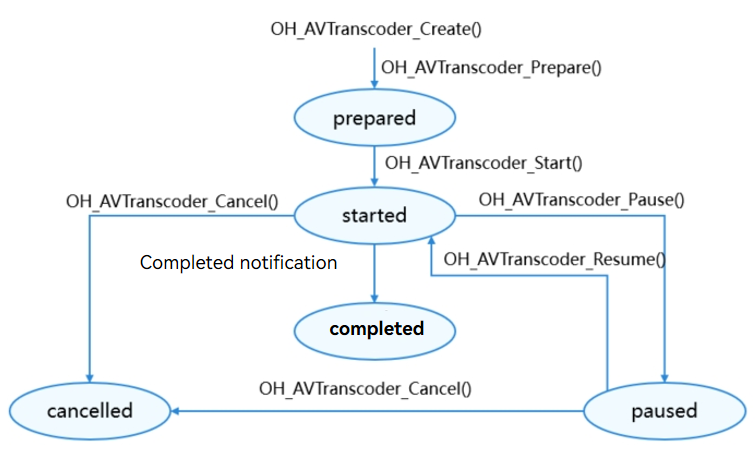
For details about the states, see OH_AVTranscoder_State.
How to Develop
Link the dynamic libraries in the CMake script.
target_link_libraries(entry PUBLIC libavtranscoder.so libace_napi.z.so)
To use system logging, include the following header file:
#include <hilog/log.h>
Link the following dynamic library in the CMake script:
target_link_libraries(sample PUBLIC libhilog_ndk.z.so)
Import the avtranscoder.h and avtranscoder_base.h header files to use the transcoding APIs.
Read AVTranscoder for the API reference.
-
Call OH_AVTranscoder_Create() to create a transcoding instance.
OH_AVTranscoder *transcoder = OH_AVTranscoder_Create();
-
Set callback functions. Specifically, call OH_AVTranscoder_SetStateCallback(), OH_AVTranscoder_SetErrorCallback(), and OH_AVTranscoder_SetProgressUpdateCallback() to set callbacks for transcoding status changes, transcoding error events, and transcoding progress update events, respectively. The table below describes these callbacks.
Event Type Description OH_AVTranscoder_OnStateChange Optional event, which is invoked when the transcoding status changes. OH_AVTranscoder_OnError Optional event, which is invoked when a transcoding error occurs. OH_AVTranscoder_OnProgressUpdate Optional event, which is invoked when the transcoding progress changes. You can also customize data using userData in these callbacks.
typedef struct NdkAVTransCoderUser { using StateChangeFunc = std::function<void()>; NdkAVTransCoderUser(); NdkAVTransCoderUser(const NdkAVTransCoderUser &other) = delete; NdkAVTransCoderUser &operator=(const NdkAVTransCoderUser &other) = delete; ~NdkAVTransCoderUser(); void OnStateChangeCb(OH_AVTranscoder *transcoder, OH_AVTranscoder_State state); void OnErrorCb(OH_AVTranscoder *transcoder, int32_t errorCode, const char *errorMsg); void OnProgressUpdateCb(OH_AVTranscoder *transcoder, int progress); std::map<uint32_t, StateChangeFunc> stateChangeFuncs_; OH_AVTranscoder *transcoder = nullptr; int32_t errorCode = AV_ERR_OK; OH_AVTranscoder_State transCoderState = AVTRANSCODER_PREPARED; int avTranscoderProgress = 0; int inStartStateCount = 0; } NdkAVTransCoderUser; void NdkAVTransCoderUser::OnProgressUpdateCb(OH_AVTranscoder *transcoder, int progress) { LOG("NdkAVTransCoderUser OnProgressUpdateCb progress: %{public}d", progress); this->avTranscoderProgress = progress; } void NdkAVTransCoderUser::OnErrorCb(OH_AVTranscoder *transcoder, int32_t errorCode, const char *errorMsg) { LOG("NdkAVTransCoderUser OnErrorCb errorCode: %{public}d ,errorMsg: %{public} s", errorCode, errorMsg == nullptr ? "unknown" : errorMsg); this->errorCode = errorCode; } void NdkAVTransCoderUser::OnStateChangeCb(OH_AVTranscoder *transcoder, OH_AVTranscoder_State state) { this->transCoderState = state; if (transcoder == nullptr) { return; } int32_t ret = -1; switch (state) { case AVTRANSCODER_PREPARED: { this->transCoderState = AVTRANSCODER_PREPARED; if (this->stateChangeFuncs_.count(AVTRANSCODER_PREPARED) > 0) { this->stateChangeFuncs_[AVTRANSCODER_PREPARED](); } break; } case AVTRANSCODER_STARTED: { this->transCoderState = AVTRANSCODER_STARTED; if (this->stateChangeFuncs_.count(AVTRANSCODER_STARTED) > 0) { this->stateChangeFuncs_[AVTRANSCODER_STARTED](); } break; } case AVTRANSCODER_PAUSED: { this->transCoderState = AVTRANSCODER_PAUSED; if (this->stateChangeFuncs_.count(AVTRANSCODER_PAUSED) > 0) { this->stateChangeFuncs_[AVTRANSCODER_PAUSED](); } break; } case AVTRANSCODER_CANCELLED: { this->transCoderState = AVTRANSCODER_CANCELLED; if (this->stateChangeFuncs_.count(AVTRANSCODER_CANCELLED) > 0) { this->stateChangeFuncs_[AVTRANSCODER_CANCELLED](); } break; } case AVTRANSCODER_COMPLETED: { this->transCoderState = AVTRANSCODER_COMPLETED; if (this->stateChangeFuncs_.count(AVTRANSCODER_COMPLETED) > 0) { this->stateChangeFuncs_[AVTRANSCODER_COMPLETED](); } break; } default: break; } } static void AvTranscoderStateChangeCbImpl(OH_AVTranscoder *transcoder, OH_AVTranscoder_State state, void *userData) { LOG("AvTranscoderStateChangeCbImpl state: %{public}d", state); NdkAVTransCoderUser *ndkAVTransCoderUser = reinterpret_cast<NdkAVTransCoderUser *>(userData); if (ndkAVTransCoderUser == nullptr || transcoder == nullptr) { LOGE("AvTranscoderStateChangeCbImpl ndkAVTransCoderUser or transcoder is nullptr"); return; } ndkAVTransCoderUser->OnStateChangeCb(transcoder, state); } static void AvTranscoderErrorCbImpl(OH_AVTranscoder *transcoder, int32_t errorCode, const char *errorMsg, void *userData) { LOG("AvTranscoderErrorCbImpl errorCode: %{public}d, errorMsg: %{public}s", errorCode, errorMsg == nullptr ? "unknown" : errorMsg); NdkAVTransCoderUser *ndkAVTransCoderUser = reinterpret_cast<NdkAVTransCoderUser *>(userData); if (ndkAVTransCoderUser == nullptr || transcoder == nullptr) { LOGE("AvTranscoderErrorCbImpl ndkAVTransCoderUser or transcoder is nullptr"); return; } ndkAVTransCoderUser->OnErrorCb(transcoder, errorCode, errorMsg); } static void AvTranscoderProgressUpdateCbImpl(OH_AVTranscoder *transcoder, int progress, void *userData) { LOG("AvTranscoderProgressUpdateCbImpl progress: %{public}d", progress); NdkAVTransCoderUser *ndkAVTransCoderUser = reinterpret_cast<NdkAVTransCoderUser *>(userData); if (ndkAVTransCoderUser == nullptr || transcoder == nullptr) { LOGE("AvTranscoderProgressUpdateCbImpl ndkAVTransCoderUser or transcoder is nullptr"); return; } ndkAVTransCoderUser->OnProgressUpdateCb(transcoder, progress); } static napi_value OHAvTranscoderNdkPlay(napi_env env, napi_callback_info info) { OH_AVTranscoder_SetStateCallback(transcoder, AvTranscoderStateChangeCbImpl, transcoderUser); // Set the status callback. OH_AVTranscoder_SetErrorCallback(transcoder, AvTranscoderErrorCbImpl, transcoderUser); // Set the error callback. OH_AVTranscoder_SetProgressUpdateCallback(transcoder, AvTranscoderProgressUpdateCbImpl, transcoderUser); // Set the progress callback. } -
Call OH_AVTranscoderConfig_Create() to create a transcoding configuration instance.
OH_AVTranscoder_Config *config = OH_AVTranscoderConfig_Create();
-
Call OH_AVTranscoderConfig_SetSrcFD() to set the file descriptor of the source video.
OH_AVTranscoderConfig_SetSrcFD(config, srcFd, srcOffset, length); // Set the file descriptor of the source video.
-
Call OH_AVTranscoderConfig_SetDstFD() to set the file descriptor of the output video.
OH_AVTranscoderConfig_SetDstFD(config, dstFd); // Set the target file descriptor dstFd for transcoding.
-
(Optional) Call OH_AVTranscoderConfig_SetDstVideoType() to set the encoding format of the output video.
OH_AVTranscoderConfig_SetDstVideoType(config, "video/avc"); // (Optional) Set the video encoding format.
-
(Optional) Call OH_AVTranscoderConfig_SetDstAudioType() to set the encoding format of the output audio.
OH_AVTranscoderConfig_SetDstAudioType(config, "audio/mp4a-latm"); // (Optional) Set the audio encoding format.
-
Call OH_AVTranscoderConfig_SetDstFileType() to set the container format of the output video.
OH_AVTranscoderConfig_SetDstFileType(config, AV_OUTPUT_FORMAT_MPEG_4); // Container format.
-
(Optional) Call OH_AVTranscoderConfig_SetDstAudioBitrate() to set the bit rate of the output audio.
const std::int32_t AUDIO_BITRATE = 200000;
OH_AVTranscoderConfig_SetDstAudioBitrate(config, AUDIO_BITRATE); // Refer to the avcodec audio encoder bitrate setting. Adjust based on actual requirements.
-
(Optional) Call OH_AVTranscoderConfig_SetDstVideoBitrate() to set the bit rate of the output video.
const std::int32_t VIDEO_BITRATE = 3000000;
OH_AVTranscoderConfig_SetDstVideoBitrate(config, VIDEO_BITRATE); // (Optional) Video bit rate.
-
(Optional) Call OH_AVTranscoderConfig_SetDstVideoResolution() to set the resolution of the output video.
const std::int32_t VIDEO_WIDTH = 1280;
const std::int32_t VIDEO_HEIGHT = 720;
OH_AVTranscoderConfig_SetDstVideoResolution(config, VIDEO_WIDTH, VIDEO_HEIGHT);
-
Call OH_AVTranscoder_Prepare() to prepare for transcoding. After a successful call, the instance transitions to the AVTRANSCODER_PREPARED state.
OH_AVErrCode errCode = AV_ERR_OK;
errCode = OH_AVTranscoder_Prepare(transcoder, config); // Prepare for transcoding.
-
Call OH_AVTranscoder_Start() to start transcoding. After a successful call, the instance transitions to the AVTRANSCODER_STARTED state.
OH_AVErrCode errCode = AV_ERR_OK;
errCode = OH_AVTranscoder_Start(transcoder); // Start transcoding.
-
(Optional) Call OH_AVTranscoder_Pause() to pause transcoding. After a successful call, the instance transitions to the AVTRANSCODER_PAUSED state.
OH_AVErrCode errCode = AV_ERR_OK;
errCode = OH_AVTranscoder_Pause(transcoder); // Pause transcoding.
-
(Optional) Call OH_AVTranscoder_Resume() to resume transcoding. After a successful call, the instance transitions to the AVTRANSCODER_STARTED state.
OH_AVErrCode errCode = AV_ERR_OK;
errCode = OH_AVTranscoder_Resume(transcoder); // Resume transcoding.
-
(Optional) Call OH_AVTranscoder_Cancel() to cancel transcoding. After a successful call, the instance transitions to the AVTRANSCODER_CANCELLED state.
OH_AVErrCode errCode = AV_ERR_OK;
errCode = OH_AVTranscoder_Cancel(transcoder); // Cancel transcoding.
-
Call OH_AVTranscoderConfig_Release() to destroy the transcoding configuration instance and release resources.
OH_AVErrCode errCode = AV_ERR_OK;
errCode = OH_AVTranscoderConfig_Release(config); // Release the transcoding configuration instance.
-
Call OH_AVTranscoder_Release() to destroy the transcoding instance and release resources.
OH_AVErrCode errCode = AV_ERR_OK;
errCode = OH_AVTranscoder_Release(transcoder); // Release the transcoding instance.
Running the Sample Project
-
Create a project, download the sample project, and copy its resources to the corresponding directories.
AVTranscoderNDK entry/src/main/ets/ └── pages │ └── Index.ets (transcoding UI) entry/src/main/ ├── cpp │ ├── types │ │ └── libentry │ │ └── Index.d.ts (JavaScript mapping of NDK functions) │ ├── CMakeLists.txt (CMake script) │ └── napi_init.cpp (NDK functions) └── resources ├── base │ └── element │ ├── color.json │ ├── float.json │ └── string.json └── rawfile └── src.mp4 (video resource) -
Compile and run the project.