Setting Configuration Items of a Cloud Function
Add the network permission to the entry/src/main/module.json5 file.
"requestPermissions": [
  {
    "name": "ohos.permission.INTERNET"
  }
]
Querying the Name and Version of a Function
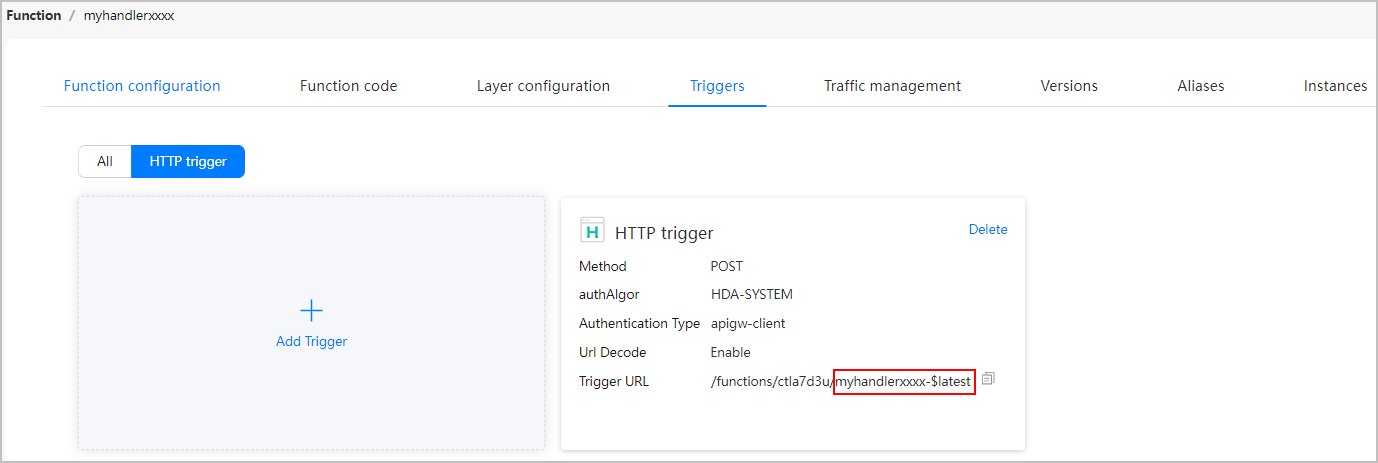
On the trigger list page of a function, click HTTP trigger and view the suffix of the value of Trigger URL. The suffix is the trigger identifier, which is in Function name-Version number format. As shown in the following figure, myhandlerxxxx-$latest is the HTTP trigger identifier, in which myhandlerxxxx is the function name, and $latest is the version number.
Calling a Function in an App
- Import the cloudFunction component to the project.
import { cloudFunction } from '@kit.CloudFoundationKit';
import { BusinessError } from '@kit.BasicServicesKit';
- Call call() to set a function and pass the function name to the method. The execution result will be returned.
- (Optional) Set timeout to the timeout interval for calling the function, in milliseconds.
- (Optional) Set version to the function version. The default value is $latest.
- (Optional) If the function has input parameters, the data parameter can be converted into a JSON object or JSON character string.
cloudFunction.call({
  name: 'myhandlerxxxx',
  version: '$latest', // If no version number is specified, the default value $latest is used.
  timeout: 10 * 1000, // Timeout interval, in milliseconds. The default interval is 70 x 1000 milliseconds.
  data: {
    param1: 'val1',
    param2: 'val2'
  }
}).then((value: cloudFunction.FunctionResult) => {
  console.info(`Succeeded in calling the function, result: ${JSON.stringify(value.result)}`);
}).catch((err: BusinessError) => {
  console.error(`Failed to call the function, Code: ${err.code}, message: ${err.message}`);
})
Or
cloudFunction.call({
  name: 'myhandlerxxxx',
  version: '$latest',
  timeout: 10 * 1000,
  data: {
    param1: 'val1',
    param2: 'val2'
  }
}, (err: BusinessError, value: cloudFunction.FunctionResult) => {
  if (err) {
    console.error(`Failed to call the function, Code: ${err.code}, message: ${err.message}`);
    return;
  }
  console.info(`Succeeded in calling the function, result: ${JSON.stringify(value.result)}`);
})
- Call the result attribute if you want to obtain the return value of the function.
let returnValue = value.result;
value is the cloudFunction.FunctionResult object returned by the call() method in step 2. The return value is the result returned by the body of the cloud function. For example, during the function testing process, value.result is {"simple":"example"}.