AtomicServiceEnhancedWeb is an advanced web component offering customization to meet specific demands. It shields irrelevant APIs from the ArkWeb component and extends functionality through JavaScript capabilities.

You can preview how this component looks on a real device, but not in DevEco Studio Previewer.
Constraints
To use this component, you must complete the development preparations. For details, see Developing the AtomicServiceEnhancedWeb Component.
Required Permissions
ohos.permission.INTERNET, required for accessing online web pages. For details about how to apply for a permission, see Declaring Permissions.
AtomicServiceEnhancedWeb
AtomicServiceEnhancedWeb({
  src: ResourceStr,
  controller: AtomicServiceEnhancedWebControll,
  navPathStack?: NavPathStack,
  mixedMode?: MixedMode,
  darkMode?: WebDarkMode,
  forceDarkAccess?: boolean,
  bgColor?: ResourceColor,
  nestedScroll?: NestedScrollOptions | NestedScrollOptionsExt,
  expandSafeAreaTypes: [SafeAreaType.SYSTEM],
  expandSafeAreaEdges: [SafeAreaEdge.TOP,SafeAreaEdge.BOTTOM],
  onMessage?: Callback<OnMessageEvent>,
  onErrorReceive?: Callback<OnErrorReceiveEvent>,
  onHttpErrorReceive?: Callback<OnHttpErrorReceiveEvent>,
  onPageBegin?: Callback<OnPageBeginEvent>,
  onPageEnd?: Callback<OnPageEndEvent>,
  onControllerAttached?: Callback<void>,
  onLoadIntercept?: Callback<OnLoadInterceptEvent, boolean>,
  onProgressChange?: Callback<OnProgressChangeEvent>,
  onTitleReceive?: Callback<OnTitleReceiveEvent>
})
Since: 1.0.12
Decorator: @Component
Parameters:
| Name | Type | Default Value | Mandatory | Decorator Type | Description |
|---|---|---|---|---|---|
| src | ResourceStr | - | Yes | - | Web page resource address. Accessing network resources requires configuring service domain names in AppGallery Connect, and accessing local resources only supports files within the package ($rawfile). Dynamic updating of the address through state variables (for example, @State) is not supported. The loaded web page supports calling system capabilities through the APIs provided by the JS SDK, with the specifics governed by the JS SDK. |
| controller | AtomicServiceEnhancedWebController | - | Yes | @ObjectLink | Used to control the behavior of the AtomicServiceEnhancedWeb component. |
| navPathStack | NavPathStack | - | No | - | Information about the navigation stack. When NavDestination serves as the root container of the page, NavPathStack corresponding to the NavDestination container must be passed to handle page routing. |
| mixedMode | MixedMode | - | No | @Prop | Whether to enable the loading of HTTP and HTTPS mixed content. By default, this feature is enabled. |
| darkMode | WebDarkMode | - | No | @Prop | Web dark mode. By default, web dark mode is disabled. |
| forceDarkAccess | boolean | - | No | @Prop | Whether to enable forcible dark mode for the web page. This feature is disabled by default. This API is effective only when web dark mode is enabled. |
| bgColor | ResourceColor | - | No | @Prop | Background color of the component. |
| nestedScroll15+ | NestedScrollOptions | NestedScrollOptionsExt | - | No | @Prop | Nested scrolling options. |
| expandSafeAreaTypes | Array<SafeAreaType> | [] | No | @Prop | Types of non-safe areas to extend into. If the Metadata configuration item is not added, the hole is not avoided on the page, and the CUTOUT type does not take effect. Invalid values are treated as the default value. Since: 1.0.23 |
| expandSafeAreaEdges | Array<SafeAreaEdge> | [] | No | @Prop | Edges for expanding the safe area. Invalid values are treated as the default value. Since: 1.0.23 |
| onMessage | Callback<OnMessageEvent> | - | No | - | Callback invoked when the HTML5 page sends a message through the postMessage() API of the JS SDK, and the Web component's corresponding page is returned or destroyed. |
| onErrorReceive | Callback<OnErrorReceiveEvent> | - | No | - | Callback triggered when an error occurs during web page loading. For performance reasons, simplify the implementation logic in the callback. This callback is invoked when there is no network connection. |
| onHttpErrorReceive | Callback<OnHttpErrorReceiveEvent> | - | No | - | Callback invoked when an HTTP error (the response code is greater than or equal to 400) occurs during web page resource loading. |
| onPageBegin | Callback<OnPageBeginEvent> | - | No | - | Callback invoked when the web page starts loading. It is invoked only for the main frame content, and not for the iframe or frameset content. |
| onPageEnd | Callback<OnPageEndEvent> | - | No | - | Callback invoked when the web page loading is complete. It is invoked only for the main frame content. |
| onControllerAttached | Callback<void> | - | No | - | Callback invoked when a controller is attached to the Web component. |
| onLoadIntercept | OnLoadInterceptCallback | - | No | - | Callback invoked when the Web component is about to load the URL. It is used to determine whether to block the loading. By default, the loading is allowed. |
| onProgressChange | Callback<OnProgressChangeEvent> | - | No | - | Callback invoked when the web page loading progress changes. |
| onTitleReceive | Callback<OnTitleReceiveEvent> | - | No | - | Callback triggered when the document title of the application page is changed. If the <title> element is not set on the page to load, AtomicServiceEnhancedWeb generates a title based on the URL and returns it to the application. |

The expandSafeAreaTypes and expandSafeAreaEdges parameters must be used together. If only one of them is used, the setting does not take effect.
AtomicServiceEnhancedWebController
Manages the behavior of the AtomicServiceEnhancedWeb component. An AtomicServiceEnhancedWebController object can control only one AtomicServiceEnhancedWeb component, and the APIs on the AtomicServiceEnhancedWebController can be called only after it has been bound to the target AtomicServiceEnhancedWeb component.
Since: 1.0.12
Decorator type: @Observed
[h2]getUserAgent
getUserAgent(): string
Obtains the default user agent.
Since: 1.0.12
Returns:
| Type | Description |
|---|---|
| string | Default user agent. For details about the default User-Agent definition and its application scenarios, see Developing User-Agent. |
Error codes:
For details about the error codes, see Webview Error Codes.
| Error Code | Error Message |
|---|---|
| 17100001 | Init error. The AtomicServiceEnhancedWebController must be associated with a AtomicServiceEnhancedWeb component. |
[h2]getCustomUserAgent
getCustomUserAgent(): string
Obtains the custom user agent.
Since: 1.0.12
Returns:
| Type | Description |
|---|---|
| string | Information about the custom user agent. |
Error codes:
For details about the error codes, see Webview Error Codes.
| Error Code | Error Message |
|---|---|
| 17100001 | Init error. The AtomicServiceEnhancedWebController must be associated with a AtomicServiceEnhancedWeb component. |
[h2]setCustomUserAgent
setCustomUserAgent(userAgent: string): void
Sets a custom user agent, which will override the default user agent.
Set the user agent in the onControllerAttached callback to ensure that it takes effect. For details about the setting, see the example.
Avoid setting User-Agent in onLoadIntercept. Otherwise, the setting may fail occasionally.

If a URL is set for the Web component src and User-Agent is not set in the onControllerAttached callback, calling setCustomUserAgent may cause mismatches between the loaded page and the intended User-Agent.
Since: 1.0.12
Parameters:
| Name | Type | Mandatory | Description |
|---|---|---|---|
| userAgent | string | Yes | Information about the custom user agent. It is recommended that you obtain the current default user agent through getUserAgent and then customize the obtained user agent. |
Error codes:
For details about the error codes, see Webview Error Codes.
| Error Code | Error Message |
|---|---|
| 401 | Parameter error. Possible causes: 1. Mandatory parameters are left unspecified. 2. Incorrect parameter types. |
| 17100001 | Init error. The AtomicServiceEnhancedWebController must be associated with a AtomicServiceEnhancedWeb component. |
[h2]refresh
refresh(): void
Instruct the AtomicServiceEnhancedWeb component to refresh the web page.
Since: 1.0.12
Error codes:
For details about the error codes, see Webview Error Codes.
| Error Code | Error Message |
|---|---|
| 17100001 | Init error. The AtomicServiceEnhancedWebController must be associated with a AtomicServiceEnhancedWeb component. |
[h2]forward
forward(): void
Navigates forward to the next page in the history stack. This API is generally used together with accessForward.
Since: 1.0.12
Error codes:
For details about the error codes, see Webview Error Codes.
| Error Code | Error Message |
|---|---|
| 17100001 | Init error. The AtomicServiceEnhancedWebController must be associated with a AtomicServiceEnhancedWeb component. |
[h2]backward
backward(): void
Navigates backward to the previous page in the history stack. This API is generally used together with accessBackward.
Since: 1.0.12
Error codes:
For details about the error codes, see Webview Error Codes.
| Error Code | Error Message |
|---|---|
| 17100001 | Init error. The AtomicServiceEnhancedWebController must be associated with a AtomicServiceEnhancedWeb component. |
[h2]accessForward
accessForward(): boolean
Checks whether going to the next page can be performed on this page.
Since: 1.0.12
Returns:
| Type | Description |
|---|---|
| boolean | true is returned if going to the next page can be performed on the current page; otherwise, false is returned. |
Error codes:
For details about the error codes, see Webview Error Codes.
| Error Code | Error Message |
|---|---|
| 17100001 | Init error. The AtomicServiceEnhancedWebController must be associated with a AtomicServiceEnhancedWeb component. |
[h2]accessBackward
accessBackward(): boolean
Checks whether going to the previous page can be performed on the current page.
Since: 1.0.12
Returns:
| Type | Description |
|---|---|
| boolean | Returns true if going to the previous page can be performed on the current page; returns false otherwise. |
Error codes:
For details about the error codes, see Webview Error Codes.
| Error Code | Error Message |
|---|---|
| 17100001 | Init error. The AtomicServiceEnhancedWebController must be associated with a AtomicServiceEnhancedWeb component. |
[h2]accessStep
accessStep(step: number): boolean
Checks whether this page can navigate forward or backward by the specified number of steps.
Since: 1.0.12
Parameters:
| Name | Type | Mandatory | Description |
|---|---|---|---|
| step | number | Yes | Number of steps to navigate. Positive values indicate forward, while negative values indicate backward. |
Returns:
| Type | Description |
|---|---|
| boolean | Whether the page can navigate forward or backward by the specified number of steps. |
Error codes:
For details about the error codes, see Webview Error Codes.
| Error Code | Error Message |
|---|---|
| 401 | Parameter error. Possible causes: 1. Mandatory parameters are left unspecified. 2. Incorrect parameter types. 3.Parameter verification failed. |
| 17100001 | Init error. The AtomicServiceEnhancedWebController must be associated with a AtomicServiceEnhancedWeb component. |
[h2]loadUrl
loadUrl(url: string | Resource, headers?: Array<WebHeader>): void
Loads a specified URL.
Since: 1.0.12
Parameters:
| Name | Type | Mandatory | Description |
|---|---|---|---|
| url | string | Resource | Yes | URL to load. |
| headers | Array<WebHeader> | No | Additional HTTP headers of the URL. |
Error codes:
For details about the error codes, see Webview Error Codes.
| Error Code | Error Message |
|---|---|
| 401 | Parameter error. Possible causes: 1. Mandatory parameters are left unspecified. 2. Incorrect parameter types. 3.Parameter verification failed. |
| 17100001 | Init error. The AtomicServiceEnhancedWebController must be associated with a AtomicServiceEnhancedWeb component. |
| 17100002 | Invalid url. |
| 17100003 | Invalid resource path or file type. |
WebHeader
Represents the request/response header object returned by the Web component.
Since: 1.0.12
| Name | Type | Readable | Writable | Description |
|---|---|---|---|---|
| headerKey | string | Yes | Yes | Key of the request or response header. |
| headerValue | string | Yes | Yes | Value of the request or response header. |
OnMessageEvent
Represents the callback invoked when the page is navigated back or destroyed.
Since: 1.0.12
| Name | Type | Mandatory | Description |
|---|---|---|---|
| data | object[] | Yes | Message list. |
OnErrorReceiveEvent
Represents the callback invoked when an error occurs during web page loading.
Since: 1.0.12
| Name | Type | Mandatory | Description |
|---|---|---|---|
| request | WebResourceRequest | Yes | Encapsulation of a web page request. |
| error | WebResourceError | Yes | Encapsulation of a web page resource loading error. |
OnHttpErrorReceiveEvent
Represents the callback invoked when an HTTP error occurs during web page resource loading.
Since: 1.0.12
| Name | Type | Mandatory | Description |
|---|---|---|---|
| request | WebResourceRequest | Yes | Encapsulation of a web page request. |
| response | WebResourceResponse | Yes | Encapsulation of a resource response. |
OnPageBeginEvent
Represents the callback invoked when the web page loading begins.
Since: 1.0.12
| Name | Type | Mandatory | Description |
|---|---|---|---|
| url | string | Yes | URL of the page. |
OnPageEndEvent
Represents the callback invoked when the web page loading ends.
Since: 1.0.12
| Name | Type | Mandatory | Description |
|---|---|---|---|
| url | string | Yes | URL of the page. |
OnLoadInterceptEvent
Represents the event triggered when resource loading is intercepted.
Since: 1.0.12
| Name | Type | Mandatory | Description |
|---|---|---|---|
| data | WebResourceRequest | Yes | Encapsulation of a web page request. |
OnProgressChangeEvent
Represents the callback invoked when the web page loading progress changes.
Since: 1.0.12
| Name | Type | Mandatory | Description |
|---|---|---|---|
| newProgress | number | Yes | New loading progress. The value is an integer ranging from 0 to 100. |
OnTitleReceiveEvent
Defines the callback triggered when the document title of the web page changes.
Since: 1.0.12
| Name | Type | Mandatory | Description |
|---|---|---|---|
| title | string | Yes | Document title. |
OnLoadInterceptCallback
type OnLoadInterceptCallback = (event: OnLoadInterceptEvent) => boolean
Represents the callback invoked when resource loading is intercepted.
Since: 1.0.12
Parameters:
| Name | Type | Mandatory | Description |
|---|---|---|---|
| event | OnLoadInterceptEvent | Yes | Event triggered when resource loading is intercepted. |
Returns:
| Type | Description |
|---|---|
| boolean | Whether the resource is intercepted. |
[h2]has.router.pushUrl
pushUrl(options: object): void
Retains the current page and jumps to the target page.
Since: 1.0.12
Parameters:
| Name | Type | Mandatory | Description |
|---|---|---|---|
| url | string | Yes | URL of the target page. |
| params | object | No | Parameters passed to the target page. |
| mode | string | No | Routing modes. The options are Standard and Single. The default value is Standard. - Standard: multi-instance mode. It is the default instance mode. The target page is added to the top of the page stack, regardless of whether a page with the same URL exists in the stack. - Single: singleton mode. If the URL of the target page already exists in the page stack, the page is moved to the top of the stack. If the URL of the target page does not exist in the page stack, the page is redirected to in multi-instance mode. |
| callback | function | No | Callback method. Method declaration: (err, res) => void. |
Example:
has.router.pushUrl({
  url: 'pages/Index',
  params: { name: 'Peter' },
  mode: 'Single',
  callback: (err, res) => {
  }
});
[h2]has.router.replaceUrl
replaceUrl(options: object): void
Destroys the current page and jumps to the target page.
Since: 1.0.12
Parameters:
| Name | Type | Mandatory | Description |
|---|---|---|---|
| url | string | Yes | URL of the target page. |
| params | object | No | Parameters passed to the target page. |
| mode | string | No | Routing modes. The options are Standard and Single. The default value is Standard. - Standard: multi-instance mode. It is the default instance mode. The target page is added to the top of the page stack, regardless of whether a page with the same URL exists in the stack. - Single: singleton mode. If the URL of the target page already exists in the page stack, the page is moved to the top of the stack. If the URL of the target page does not exist in the page stack, the page is redirected to in multi-instance mode. |
| callback | function | No | Callback method. Method declaration: (err, res) => void. |
Example:
has.router.replaceUrl({
  url: 'pages/Index',
  params: { name: 'Peter' },
  mode: 'Standard',
  callback: (err, res) => {
  }
});
[h2]has.router.back
back(options: object): void
Returns to the previous page.
Since: 1.0.12
Parameters:

Among the url, index, and delta parameters (in descending order of priority), only one of them takes effect at a time. If none of them is passed in, the previous page is displayed.
| Name | Type | Mandatory | Description |
|---|---|---|---|
| url | string | No | URL of the page to return to. |
| index | number | No | Index of the page to return to. The index is sequentially numbered starting from 1 based on the order in which pages are opened. |
| delta | number | No | Level of pages to be returned to at a time. If the level exceeds the value allowed by delta, the home page is displayed. |
| params | object | No | Parameters passed to the page to return to. |
| callback | function | No | Callback method. Method declaration: (err, res) => void. |
Example:
has.router.back({
  delta: 2,
  params: { name: 'Peter' },
  callback: (err, res) => {
  }
});
[h2]has.router.clear
clear(options: object): void
Clears all historical pages but retains the current page.
Since: 1.0.12
Parameters:
| Name | Type | Mandatory | Description |
|---|---|---|---|
| callback | function | No | Callback method. Method declaration: (err, res) => void. |
Example:
has.router.clear({
  callback: (err, res) => {
  }
}); [h2]has.navPathStack.pop
pop(options: object): void
Navigates back to the previous page.
Since: 1.0.12
Parameters:

Among the name, index, and delta parameters (in descending order of priority), only one of them takes effect at a time. If none of them is passed in, the previous page is displayed.
| Name | Type | Mandatory | Description |
|---|---|---|---|
| name | string | No | Name of the page to return to. |
| index | number | No | Index of the page to return to. The value of index starts from -1, which indicates the navigation root page. Value 0 indicates the first opened subpage of NavDestination, and subsequent values follow the same rule. |
| delta | number | No | Number of pages to return to. |
| result | object | No | Page return result. |
| animated | boolean | No | Whether to support transition animation. Default value: true. |
| callback | function | No | Callback method. Method declaration: (err, res) => void. |
Returns:
| Name | Type | Description |
|---|---|---|
| name | string | Name of the top page after the pop operation. |
| index | number | Index of the top page after the pop operation. |
| param | object | Parameters of the top page after the pop operation. |
Example:
has.navPathStack.pop({
  name: 'PageIndex',
  result: { name: 'Peter' },
  animated: true,
  callback: (err, res) => {
  }
}); [h2]has.asWeb.postMessage
postMessage(options: object): void
Sends a message. When a page is returned or destroyed, the onMessage() callback is triggered for the AtomicServiceEnhancedWeb component.
Since: 1.0.12
Parameters:
| Name | Type | Mandatory | Description |
|---|---|---|---|
| data | object | Yes | Message content. |
| callback | function | No | Callback method. Method declaration: (err, res) => void. |
Example:
has.asWeb.postMessage({
  data: { name: 'Peter' },
  callback: (err, res) => {
  }
});

// ArkTS page.
AtomicServiceEnhancedWeb({
  src: $rawfile("Index.html"),
  onMessage: (event) => {
    console.info('onMessage data: ', event.data);
  }
})
[h2]has.asWeb.getEnv
getEnv(options: object): void
Obtains the current environment information.
Since: 1.0.12
Parameters:
| Name | Type | Mandatory | Description |
|---|---|---|---|
| callback | function | No | Callback method. Method declaration: (err, res) => void. |
Returns:
| Name | Type | Description |
|---|---|---|
| deviceType | string | Device type. |
| brand | string | Device brand. |
| productModel | string | Product model. |
| osFullName | string | OS version. |
Example:
has.asWeb.getEnv({
  callback: (err, res) => {
  }
});
[h2]has.asWeb.checkJsApi
checkJsApi(options: object): void
Checks whether the specified JS APIs are supported.
Since: 1.0.12
Parameters:
| Name | Type | Mandatory | Description |
|---|---|---|---|
| jsApiList | string[] | Yes | List of JS APIs. |
| callback | function | No | Callback method. Method declaration: (err, res) => void. |
Returns:
| Name | Type | Description |
|---|---|---|
| checkResult | Map<string, boolean> | JS API check result. |
Example:
has.asWeb.checkJsApi({
  jsApiList: ['router.back', 'navPathStack.clear', 'postMessage'],
  callback: (err, res) => {
  }
});
[h2]has.cameraPicker.pick
pick(options: object): void
Takes a photo or records a video.
Since: 1.0.12
Parameters:
| Name | Type | Mandatory | Description |
|---|---|---|---|
| mediaTypes | string[] | Yes | Media type. The options are photo and video. |
| cameraPosition | number | Yes | Camera position. The options are as follows: 0: unspecified position. 1: rear camera. 2: front camera. 3: folded camera. |
| saveUri | string | No | URI for saving the result. |
| videoDuration | number | No | Maximum recording duration. |
| callback | function | No | Callback method. Method declaration: (err, res) => void. |
Returns:
| Name | Type | Description |
|---|---|---|
| resultCode | number | Result code. The value 0 means that the processing is successful, and -1 means that the processing fails. |
| resultUri | string | URI of the result. If saveUri is empty, resultUri indicates the public media path. If saveUri is not empty and the application has the write permission on the URI, the value of resultUri is the same as that of saveUri. If saveUri is not empty and the application does not have the write permission on the URI, resultUri cannot be obtained. |
| mediaType | string | Returned media type. The options are photo and video. |
Example:
has.cameraPicker.pick({
  mediaTypes: ['photo', 'video'],
  cameraPosition: 1,
  saveUri: '',
  videoDuration: 30,
  callback: (err, res) => {
  }
});
[h2]has.photoViewPicker.select
select(options: object): void
Takes or selects a photo.
Since: 1.0.12
Parameters:
| Name | Type | Mandatory | Description |
|---|---|---|---|
| mimeType | string | No | Media file type. If this parameter is not specified, the image and video types are used by default. The options are image/*, video/*, and */*. |
| maxSelectNumber | number | No | Maximum number of media files that can be selected. The default value is 50, and the maximum value is 500. |
| isPhotoTakingSupported | boolean | No | Whether to support photographing. |
| isEditSupported | boolean | No | Whether to support image editing. |
| isSearchSupported | boolean | No | Whether to support search. |
| recommendationType | number | No | Whether to support image recommendation. |
| preselectedUris | string[] | No | URI of the preselected image. |
| callback | function | No | Callback method. Method declaration: (err, res) => void. |
Returns:
| Name | Type | Description |
|---|---|---|
| photoUris | string[] | URI array of the media files selected from Gallery. The URI array can be used only by the photoAccessHelper.getAssets API in temporary authorization mode. |
| isOriginalPhoto | boolean | Whether the selected media file is the original image. |
Example:
has.photoViewPicker.select({
  maxSelectNumber: 9,
  callback: (err, res) => {
  }
});
[h2]has.getLocalImgData
getLocalImgData(options: object): void
Obtains a local image.
Since: 1.0.12
Parameters:
| Name | Type | Mandatory | Description |
|---|---|---|---|
| uri | string | Yes | URI of the file. |
| compressionRatio | number | No | Compression ratio. The value range is [0,1], with the default value of 0.3. |
| success | function | No | Callback invoked when the API call is successful. |
| fail | function | No | Callback invoked when the API call fails. |
| complete | function | No | Callback to be invoked when the API call is complete, regardless of success or failure. |
Returns
| Name | Type | Description |
|---|---|---|
| localData | string | Base64 data of the image. |
Example:
has.getLocalImgData({
  uri: '/data/storage/el2/base/haps/entry/cache/example.jpg',
  compressionRatio: 0.3,
  success: (res) => {
    let localData = res.localData;
  },
  fail: (err) => {
  },
  complete: (res) => {
  }
});
[h2]has.filePreview.openPreview
openPreview(options: object): void
Previews a file. Only local files can be previewed.
Since: 1.0.12
Parameters:
| Name | Type | Mandatory | Description |
|---|---|---|---|
| title | string | No | File title. |
| uri | string | Yes | URI of the file. |
| mimeType | string | No | Media resource type of the file or folder, for example, text/plain. |
| callback | function | No | Callback method. Method declaration: (err, res) => void. |
mimeType description
| Type | File Name Extension | MIME Type |
|---|---|---|
| Text | txt, cpp, c, h, java, xhtml, and xml | text/plain, text/x-c++src, text/x-csrc, text/x-chdr, text/x-java, application/xhtml+xml, and text/xml |
| Web page | html and htm | text/html |
| Image | jpg, png, gif, webp, bmp, and svg | image/jpeg, image/png, image/gif, image/webp, image/bmp, and image/svg+xml |
| Audio | m4a, aac, mp3, ogg, and wav | audio/mp4a-latm, audio/aac, audio/mpeg, audio/ogg, and audio/x-wav |
| Video | mp4, mkv, and ts | video/mp4, video/x-matroska, and video/mp2ts |
| Folder | N/A | N/A |
Example:
has.filePreview.openPreview({
  title: 'Image Preview',
  uri: '/data/storage/el2/base/haps/entry/cache/example.jpg',
  mimeType: 'image/jpeg',
  callback: (err, res) => {
  }
});
[h2]has.request.uploadFile
uploadFile(options: object): void
Uploads a file.
Since: 1.0.12
Required permission: ohos.permission.INTERNET, which needs to be declared in module.json5
Precautions: Before calling this API, you need to configure the server domain name.
Parameters:
| Name | Type | Mandatory | Description |
|---|---|---|---|
| url | string | Yes | URL of the file to upload. |
| header | object | No | Request header. |
| method | string | No | Request method. The default value is POST. |
| files | UploadFile[] | Yes | File to upload. |
| data | UploadRequestData[] | No | Form data in the request body. |
| callback | function | No | Callback method. Method declaration: (err, res) => void. |
Returns:
| Name | Type | Description |
|---|---|---|
| taskStates | UploadFileTaskState[] | Result of the file upload task. |
| headers | object | Response headers. |
| body | object | Response body. |
Example:
has.request.uploadFile({
  url: 'https://www.example.com/upload',
  header: { 'Accept': '*/*' },
  method: 'POST',
  files: [{
    filename: 'example.jpg',
    name: 'file',
    uri: '/data/storage/el2/base/haps/entry/cache/example.jpg',
    type: 'jpg'
  }],
  data: [{
    name: 'key1',
    value: 'value1'
  }],
  callback: (err, res) => {
  }
});
[h2]has.request.downloadFile
downloadFile(options: object): void
Downloads a file.
Since: 1.0.12
Required permission: ohos.permission.INTERNET, which needs to be declared in module.json5
Precautions: Before calling this API, you need to configure the server domain name.
Parameters:
| Name | Type | Mandatory | Description |
|---|---|---|---|
| url | string | Yes | URL of the file to download. |
| header | object | No | Request header. |
| fileName | string | No | Name of the downloaded file. |
| enableMetered | boolean | No | Whether to allow downloads over metered connections. The default value is false. Mobile data connections are considered metered, while Wi-Fi connections are typically non-metered. |
| enableRoaming | boolean | No | Whether to allow downloads on a roaming network. The default value is false. |
| networkType | number | No | Type of the network that allows download. The default value is NETWORK_MOBILE&NETWORK_WIFI. You can set the type to NETWORK_MOBILE (0x00000001) or NETWORK_WIFI (0x00010000) as required. |
| callback | function | No | Callback method. Method declaration: (err, res) => void. |
Returns:
| Name | Type | Description |
|---|---|---|
| uri | uri | URI for saving the file. |
Example:
has.request.downloadFile({
  url: 'https://www.example.com/test.jpg',
  fileName: 'test.jpg',
  callback: (err, res) => {
  }
});
[h2]has.connection.getNetworkType
getNetworkType(options: object): void
Obtains the network status.
Since: 1.0.12
Required permission: ohos.permission.GET_NETWORK_INFO, which must be declared in module.json5
Parameters:
| Name | Type | Mandatory | Description |
|---|---|---|---|
| callback | function | No | Callback method. Method declaration: (err, res) => void. |
Returns:
| Name | Type | Description |
|---|---|---|
| bearerTypes | number[] | Network type. The value 0 indicates the cellular network, 1 indicates the Wi-Fi network, and 2 indicates the Ethernet network. |
| networkCap | number[] | Network capability. The value 0 indicates that the network can access the MMSC of the carrier to send and receive MMS messages. 11 indicates that the network traffic is not charged. 12 indicates that the network must have the capability of accessing the Internet. 15 indicates that the network does not use the VPN. 16 indicates that the Internet access capability of the network is successfully verified by the network management module. |
| linkUpBandwidthKbps | number | Uplink (device-to-network) bandwidth, in kbit/s. The value 0 indicates that the network bandwidth cannot be evaluated. |
| linkDownBandwidthKbps | number | Downlink (network-to-device) bandwidth, in kbit/s. The value 0 indicates that the network bandwidth cannot be evaluated. |
Example:
has.connection.getNetworkType({
  callback: (err, res) => {
  }
});
[h2]has.location.getLocation
getLocation(options: object): void
Obtains the current geographic location.
The accurate location is used when priority is set to 0x201 (accuracy priority) scenario is set to 0x301 (navigation), 0x302 (trajectory tracking), or 0x303 (ride hailing), or maxAccuracy is set to a value less than 50. Otherwise, the approximate location is used.
Since: 1.0.12
Required permissions: ohos.permission.APPROXIMATELY_LOCATION, which needs to be declared in module.json5 for approximate location; declare ohos.permission.LOCATION and ohos.permission.APPROXIMATELY_LOCATION, which need to be declared in module.json5 for accurate location
Parameters:
| Name | Type | Mandatory | Description |
|---|---|---|---|
| priority | number | No | Priority of a location request. The options are as follows: This parameter is effective only when scenario is set to UNSET. If this parameter and scenario are both set to UNSET, the attempt to initiate a location request will fail. |
| scenario | number | No | Scenario of a location request. The options are as follows: This parameter is effective only when scenario is set to UNSET. If this parameter and scenario are both set to UNSET, the attempt to initiate a location request will fail. |
| maxAccuracy | number | No | Location accuracy, in meters. |
| timeoutMs | number | No | Timeout duration, in milliseconds. The minimum value is 1000. The value must be greater than or equal to 1000. |
priority Values
| Value | Description |
|---|---|
| 0x200 | priority is not set, indicating it is invalid. |
| 0x201 | Location accuracy preferred. The location accuracy priority mainly uses the GNSS positioning technology. The system uses the network positioning technology as an alternative to provide the location service for your application until the GNSS can provide stable location results. During the continuous location process, the network positioning technology is used if the GNSS location result cannot be obtained within 30 seconds. This policy can lead to significant hardware resource consumption and power consumption. |
| 0x202 | Power efficiency preferred. This policy uses only the network positioning technology to obtain device location in both indoor and outdoor scenarios. The location accuracy depends on the distribution of surrounding base stations, visible WLANs, and Bluetooth devices and therefore may fluctuate greatly. This policy is recommended and can reduce power consumption if a high location accuracy is not required. |
| 0x203 | Fast location preferred. Use this option if you want to obtain a location as fast as possible. This policy uses the GNSS positioning and network positioning technologies simultaneously to obtain the device location in both the indoor and outdoor scenarios. When all positioning technologies provide a location result, the system provides the most accurate location result for your application. It can lead to significant hardware resource consumption and power consumption. |
scenario Values
| Value | Description |
|---|---|
| 0x300 | scenario is not set, indicating it is invalid. |
| 0x301 | Navigation scenario. This option is applicable when your application needs to obtain the real-time location of a mobile device outdoors, such as navigation for driving or walking. This option mainly uses the GNSS positioning technology and therefore the power consumption is relatively high. |
| 0x302 | Trajectory tracking scenario. This option is applicable when your application needs to record user trajectories, for example, the track recording function of sports applications. This option mainly uses the GNSS positioning technology and therefore the power consumption is relatively high. |
| 0x303 | Ride hailing scenario. Applicable when your application needs to obtain the current location of a user who is hailing a taxi. This option mainly uses the GNSS positioning technology and therefore the power consumption is relatively high. |
| 0x304 | Daily life service scenario. This option is applicable when your application only needs the approximate location in scenarios such as when the user is browsing news, shopping online, and ordering food. It mainly uses the network positioning technology and therefore the power consumption is relatively low. |
| 0x305 | passive location scenario. In this scenario, location tracking is not actively triggered; the location is returned to the application only when other applications trigger location requests. |
Returns:
| Name | Type | Description |
|---|---|---|
| latitude | number | Latitude information. A positive value indicates north latitude, and a negative value indicates south latitude. The value ranges from -90 to 90. |
| longitude | number | Longitude information. A positive value indicates east longitude, and a negative value indicates west longitude. The value ranges from -180 to 180. |
| altitude | number | Location altitude, in meters. |
| accuracy | number | Location accuracy, in meters. |
| speed | number | Speed, in m/s. |
| timeStamp | number | Location timestamp in the UTC format. |
| direction | number | Direction information. The value ranges from 0 to 360, in degrees. |
| timeSinceBoot | number | Location timestamp since boot. |
| additions | string[] | Additional description. |
| additionSize | number | Number of additional descriptions. The value must be greater than or equal to 0. |
Example:
has.location.getLocation({
  priority: 0x203,
  scenario: 0x300,
  maxAccuracy: 0,
  timeoutMs: 5000,
  callback: (err, res) => {
  }
});
[h2]has.authorize
has.authorize(Object object): void
Initiates an authorization request to a user in advance. After the API is called, a dialog box will be displayed immediately, asking the user to authorize the atomic service to use a feature or acquire user data. However, it will not actually call the corresponding API to use the feature or acquire the data. If the user has already agreed to the authorization, no dialog box is displayed and a success message is returned directly.
Since: 1.0.23
Parameters:
The input parameter is an object containing the following fields.
| Property | Type | Mandatory | Description |
|---|---|---|---|
| scope | string | Yes | Scope of the permission to be obtained. For details, see Scope List. Note: Only the camera lens (scope.camera) and microphone (scope.microphone) permissions can be requested. |
| success | function | No | Callback invoked when the API call is successful. |
| fail | function | No | Callback invoked when the API call fails. |
| complete | function | No | Callback to be invoked when the API call is complete, regardless of success or failure. |

To apply for permissions, declare all the permissions one by one in the project configuration file. For details about the configuration method, see Declaring Permissions.
Example:
has.authorize({
  scope: 'scope.camera',
  success: () => {
    console.info('authorize success');
  },
  fail: (err) => {
    console.error('authorize fail', err);
  },
  complete: (res) => {
    console.info('authorize complete', res);
  }
});
[h2]has.login
has.login(Object object): void
Obtains the login credential (code). The credential is used to obtain the user login information, including the unique user identifier in the application (openid), the unique identifier of the platform account (unionid), and the session key of the current login (session_key). The session key is used to encrypt and decrypt user data.
Since: 1.0.12
Parameters:
The input parameter is an object containing the following fields.
| Property | Type | Default Value | Mandatory | Description |
|---|---|---|---|---|
| success | function | - | No | Callback invoked when the API call is successful. |
| fail | function | - | No | Callback invoked when the API call fails. |
| complete | function | - | No | Callback to be invoked when the API call is complete, regardless of success or failure. |
Return values of success
| Property | Type | Description |
|---|---|---|
| code | string | Sign-in credential of the user (valid for 5 minutes). |
| idToken | string | User information in JWT format. |
| openID | string | Identifier of a HUAWEI ID user when using different applications. A user has different OpenIDs for different applications. |
| unionID | string | Identifier of a HUAWEI ID user in different applications of the same developer. A user has the same UnionID for different applications of the same developer. |
Example:
has.login({
  success: (res) => {
    console.info('login success', res);
  },
  fail: (err) => {
    console.error('login fail', err);
  },
  complete: (res) => {
    console.info('login complete', res);
  }
});
[h2]has.requestSubscribeMessage
has.requestSubscribeMessage(Object object)
Subscribes to messages.
Since: 1.0.12
Parameters:
The input parameter is an object containing the following fields.
| Parameter | Type | Default Value | Mandatory | Description |
|---|---|---|---|---|
| tmplIds | Array<string> | - | Yes | IDs of the message templates to be subscribed to. A maximum of three messages can be subscribed to at a time. |
| success | function | - | No | Callback invoked when the API call is successful. |
| fail | function | - | No | Callback invoked when the API call fails. |
| complete | function | - | No | Callback to be invoked when the API call is complete, regardless of success or failure. |
Return values of success
| Parameter | Type | Description |
|---|---|---|
| errMsg | string | 'requestSubscribeMessage:ok' if the API call is successful. |
| [TEMPLATE_ID:string] | string | TEMPLATE_ID indicates the template ID. The string can be any of the following: - 'accept': The user agrees to subscribe to the message of the specified template. - 'reject': The user rejects to subscribe to the message of the specified template. - 'ban': The template is banned by the background. - 'filter': The template is filtered out by the background due to duplicate template titles. |
Example:
has.requestSubscribeMessage({
  tmplIds: [''],
  success: (res) => {
    console.info('requestSubscribeMessage success', res);
  },
  fail: (err) => {
    console.error('requestSubscribeMessage fail', err);
  },
  complete: (res) => {
    console.info('requestSubscribeMessage complete', res);
  }
});
[h2]has.queryIapEnvStatus
has.queryIapEnvStatus(Object object)
Checks whether the logged-in account is located in a country or region where IAP is available. The IAP service is currently available only in the Chinese mainland.
Required permissions: Before development, you need to configure the client ID, configure the signing certificate fingerprint, enable merchant service, and enable and activate IAP Kit.
Since: 1.0.12
Parameters:
The input parameter is an object containing the following fields.
| Parameter | Type | Default Value | Mandatory | Description |
|---|---|---|---|---|
| success | function | - | No | Callback invoked when the API call is successful. |
| fail | function | - | No | Callback invoked when the API call fails. |
| complete | function | - | No | Callback to be invoked when the API call is complete, regardless of success or failure. |
Return value of fail
| Result Code | Error Message |
|---|---|
| 401 | Parameter error. |
| 1001860000 | The operation was canceled by the user. |
| 1001860001 | System internal error. |
| 1001860004 | Too frequent API calls. |
| 1001860005 | Network connection error. |
| 1001860050 | The HUAWEI ID is not signed in. |
| 1001860054 | The country or region of the signed-in HUAWEI ID does not support IAP. |
Example:
has.queryIapEnvStatus({
  success: () => {
    console.info('queryIapEnvStatus success');
  },
  fail: (err) => {
    console.error('queryIapEnvStatus fail', err);
  },
  complete: (res) => {
    console.info('queryIapEnvStatus complete', res);
  }
});
[h2]has.createIap
has.createIap(Object object)
Initiates a purchase. Consumables, non-consumables, and auto-renewable subscriptions are supported. After a user initiates a purchase for a product already configured in AppGallery Connect, this API brings up the checkout screen of IAP Kit to show information such as the product name and price.
Required permissions: Before development, you need to configure the client ID, configure the signing certificate fingerprint, enable merchant service, and enable and activate IAP Kit.
Since: 1.0.12
Parameters:
The input parameter is an object containing the following fields.
| Parameter | Type | Default Value | Mandatory | Description |
|---|---|---|---|---|
| productId | string | - | Yes | ID of the product to purchase. The product IDs come from the product information you have configured in AppGallery Connect. For details, see Configuring Products. |
| productType | number | - | Yes | Type of products to be queried. - 0: consumables - 1: non-consumables - 2: auto-renewable subscription - 3: non-renewable subscription |
| developerPayload | string | - | No | Information provided by the merchant. If this parameter contains a value, it will be returned to the application unchanged in the payment-success callback result. NOTE The value length is [0, 256]. |
| reservedInfo | string | - | No | Additional information passed via a JSON string in key-value format. Example: let reservedInfo = "{"key1":"value1","key2":"value2"}"; NOTE This field is reserved and optional. |
| promotionalOfferId | string | - | No | Promotional offer ID. The value is the promotion identifier set by you when configuring product information in the AppGallery Connect. For details, see Auto-renewable Subscriptions. The parameter is valid only when being passed with jwsRepresentation. |
| applicationUserName | string | - | No | Obfuscated string that uniquely identifies a user's account. This parameter can be passed when promotionalOfferId is passed. |
| jwsRepresentation | string | - | No | Signature data containing purchase parameters, such as the promotion information, in JWS format. For details, see Generating a Signed Purchase Parameter for a Promotion. |
| success | function | - | No | Callback invoked when the API call is successful. |
| fail | function | - | No | Callback invoked when the API call fails. |
| complete | function | - | No | Callback to be invoked when the API call is complete, regardless of success or failure. |
Return value of success
| Parameter | Type | Description |
|---|---|---|
| purchaseData | string | JSON string containing the payment result. For details about the parameters, see PurchaseData. |
Return value of fail
| Result Code | Error Message |
|---|---|
| 102 | Param error |
| 401 | Parameter error. |
| 1001860000 | The operation was canceled by the user. |
| 1001860001 | System internal error. |
| 1001860002 | The application is not authorized. |
| 1001860003 | Invalid product information. |
| 1001860004 | Too frequent API calls. |
| 1001860005 | Network connection error. |
| 1001860007 | The app to which the product belongs is not released in a specified location. |
| 1001860051 | Failed to purchase a product because the user already owns the product. |
| 1001860054 | The country or region of the signed-in HUAWEI ID does not support IAP. |
| 1001860056 | The user is not allowed to make purchase. |
| 1001860059 | Invalid promotional offer id. |
| 1001860060 | Invalid purchase signature. |
Example:
has.createIap({
  // Replace it with the actual product ID.
  productId: 'product_id',
  productType: 0,
  developerPayload: '',
  reservedInfo: JSON.stringify({ key1: 'value1' }),
  promotionalOfferId: '',
  applicationUserName: '',
  jwsRepresentation: '',
  success: (res) => {
    console.info('createIap success', res);
  },
  fail: (err) => {
    console.error('createIap fail', err);
  },
  complete: (res) => {
    console.info('createIap complete', res);
  }
});
[h2]has.finishIap
has.finishIap(Object object)
Finalizes the purchase transaction. This API is called after the purchased product is delivered.
Required permissions: Before development, you need to configure the client ID, configure the signing certificate fingerprint, enable merchant service, and enable and activate IAP Kit.
Since: 1.0.12
Parameters:
The input parameter is an object containing the following fields.
| Parameter | Type | Default Value | Mandatory | Description |
|---|---|---|---|---|
| productType | number | - | Yes | Type of products to be queried. - 0: consumables - 1: non-consumables - 2: auto-renewable subscription - 3: non-renewable subscription |
| purchaseToken | string | - | Yes | Purchase token returned in the purchase order. For a single purchase, the value corresponds to a purchase order. For a subscription purchase, the value corresponds to a subscription ID. The value is returned by the has.createIap or has.queryIap API. |
| purchaseOrderId | string | - | Yes | Order ID returned after a purchase. The value is returned by the has.createIap or has.queryIap API. |
| success | function | - | No | Callback invoked when the API call is successful. |
| fail | function | - | No | Callback invoked when the API call fails. |
| complete | function | - | No | Callback to be invoked when the API call is complete, regardless of success or failure. |
Return value of fail
| Result Code | Error Message |
|---|---|
| 102 | Param error |
| 401 | Parameter error. |
| 1001860001 | System internal error. |
| 1001860002 | The application is not authorized. |
| 1001860004 | Too frequent API calls. |
| 1001860005 | Network connection error. |
| 1001860050 | The HUAWEI ID is not signed in. |
| 1001860052 | The purchase cannot be finished because the user has not paid for it. |
| 1001860053 | The purchase has been finished and cannot be finished again. |
| 1001860054 | The country or region of the signed-in HUAWEI ID does not support IAP. |
Example:
has.finishIap({
  productType: 0,
  // Replace it with the actual purchaseToken.
  purchaseToken: '***',
  // Replace it with the actual purchaseOrderId.
  purchaseOrderId: '***',
  success: () => {
    console.info('finishIap success');
  },
  fail: (err) => {
    console.error('finishIap fail', err);
  },
  complete: (res) => {
    console.info('finishIap complete', res);
  }
});
[h2]has.queryIap
has.queryIap(Object object)
Queries information about the purchased products, including consumables and non-consumables. Only one type of products can be queried per API call.
For consumables, this API returns only the data of purchased but not consumed products. If purchase data is returned, the product may not be delivered due to certain reasons. The application needs to determine whether the product has been delivered and initiate redelivery if necessary.
For non-consumables, this API returns information about all purchased products.
Required permissions: Before development, you need to configure the client ID, configure the signing certificate fingerprint, enable merchant service, and enable and activate IAP Kit.
Since: 1.0.12
Parameters:
The input parameter is an object containing the following fields.
| Parameter | Type | Default Value | Mandatory | Description |
|---|---|---|---|---|
| productType | number | - | Yes | Type of products to be queried. - 0: consumables - 1: non-consumables - 2: auto-renewable subscription - 3: non-renewable subscription |
| continuationToken | string | - | No | Pagination cursor used to locate data for paginated queries. This parameter is optional for the first query. If a user owns a large number of products and a continuationToken is returned in the response, the app must call this API again and pass the received continuationToken. If not all products have been retrieved, additional calls must continue to be made until no continuationToken is returned, indicating that all products have been fetched. |
| queryType | number | 1 | No | Query type. The default value is 1. - 0: all purchase records of consumables, non-consumables, or auto-renewable subscriptions - 1: all purchased consumables, non-consumables, or auto-renewable subscriptions that have not been delivered - 2: purchased non-consumables or active auto-renewable subscriptions In the sandbox environment: If productType is 1, only information about the purchased non-consumables that have not been delivered will be returned. If productType is 2, only information about the active auto-renewable subscriptions is returned. |
| success | function | - | No | Callback invoked when the API call is successful. |
| fail | function | - | No | Callback invoked when the API call fails. |
| complete | function | - | No | Callback to be invoked when the API call is complete, regardless of success or failure. |
Return values of success
| Parameter | Type | Description |
|---|---|---|
| purchaseDataList | string[] | Array of PurchaseData strings. |
| continuationToken | string | Pagination cursor used to locate data for paginated queries. If a user owns a large number of products and a continuationToken is returned in the response, the app must call this API again and pass the received continuationToken. If not all products have been retrieved, additional calls must continue to be made until no continuationToken is returned, indicating that all products have been fetched. |
Return values of fail
| Result Code | Error Message |
|---|---|
| 102 | Param error |
| 401 | Parameter error. |
| 1001860001 | System internal error. |
| 1001860002 | The application is not authorized. |
| 1001860004 | Too frequent API calls. |
| 1001860005 | Network connection error. |
| 1001860050 | The HUAWEI ID is not signed in. |
| 1001860054 | The country or region of the signed-in HUAWEI ID does not support IAP. |
Example:
has.queryIap({
  productType: 0,
  queryType: 1,
  success: (res) => {
    console.info('queryIap success', res);
  },
  fail: (err) => {
    console.error('queryIap fail', err);
  },
  complete: (res) => {
    console.info('queryIap complete', res);
  }
});
[h2]has.queryIapProducts
has.queryIapProducts(Object object)
Obtains the product details configured in AppGallery Connect.
Required permissions: Before development, you need to configure the client ID, configure the signing certificate fingerprint, enable merchant service, and enable and activate IAP Kit.
Since: 1.0.12
Parameters:
The input parameter is an object containing the following fields.
| Parameter | Type | Default Value | Mandatory | Description |
|---|---|---|---|---|
| productType | number | - | Yes | Type of products to be queried. - 0: consumables - 1: non-consumables - 2: auto-renewable subscription - 3: non-renewable subscription |
| productIds | string[] | - | Yes | ID list of products to be queried. Each product ID must exist and be unique in your app. The product IDs come from the product information you have configured in AppGallery Connect. For details, see Configuring Products. NOTE A maximum of 200 product IDs can be queried at a time. For a large number of products, it is advised to query their IDs in batches. |
| success | function | - | No | Callback invoked when the API call is successful. |
| fail | function | - | No | Callback invoked when the API call fails. |
| complete | function | - | No | Callback to be invoked when the API call is complete, regardless of success or failure. |
Return values of success
Product array.
Return values of fail
| Result Code | Error Message |
|---|---|
| 102 | Param error |
| 401 | Parameter error. |
| 1001860001 | System internal error. |
| 1001860002 | The application is not authorized. |
| 1001860003 | Invalid product information. |
| 1001860004 | Too frequent API calls. |
| 1001860005 | Network connection error. |
| 1001860007 | The app to which the product belongs is not released in a specified location. |
| 1001860050 | The HUAWEI ID is not signed in. |
| 1001860054 | The country or region of the signed-in HUAWEI ID does not support IAP. |
Example:
has.queryIapProducts({
  productType: 0,
  productIds: ['xxx-1', 'xxx-2'],
  success: (res) => {
    console.info('queryIapProducts success', res);
  },
  fail: (err) => {
    console.error('queryIapProducts fail', err);
  },
  complete: (res) => {
    console.info('queryIapProducts complete', res);
  }
});
[h2]has.isIapSandboxActivated
has.isIapSandboxActivated(Object object)
Checks whether the sandbox environment is available.
Required permissions: Before development, you need to configure the client ID, configure the signing certificate fingerprint, enable merchant service, and enable and activate IAP Kit.
Since: 1.0.12
Parameters:
The input parameter is an object containing the following fields.
| Parameter | Type | Default Value | Mandatory | Description |
|---|---|---|---|---|
| success | function | - | No | Callback invoked when the API call is successful. |
| fail | function | - | No | Callback invoked when the API call fails. |
| complete | function | - | No | Callback to be invoked when the API call is complete, regardless of success or failure. |
Return values of success
A boolean value, indicating whether the sandbox testing capability is active.
Return values of fail
| Result Code | Error Message |
|---|---|
| 401 | Parameter error. |
| 1001860001 | System internal error. |
| 1001860002 | The application is not authorized. |
| 1001860004 | Too frequent API calls. |
| 1001860005 | Network connection error. |
| 1001860050 | The HUAWEI ID is not signed in. |
| 1001860054 | The country or region of the signed-in HUAWEI ID does not support IAP. |
| 1001860057 | The app provision type is not debug. |
| 1001860058 | The HUAWEI ID is not test account. |
Example:
has.isIapSandboxActivated({
  success: (res) => {
    console.info('isIapSandboxActivated success', res);
  },
  fail: (err) => {
    console.error('isIapSandboxActivated fail', err);
  },
  complete: (res) => {
    console.info('isIapSandboxActivated complete', res);
  }
});
[h2]has.showIapManagedSubscriptions
has.showIapManagedSubscriptions(Object object)
Redirects to the subscription status screen or the subscription details screen.
Required permissions: Before development, you need to configure the client ID, configure the signing certificate fingerprint, enable merchant service, and enable and activate IAP Kit.
Since: 1.0.12
Parameters:
The input parameter is an object containing the following fields.
| Parameter | Type | Default Value | Mandatory | Description |
|---|---|---|---|---|
| uiParameter | UIWindowParameter | - | Yes | UIWindowParameter object, which contains the window display mode. |
| groupId | string | - | No | Subscription group ID, which you have defined in AppGallery Connect. For details,see Configuring Products. NOTE If groupId is passed, the subscription details screen will be displayed. If groupId is not passed, the subscription status screen will be displayed. If a user has only one subscription data record in an app, the screen for showing the details of this subscription will be displayed. |
| success | function | - | No | Callback invoked when the API call is successful. |
| fail | function | - | No | Callback invoked when the API call fails. |
| complete | function | - | No | Callback to be invoked when the API call is complete, regardless of success or failure. |
Return values of fail
| Result Code | Error Message |
|---|---|
| 102 | Param error |
| 401 | Parameter error. |
| 1001860001 | System internal error. |
| 1001860002 | The application is not authorized. |
| 1001860004 | Too frequent API calls. |
| 1001860005 | Network connection error. |
| 1001860050 | The HUAWEI ID is not signed in. |
| 1001860054 | The country or region of the signed-in HUAWEI ID does not support IAP. |
Example:
has.showIapManagedSubscriptions({
  uiParameter: {
    windowScreenMode: 1
  },
  groupId: 'xxx',
  success: () => {
    console.info('showIapManagedSubscriptions success');
  },
  fail: (err) => {
    console.error('showIapManagedSubscriptions fail', err);
  },
  complete: (res) => {
    console.info('showIapManagedSubscriptions complete', res);
  }
});
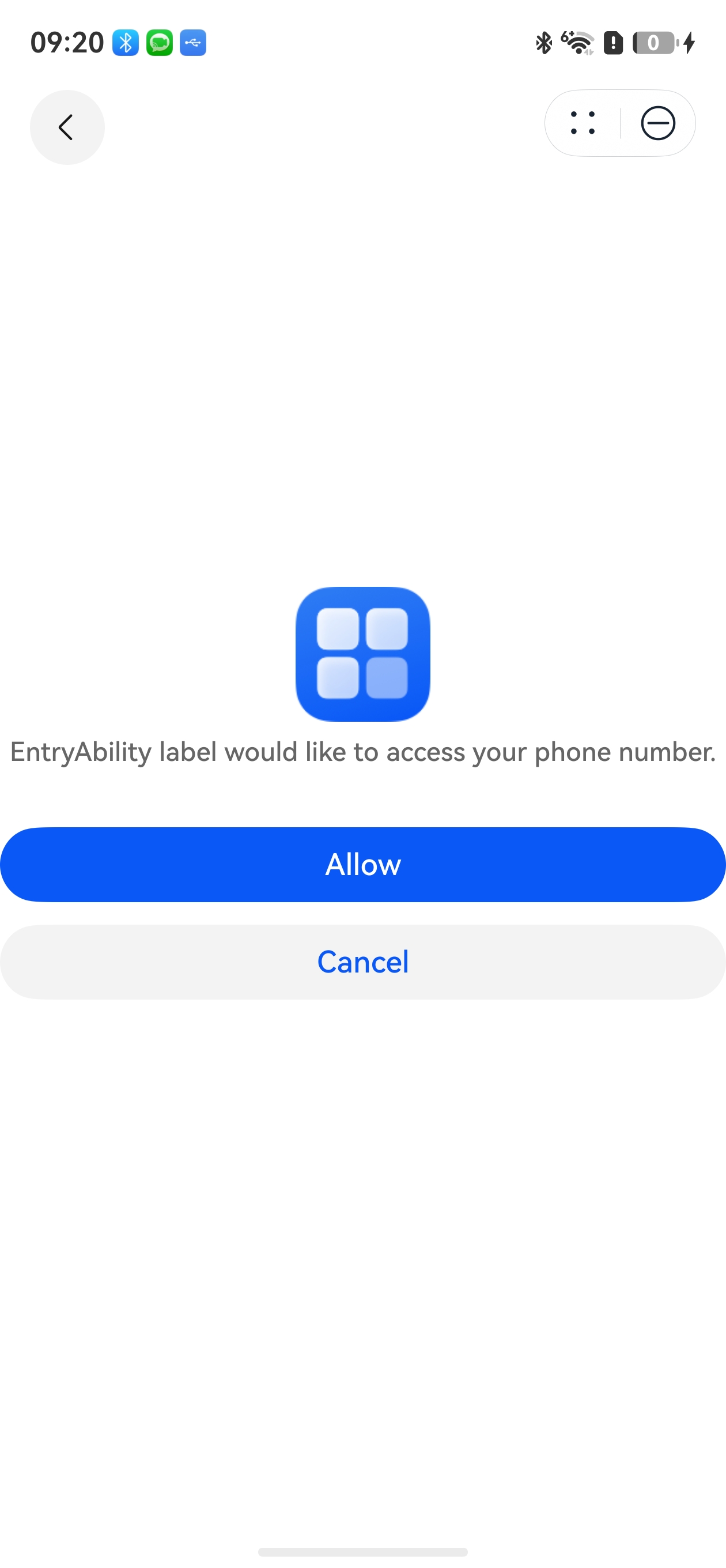
[h2]has.getPhoneNumber
has.getPhoneNumber(Object object):void
Launches the function page for obtaining a user's phone number. Before using this API, see Getting Started.
Since: 1.0.12
Parameters:
The input parameter is an object containing the following fields.
| Parameter | Type | Default Value | Mandatory | Description |
|---|---|---|---|---|
| success | function | - | No | Callback invoked when the API call is successful. |
| fail | function | - | No | Callback invoked when the API call fails. |
| complete | function | - | No | Callback to be invoked when the API call is complete, regardless of success or failure. |
Return value of success
| Property | Type | Description |
|---|---|---|
| code | string | Mobile number of the user. |
Example:
has.getPhoneNumber({
  success: (res) => {
    console.info('getPhoneNumber success', res);
  },
  fail: (err) => {
    console.error('getPhoneNumber fail', err);
  },
  complete: (res) => {
    console.info('getPhoneNumber complete', res);
  }
});
Below shows the UI effect.
[h2]has.getAvatarInfo
has.getAvatarInfo(Object object): void
Launches the function page for obtaining a user's profile photo. Before using this API, see Configuring the Client ID.
Since: 1.0.12
Parameters:
The input parameter is an object containing the following fields.
| Parameter | Type | Default Value | Mandatory | Description |
|---|---|---|---|---|
| success | function | - | No | Callback invoked when the API call is successful. |
| fail | function | - | No | Callback invoked when the API call fails. |
| complete | function | - | No | Callback to be invoked when the API call is complete, regardless of success or failure. |
Return value of success
| Property | Type | Description |
|---|---|---|
| avatarUri | string | Local path of the profile photo. |
Example:
has.getAvatarInfo({
  success: (res) => {
    console.info('getAvatarInfo success', res);
  },
  fail: (err) => {
    console.error('getAvatarInfo fail', err);
  },
  complete: (res) => {
    console.info('getAvatarInfo complete', res);
  }
});
Below shows the UI effect.

[h2]has.getInvoiceTitle
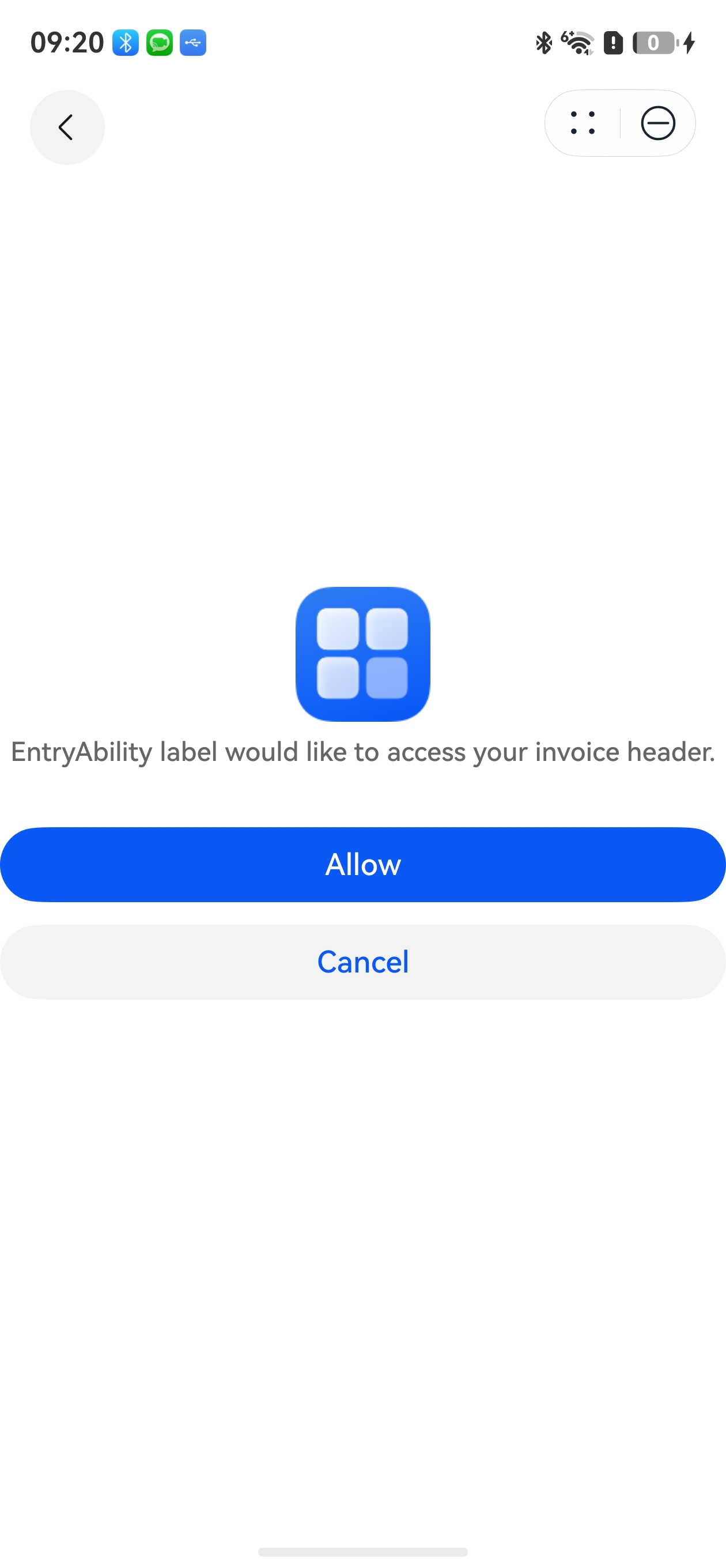
has.getInvoiceTitle(Object object): void
Launches the function page for obtaining a user's invoice title. Before using this API, see Configuring the Client ID.
Since: 1.0.12
Parameters:
The input parameter is an object containing the following fields.
| Parameter | Type | Default Value | Mandatory | Description |
|---|---|---|---|---|
| success | function | - | No | Callback invoked when the API call is successful. |
| fail | function | - | No | Callback invoked when the API call fails. |
| complete | function | - | No | Callback to be invoked when the API call is complete, regardless of success or failure. |
Return values of success
| Property | Type | Description |
|---|---|---|
| type | string | Invoice title type. |
| title | string | Invoice title. |
| taxNumber | string | Taxpayer identification number. |
| companyAddress | string | Company address. |
| telephone | string | Phone number of a company. |
| bankName | string | Bank name of a company. |
| bankAccount | string | Bank account of a company. |
Example:
has.getInvoiceTitle({
  success: () => {
    console.info('getInvoiceTitle success');
  },
  fail: (err) => {
    console.error('getInvoiceTitle fail', err);
  },
  complete: (res) => {
    console.info('getInvoiceTitle complete', res);
  }
});
Below shows the UI effect.
[h2]has.getDeliveryAddress
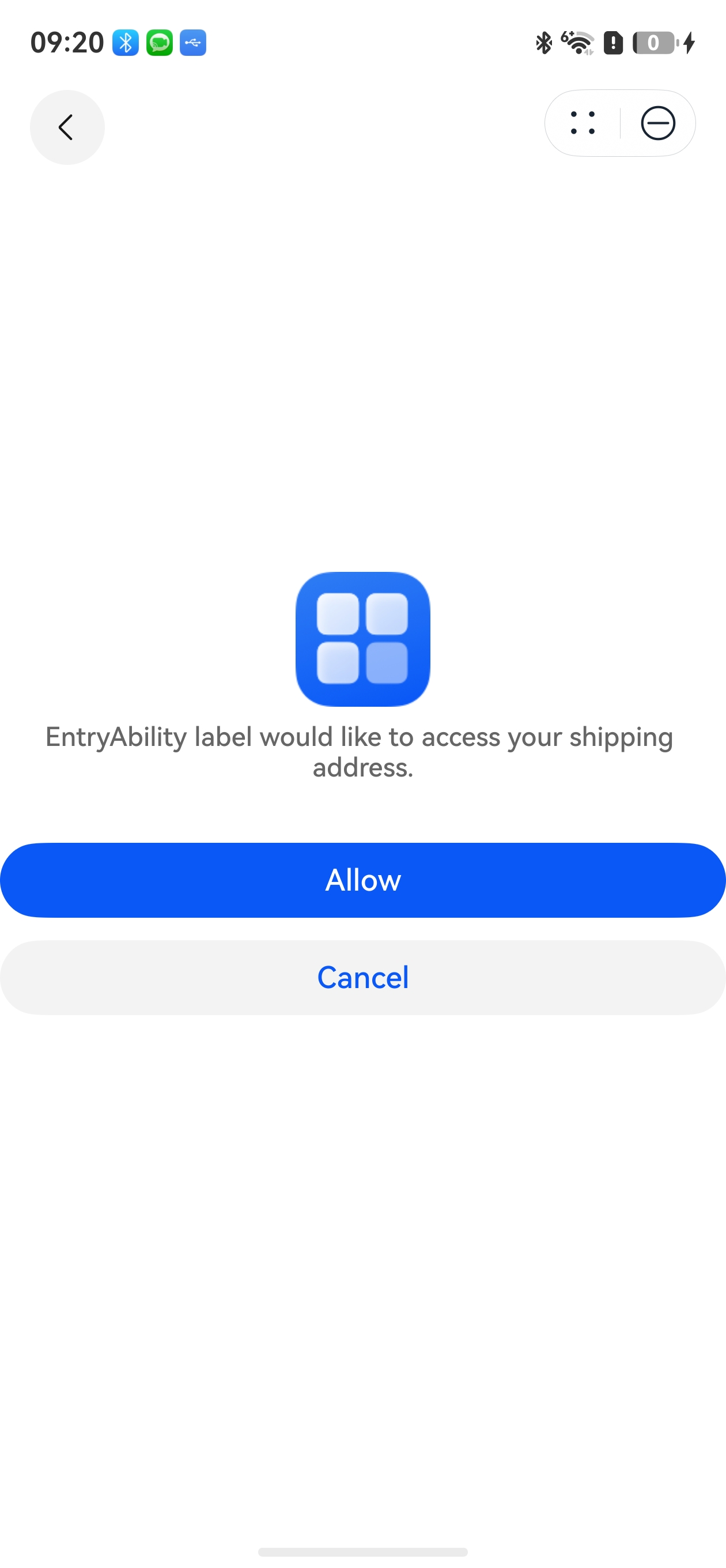
has.getDeliveryAddress(Object object): void
Launches the function page for obtaining a user's shipping address. Before using this API, see Configuring the Client ID.
Since: 1.0.12
Parameters:
The input parameter is an object containing the following fields.
| Parameter | Type | Default Value | Mandatory | Description |
|---|---|---|---|---|
| success | function | - | No | Callback invoked when the API call is successful. |
| fail | function | - | No | Callback invoked when the API call fails. |
| complete | function | - | No | Callback to be invoked when the API call is complete, regardless of success or failure. |
Return values of success
| Property | Type | Description |
|---|---|---|
| userName | string | Recipient name |
| telNumber | string | Phone number of the recipient. |
| postalCode | string | Postal code. |
| nationalCode | string | Country code obtained. |
| provinceName | string | Province name. |
| cityName | string | City name. |
| countyName | string | District name. |
| streetName | string | Street name. |
| detailInfo | string | Detailed address. |
Example:
has.getDeliveryAddress({
  success: (res) => {
    console.info('getDeliveryAddress success', res);
  },
  fail: (err) => {
    console.error('getDeliveryAddress fail', err);
  },
  complete: (res) => {
    console.info('getDeliveryAddress complete', res);
  }
});
Below shows the UI effect.
[h2]has.getServiceSubscription
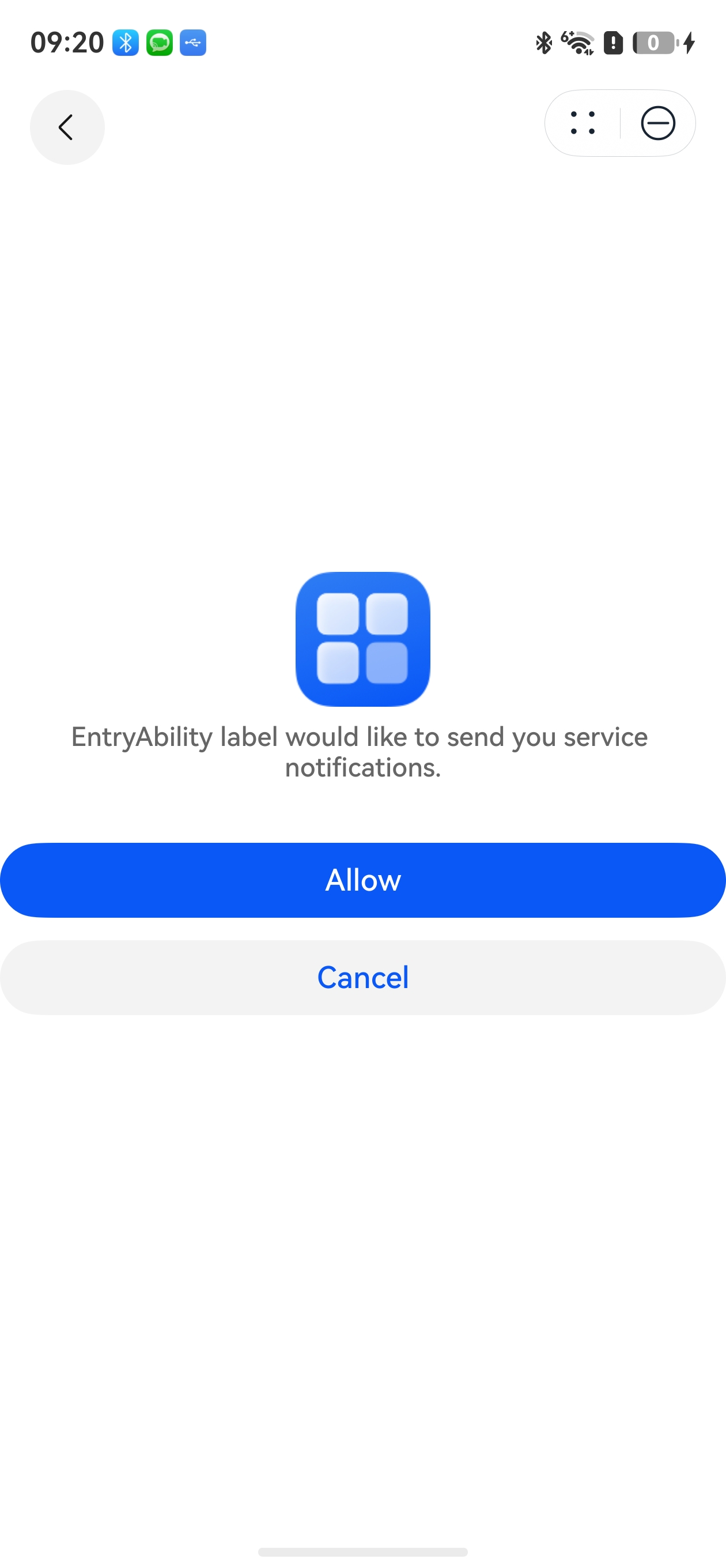
has.getServiceSubscription(Object object): void
Launches the subscription service page. Before using this API, enable Push Kit by referring to Enabling Push Kit.
Since: 1.0.12
Parameters:
The input parameter is an object containing the following fields.
| Parameter | Type | Default Value | Mandatory | Description |
|---|---|---|---|---|
| tmplIds | Array<string> | - | Yes | IDs of the message templates to be subscribed to. A maximum of three messages can be subscribed to at a time. |
| success | function | - | No | Callback invoked when the API call is successful. |
| fail | function | - | No | Callback invoked when the API call fails. |
| complete | function | - | No | Callback to be invoked when the API call is complete, regardless of success or failure. |
Return value of success
| Property | Type | Description |
|---|---|---|
| errMsg | string | Call result. 'requestSubscribeMessage:ok' is returned if the API call is successful. |
Example:
has.getServiceSubscription({
  tmplIds: [''],
  success: (res) => {
    console.info('getServiceSubscription success', res);
  },
  fail: (err) => {
    console.error('getServiceSubscription fail', err);
  },
  complete: (res) => {
    console.info('getServiceSubscription complete', res);
  }
});
Below shows the UI effect.
UploadFile
Represents the uploaded file information.
Since: 1.0.12
| Name | Type | Mandatory | Description |
|---|---|---|---|
| filename | string | Yes | File name in the header when multipart is used. |
| name | string | Yes | Name of a form item when multipart is used. The default value is file. |
| uri | string | Yes | File path. The value can be a user directory or an application directory. |
| type | string | Yes | Type of the file content. By default, the type is obtained based on the extension of the file name or URI. |
UploadRequestData
Represents the uploaded form data.
Since: 1.0.12
| Name | Type | Mandatory | Description |
|---|---|---|---|
| name | string | Yes | Name of a form element. |
| value | string | Yes | Value of a form element. |
UploadFileTaskState
Represents the information about an upload task.
Since: 1.0.12
| Name | Type | Mandatory | Description |
|---|---|---|---|
| path | string | Yes | Path of the file to upload. |
| responseCode | number | Yes | Result code of the upload task. For details about the result codes, see TaskState. |
| message | string | Yes | Description of the upload task result. |
PurchaseData
Represents the order information and subscription status information in JWS format.
Since: 1.0.12
| Name | Type | Mandatory | Description |
|---|---|---|---|
| type | number | Yes | Product type. - 0: consumables - 1: non-consumables - 2: auto-renewable subscription - 3: non-renewable subscription |
| jwsPurchaseOrder | string | No | Order information in JWS format. Follow the instructions in Verifying the Signature in the Returned Result to decode and perform signature verification for the returned result to obtain purchase data in JSON format. Check the parameters in the JSON string in PurchaseOrderPayload. |
| jwsSubscriptionStatus | string | No | Subscription status information in JWS format. You can decode the signature verification by referring to Verifying the Signature in the Returned Result to obtain the JSON string containing the subscription status information. |
PurchaseOrderPayload
Represents the purchase order model, which supports consumables, non-consumables, and auto-renewable subscriptions.
Since: 1.0.12
| Name | Type | Mandatory | Description |
|---|---|---|---|
| environment | string | Yes | Environment type. - NORMAL: normal environment - SANDBOX: sandbox environment |
| purchaseOrderId | string | Yes | Order ID of a purchase. |
| purchaseToken | string | Yes | Purchase token. In a consumable/non-consumable purchase, each purchase token matches a specific order. In a subscription purchase, each purchase token matches a subscription ID. |
| applicationId | string | Yes | App ID. |
| productId | string | Yes | Product ID. |
| productType | string | Yes | Product type. The options are as follows: - 0: consumables - 1: non-consumables - 2: auto-renewable subscription - 3: non-renewable subscription |
| purchaseTime | number | Yes | Purchase time, which is a UTC timestamp in milliseconds. If the purchase is not complete, this parameter is left empty. |
| finishStatus | string | No | Delivery status. The options are as follows: - 1: delivered - 2: not delivered |
| needFinish | boolean | No | Indicates whether the delivery should be acknowledged to complete the purchase process. The options are as follows: - true: Delivery acknowledgement is required. - false: Delivery acknowledgement is optional. |
| price | number | Yes | Price in currency sub-units. The specific sub-unit, like cents, varies by currency. |
| currency | string | Yes | Currency. For details, see the ISO 4217 standard. For example, CNY, USD, and MYR. |
| developerPayload | string | No | Information stored on the merchant side, which an app passes when calling the payment API. |
| purchaseOrderRevocationReasonCode | string | No | Reason for revoking the purchase order. - 0: others - 1: order revoked at the user's request |
| revocationTime | number | No | Time when a purchase order is canceled, which is a UTC timestamp in milliseconds. |
| offerTypeCode | string | No | Promotional offer type. - 1: introductory offers for new users - 2: promotional offers for specific user groups |
| offerId | string | No | Promotional offer ID. |
| countryCode | string | Yes | Country/Region code, which is used to identify the country or region. For details, see the ISO 3166 standard. |
| signedTime | number | Yes | Time when signing is performed, which is a UTC timestamp in milliseconds. |
SubGroupStatusPayload
Represents the subscription status information related to a subscription group.
Since: 1.0.12
| Name | Type | Mandatory | Description |
|---|---|---|---|
| environment | string | Yes | Environment type. - NORMAL: normal environment - SANDBOX: sandbox environment |
| applicationId | string | Yes | App ID. |
| packageName | string | Yes | App package name. |
| subGroupId | string | Yes | Subscription group ID. |
| lastSubscriptionStatus | object | No | Final subscription status (SubscriptionStatus) within a subscription group. For example, if a user switches from subscription A to B and then to C, this parameter indicates the status of subscription C. |
| historySubscriptionStatusList | object[] | No | List of all historical subscription statuses (SubscriptionStatus) within a subscription group. For example, if a user switches from subscription A to B and then to C, this parameter indicates the statuses of subscriptions C, B, and A. |
SubscriptionStatus
Represents subscription status information.
Since: 1.0.12
| Name | Type | Mandatory | Description |
|---|---|---|---|
| subGroupGenerationId | string | Yes | Subscription group generation ID. - This ID remains unchanged when a user switches between different subscription products in the same group. - This ID will change when a user purchases the product again after the subscription expires and the retention period ends. |
| subscriptionId | string | Yes | Subscription ID. The ID will change when: - A user switches from a subscription to another. - A user purchases the product again after the subscription expires and the retention period ends. |
| purchaseToken | string | Yes | Purchase token. In a consumable/non-consumable purchase, each purchase token matches a specific order. In a subscription purchase, each purchase token matches a subscription ID. |
| status | string | Yes | Subscription status. - 1: active - 2: expired - 3: billing retry - 5: revoked |
| expiresTime | number | Yes | Time when the subscription expires. The value is a UTC timestamp, in milliseconds. |
| lastPurchaseOrder | object | No | Latest purchase order for a subscription. For details about the parameters contained in the purchase order, see PurchaseOrderPayload. |
| recentPurchaseOrderList | object[] | No | List of the recently purchased subscriptions, including the purchase orders generated upon renewal and balance conversion. For details about the parameters contained in the purchase order, see PurchaseOrderPayload. |
| renewalInfo | object | No | Latest future billing plan of the current subscription. For details about the parameters contained in the billing plan, see SubRenewalInfo. |
SubRenewalInfo
Represents the renewal information about a subscription.
Since: 1.0.12
| Name | Type | Mandatory | Description |
|---|---|---|---|
| environment | string | Yes | Environment type. - NORMAL: normal environment - SANDBOX: sandbox environment |
| subGroupGenerationId | string | Yes | Subscription group generation ID. - This ID remains unchanged when a user switches between different subscription products in the same group. - This ID will change when a user purchases the product again after the subscription expires and the retention period ends. |
| nextRenewPeriodProductId | string | No | ID of the product to be renewed in the next billing cycle. |
| productId | string | Yes | ID of the product that is currently active. |
| autoRenewStatusCode | string | Yes | Auto-renewal status. - 0: disabled - 1: enabled |
| hasInBillingRetryPeriod | boolean | Yes | Whether the system is still attempting to retry the billing. - true: yes - false: no |
| priceIncreaseStatusCode | string | No | Price increase status code. - 1: The user has not agreed to a price increase. - 2: The user has agreed to a price increase. |
| offerTypeCode | string | No | Promotional offer type. - 1: introductory offers for new users - 2: promotional offers for specific user groups |
| offerId | string | No | Promotional offer ID. |
| renewalPrice | number | No | Price for the next renewal, in currency sub-units. The specific sub-unit, like cents, varies by currency. This field is not returned if the subscription is revoked. |
| currency | string | No | Currency. For details, see the ISO 4217 standard. For example, CNY, USD, and MYR. |
| renewalTime | number | No | Time when the subscription is renewed. The value is a UTC timestamp, in milliseconds. |
| expirationIntent | string | No | Reason for subscription renewal failure. - 1: The user canceled the subscription. - 2: The product is invalid. - 3: The subscription agreement is invalid. - 4: An exception occurred during billing. - 5: The user did not agree to the price increase. - 6: The failure reason is unknown. |
UIWindowParameter
Window parameters.
Since: 1.0.12
| Name | Type | Mandatory | Description |
|---|---|---|---|
| windowScreenMode | number | Yes | UI window mode. - 1: pop-up - 2: full-screen |
Product
Details of a product.
Since: 1.0.12
| Name | Type | Mandatory | Description |
|---|---|---|---|
| id | string | Yes | Product ID. |
| type | number | Yes | Product type. - 0: consumables - 1: non-consumables - 2: auto-renewable subscription - 3: non-renewable subscription |
| name | string | Yes | Product name, which you set when adding a product. The name is displayed on the checkout screen of IAP Kit. |
| description | string | Yes | Product description, which you set when adding a product. |
| price | string | Yes | Displayed price of a product, in the format Currency+Price, for example, EUR 0.15. In some countries or regions, the value format is Currency symbol+Price, for example, ¥0.15 in the Chinese mainland. The price includes the tax. - For consumable or non-consumable products, this parameter represents the promotional price if one is set; otherwise, it defaults to the original price. - For an auto-renewable subscription, this parameter indicates its original price. NOTE This parameter has been deprecated. You are advised to use localPrice instead. |
| localPrice | string | No | Displayed price of a product, in the format Currency+Price, for example, EUR 0.15. In some countries or regions, the value format is Currency symbol+Price, for example, ¥0.15 in the Chinese mainland. The price includes the tax. - For consumable or non-consumable products, this parameter represents the promotional price if one is set; otherwise, it defaults to the original price. - For an auto-renewable subscription, this parameter indicates its original price. |
| microPrice | number | Yes | Product price in micro unit, which equals the actual product price multiplied by 1,000,000. For example, if the actual price of a product is US$1.99, the product price in micro unit is 1,990,000 (1.99*1000000). - For consumable, non-consumable, or non-renewable subscriptions, this parameter indicates the promotional price in micro unit if set; otherwise, it defaults to the original price in micro unit. - For an auto-renewable subscription, this parameter indicates its original price in micro unit. |
| originalLocalPrice | string | Yes | Original price of a product, in the format Currency+Price, for example, EUR 0.15. In some countries or regions, the value format is Currency symbol+Price, for example, ¥0.15 in the Chinese mainland. The price includes the tax. - For a consumable, non-consumable, or non-renewable subscription, this parameter indicates the original price regardless of whether a promotional price is set. - For an auto-renewable subscription, this parameter will not be returned. |
| originalMicroPrice | number | Yes | Original price in micro unit of a product. It equals the original product price multiplied by 1,000,000. For example, if the original price of a product is US$1.99, the product price in micro unit is 1,990,000 (1.99*1000000). - For a consumable, non-consumable, or non-renewable subscription, this parameter indicates the original price in micro-units regardless of whether a promotional price is set. - For an auto-renewable subscription, this parameter will not be returned. |
| currency | string | Yes | Currency used to pay for a product, for example, CNY. |
| status | number | No | Product status. - 0: valid - 1: canceled, that is, deleted Products in this status cannot be purchased by new users or renewed by existing subscribers. - 3: offline. Offline subscriptions cannot be purchased by new users, but existing subscribers can still renew their plans. |
| subscriptionInfo | SubscriptionInfo | No | Information about an auto-renewable subscription. |
| promotionalOffers | PromotionalOffer[] | No | List of promotional offers supported by a subscription. |
| jsonRepresentation | string | No | Original JSON character string of product details. |
SubscriptionInfo
Subscription information.
Since: 1.0.12
| Name | Type | Mandatory | Description |
|---|---|---|---|
| periodUnit | number | Yes | Unit of the subscription billing cycle. - 0: day - 1: week - 2: month - 3: year - 4: minute (reserved; not supported currently) |
| periodCount | number | Yes | Number of billing cycles for a subscription. |
| groupId | string | Yes | Subscription group ID. |
| groupLevel | number | Yes | Product level. |
| hasEligibilityForIntroOffer | boolean | No | Whether a user has already enjoyed the promotion of a subscription in the same group. Options: - true: yes - false: no - Other values: No relevant information is obtained. |
| introductoryOffer | SubscriptionOffer | No | Promotion information. |
SubscriptionOffer
Promotion information.
Since: 1.0.12
| Name | Type | Mandatory | Description |
|---|---|---|---|
| paymentMode | number | Yes | Payment method for a promotion. - 1: free trial - 2: pay-per-use - 3: upfront payment |
| periodUnit | number | Yes | Unit of the subscription billing cycle. - 0: day - 1: week - 2: month - 3: year - 4: minute (reserved; not supported currently) |
| periodCount | number | Yes | Period count of a promotion. |
| localPrice | string | Yes | Promotional price of a product, in the format Currency+Price, for example, EUR 0.15. In some countries or regions, the value format is Currency symbol+Price, for example, ¥0.15 in the Chinese mainland. |
| microPrice | number | Yes | Promotional price in micro unit. Promotional price in micro unit, which equals the product price multiplied by 1,000,000. |
| offerType | number | Yes | Promotion type. - 0: offer for new users - 1: promotional offers for specific user groups |
PromotionalOffer
Promotional offer information that you can define for a subscription.
Since: 1.0.12
| Name | Type | Mandatory | Description |
|---|---|---|---|
| offerId | string | Yes | Promotional offer ID. |
| paymentMode | number | Yes | Payment method for a promotion. - 1: free trial - 2: pay-per-use - 3: upfront payment |
| periodUnit | number | No | Unit of the subscription billing cycle. - 0: day - 1: week - 2: month - 3: year - 4: minute (reserved; not supported currently) |
| periodCount | number | No | Number of billing cycles for a subscription. |
| localPrice | string | Yes | Discounted price of a product, in the format Currency+Price, for example, EUR 0.15. In some countries or regions, the value format is Currency symbol+Price, for example, ¥0.15 in the Chinese mainland. |
| microPrice | number | Yes | Discounted price in micro unit, which equals the actual product price multiplied by 1,000,000. For example, if the actual price of a product is US$1.99, the product price in micro unit is 1,990,000 (1.99*1000000). |
[h2]Example 1
This example demonstrates how to load a local web page.
// xxx.ets
import { AtomicServiceEnhancedWeb, AtomicServiceEnhancedWebController } from '@atomicservice/ascfapi';
@Entry
@Component
struct WebComponent {
  @State controller: AtomicServiceEnhancedWebController = new AtomicServiceEnhancedWebController();
  build() {
    Column() {
      AtomicServiceEnhancedWeb({ src: $rawfile("index.html"), controller: this.controller })
    }
  }
}
[h2]Example 2
This example loads an online web page:
// xxx.ets
import { AtomicServiceEnhancedWeb, AtomicServiceEnhancedWebController } from '@atomicservice/ascfapi';
@Entry
@Component
struct WebComponent {
  @State controller: AtomicServiceEnhancedWebController = new AtomicServiceEnhancedWebController();
  build() {
    Column() {
      AtomicServiceEnhancedWeb({ src: 'https://www.example.com', controller: this.controller })
    }
  }
}
[h2]Example 3
This example demonstrates how to load a web page within a NavDestination container.
// xxx.ets
import { AtomicServiceEnhancedWeb, AtomicServiceEnhancedWebController } from '@atomicservice/ascfapi';
@Builder
export function WebComponentBuilder(name: string, param: Object) {
  WebComponent()
}
@Component
struct WebComponent {
  navPathStack: NavPathStack = new NavPathStack();
  @State controller: AtomicServiceEnhancedWebController = new AtomicServiceEnhancedWebController();
  build() {
    NavDestination() {
      AtomicServiceEnhancedWeb({
        src: $rawfile("index.html"),
        controller: this.controller,
        navPathStack: this.navPathStack
      })
    }
    .onReady((context: NavDestinationContext) => {
      this.navPathStack = context.pathStack;
    })
  }
}
[h2]Example 4
This example sets the onMessage() event callback.
// xxx.ets
import { AtomicServiceEnhancedWeb, AtomicServiceEnhancedWebController, OnMessageEvent } from '@atomicservice/ascfapi';
@Entry
@Component
struct WebComponent {
  @State controller: AtomicServiceEnhancedWebController = new AtomicServiceEnhancedWebController();
  build() {
    Column() {
      AtomicServiceEnhancedWeb({
        src: $rawfile("index.html"),
        controller: this.controller,
        // Called when the user clicks Send Message and then Back on an HTML5 page.
        onMessage: (event: OnMessageEvent) => {
          console.info(`onMessage data = ${JSON.stringify(event.data)}`);
        }
      })
    }
  }
}
<!-- index.html -->
<!DOCTYPE html>
<html>
<meta charset="utf-8">
<!-- Import the JS SDK file. -->
<script src="../js/aseweb-sdk.umd.js" type="text/javascript"></script>
<body>
<h1>JS SDK - postMessage()</h1>
<br/>
<button type="button" onclick="postMessage({ name: 'Jerry', age: 18 });">Send Message</button>
<br/>
<button type="button" onclick="back();">Back</button>
</body>
<script type="text/javascript">
function postMessage(data) {
// API provided by the JS SDK for sending messages.
has.asWeb.postMessage({
data: data,
callback: (err, res) => {
if (err) {
console.error(`postMessage error err. Code: ${err.code}, message: ${err.message}`);
} else {
console.info(`postMessage success res = ${JSON.stringify(res)}`);
}
}
});
}
function back() {
// Router API provided by the JS SDK for navigation back.
has.router.back({
delta: 1
});
}
</script>
</html> [h2]Example 5
This example sets the web page loading event callbacks.
// xxx.ets
import {
  AtomicServiceEnhancedWeb,
  AtomicServiceEnhancedWebController,
  OnErrorReceiveEvent,
  OnHttpErrorReceiveEvent,
  OnPageBeginEvent,
  OnPageEndEvent
} from '@atomicservice/ascfapi';
@Entry
@Component
struct WebComponent {
  @State controller: AtomicServiceEnhancedWebController = new AtomicServiceEnhancedWebController();
  build() {
    Column() {
      AtomicServiceEnhancedWeb({
        src: $rawfile('index.html'),
        controller: this.controller,
        // Invoked when an error occurs during web page loading.
        onErrorReceive: (event: OnErrorReceiveEvent) => {
          console.info(`onErrorReceive event=${JSON.stringify({
            requestUrl: event.request?.getRequestUrl(),
            requestMethod: event.request?.getRequestMethod(),
            errorCode: event.error?.getErrorCode(),
            errorInfo: event.error?.getErrorInfo()
          })}`);
        },
        // Invoked when an HTTP error occurs during web page resource loading.
        onHttpErrorReceive: (event: OnHttpErrorReceiveEvent) => {
          console.info(`onHttpErrorReceive event=${JSON.stringify({
            requestUrl: event.request?.getRequestUrl(),
            requestMethod: event.request?.getRequestMethod(),
            responseCode: event.response?.getResponseCode(),
            responseData: event.response?.getResponseData(),
          })}`);
        },
        // Invoked when the web page starts to be loaded.
        onPageBegin: (event: OnPageBeginEvent) => {
          console.info(`onPageBegin event=${JSON.stringify({
            url: event.url
          })}`);
        },
        // Invoked when loading of the web page is complete.
        onPageEnd: (event: OnPageEndEvent) => {
          console.info(`onPageEnd event=${JSON.stringify({
            url: event.url
          })}`);
        }
      })
    }
  }
}
[h2]Example 6
This example demonstrates how to use AtomicServiceEnhancedWeb and AtomicServiceEnhancedWebController.
// xxx.ets
import {
  AtomicServiceEnhancedWeb,
  AtomicServiceEnhancedWebController,
  OnErrorReceiveEvent,
  OnHttpErrorReceiveEvent,
  OnPageBeginEvent,
  OnPageEndEvent,
  OnMessageEvent,
  OnLoadInterceptEvent,
  OnProgressChangeEvent
} from '@atomicservice/ascfapi';
@Entry
@Component
struct WebComponent {
  @State darkMode: WebDarkMode = WebDarkMode.On;
  @State forceDarkAccess: boolean = true;
  @State mixedMode: MixedMode = MixedMode.None;
  @State controller: AtomicServiceEnhancedWebController = new AtomicServiceEnhancedWebController();
  @State num: number = 1;
  build() {
    Column() {
      Button('accessForward').onClick(() => {
        console.info(`accessForward = ${this.controller.accessForward()}`);
      })
      Button('accessBackward').onClick(() => {
        console.info(`accessBackward = ${this.controller.accessBackward()}`);
      })
      Button('accessStep').onClick(() => {
        console.info(`accessStep = ${this.controller.accessStep(1)}`);
      })
      Button('forward').onClick(() => {
        this.controller.forward();
        console.info('forward success');
      })
      Button('backward').onClick(() => {
        this.controller.backward();
        console.info('backward success');
      })
      Button('refresh').onClick(() => {
        this.controller.refresh();
        console.info('refresh success');
      })
      Button('loadUrl').onClick(() => {
        this.controller.loadUrl('https://www.baidu.com/');
        console.info('loadUrl success');
      })
      Button('Dark Mode').onClick(() => {
        this.forceDarkAccess = !this.forceDarkAccess;
      })
      Button('mixedMode').onClick(() => {
        this.mixedMode = this.mixedMode == MixedMode.None ? MixedMode.All : MixedMode.None;
      })
      Button('Click').onClick(() => {
        console.info(`getUserAgent = ${this.controller.getUserAgent()}`);
        console.info(`getCustomUserAgent = ${this.controller.getCustomUserAgent()}`);
        this.controller.setCustomUserAgent('test' + this.num++);
        console.info(`getUserAgent after set = ${this.controller.getUserAgent()}`);
        console.info(`getCustomUserAgent after set = ${this.controller.getCustomUserAgent()}`);
      })
      AtomicServiceEnhancedWeb({
        src: 'https://www.example.com',
        mixedMode: this.mixedMode,
        darkMode: this.darkMode,
        forceDarkAccess: this.forceDarkAccess,
        controller: this.controller,
        onControllerAttached: () => {
          console.info("onControllerAttached call back success");
        },
        onLoadIntercept: (event: OnLoadInterceptEvent) => {
          console.info("onLoadIntercept call back success " + JSON.stringify({
            getRequestUrl: event.data.getRequestUrl(),
            getRequestMethod: event.data.getRequestMethod(),
            getRequestHeader: event.data.getRequestHeader(),
            isRequestGesture: event.data.isRequestGesture(),
            isMainFrame: event.data.isMainFrame(),
            isRedirect: event.data.isRedirect(),
          }))
          return false;
        },
        onProgressChange: (event: OnProgressChangeEvent) => {
          console.info("onProgressChange call back success " + JSON.stringify(event));
        },
        onMessage: (event: OnMessageEvent) => {
          console.info("onMessage call back success " + JSON.stringify(event));
        },
        onPageBegin: (event: OnPageBeginEvent) => {
          console.info("onPageBegin call back success " + JSON.stringify(event));
        },
        onPageEnd: (event: OnPageEndEvent) => {
          console.info("onPageEnd call back success " + JSON.stringify(event));
        },
        onHttpErrorReceive: (event: OnHttpErrorReceiveEvent) => {
          console.info("onHttpErrorReceive call back success " + JSON.stringify(event));
        },
        onErrorReceive: (event: OnErrorReceiveEvent) => {
          console.info("onErrorReceive call back success " + JSON.stringify(event));
        }
      })
    }
  }
}
[h2]Example 7
This example shows how to set nested scrolling.
import { AtomicServiceEnhancedWeb, AtomicServiceEnhancedWebController } from '@atomicservice/ascfapi';
@Entry
@Component
struct AtomicServiceNestedScroll {
  @State controller: AtomicServiceEnhancedWebController = new AtomicServiceEnhancedWebController();
  @State mode: string = 'PARALLEL mode (click to switch)';
  @State nestedScroll: NestedScrollOptions | NestedScrollOptionsExt = {
    scrollForward: NestedScrollMode.PARALLEL,
    scrollBackward: NestedScrollMode.PARALLEL
  };
  build() {
    Scroll() {
      Column() {
        Text("Nested AsWeb - Header")
          .height("15%")
          .width("100%")
          .fontSize(30)
          .backgroundColor(Color.Yellow)
        Button(this.mode)
          .margin({ top: 10, bottom: 10 })
          .onClick(() => {
            if (!(this.nestedScroll as NestedScrollOptions).scrollForward) {
              this.mode = 'SELF_FIRST mode (click to switch)';
              this.nestedScroll = {
                scrollForward: NestedScrollMode.SELF_FIRST,
                scrollBackward: NestedScrollMode.SELF_FIRST
              }
            } else {
              this.mode = 'PARENT_FIRST mode (click to switch)';
              this.nestedScroll = {
                scrollUp: NestedScrollMode.PARENT_FIRST,
                scrollDown: NestedScrollMode.PARENT_FIRST
              }
            }
          })
        AtomicServiceEnhancedWeb({
          src: 'https://www.example.com',
          controller: this.controller,
          nestedScroll: this.nestedScroll
        })
        Text("Nested AsWeb - Footer")
          .height("15%")
          .width("100%")
          .fontSize(30)
          .backgroundColor(Color.Yellow)
      }
    }
  }
}