


Intelligent Assistant
Chat with our virtual assistant to get answers promptly.
We use essential cookies for the website to function, as well as analytics cookies for analyzing and creating statistics of the website performance. To agree to the use of analytics cookies, click "Accept All". You can manage your preferences at any time by clicking "Cookie Settings" on the footer. More Information.
The compute units are the core of powerful compute capabilities of the AI Core, including the Cube Unit, Vector Unit, and Scalar Unit. These three units process different types of data in the AI Core.
Performs scalar computation and controls the program flow. It can be regarded as a mini CPU, which implements iteration control, selection judgment, address and parameter computations of Cube/Vector instructions, and basic arithmetic operations for a program. In addition, the execution pipeline of other functional units in the AI Core can be controlled by inserting a synchronization code into the event synchronization module. Compared with the host CPU, Scalar has a weaker computing capability and is mainly used to send instructions. You are advised to minimize the if/else statement and variable computation during performance optimization.
As shown in the following figure, Scalar executes scalar operation instructions through the standard arithmetic logic unit (ALU).
Figure 1 Scalar accessing instructions and data
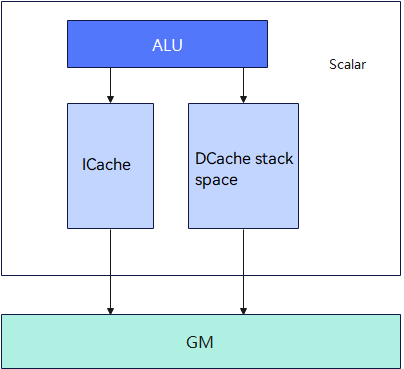
The code snippet and data segment (stack space) required by the ALU are from the GM. I-cache is used to cache code segments, and the cache size is related to hardware specifications. If the size is 16 KB or 32 KB, the code segment is loaded in the unit of 2 KB. D-cache is used to cache data segments, and the cache size is related to hardware specifications. If the size is 16 KB, the data segment is loaded in the unit of cache lines (64 bytes).
Considering that access inside the core is most efficient, ensure that code segments and data segments are cached in the iCache and dCache to avoid access outside the core. In addition, based on the data loading unit, you can adjust the size of data to be loaded at a time during programming to improve the loading efficiency. For example, when data is loaded to the dCache and the start address of the data memory is aligned with the cache lines (64 bytes), the loading efficiency is the highest.
The Vector Unit performs vector computation. It executes vector instructions, which are similar to conventional single instruction multiple data (SIMD) instructions. Each vector instruction can complete the same type of operation for a plurality of operands. As shown in the following figure, the Vector Unit can quickly add or multiply two FP16 vectors. Vector instructions support multiple repeats and direct computation of vectors with intervals.
Figure 2 Vector operation
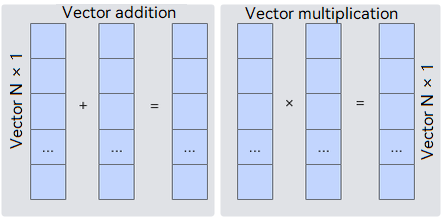
All the computed source data and target data of the vector must be stored in the Unified Buffer (UB), and the start address and operation length must be 32-byte aligned.
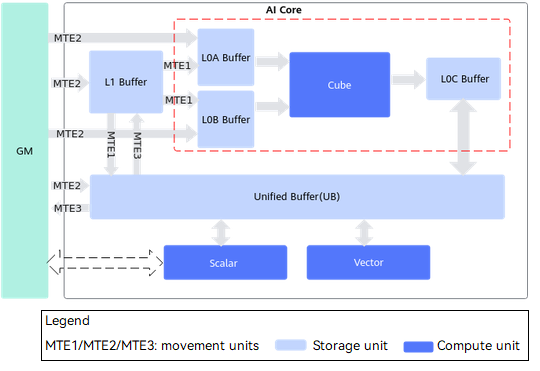
The Cube Unit performs matrix operations. Matrix multiplication of matrix A (M x K) and matrix B (K x N) that can be completed by the Cube Unit at a time. As shown in the following figure, the red dotted box shows the Cube Unit and its accessed storage units. The left matrix A is from L0A, the right matrix B is from L0B, and L0C stores the matrix multiplication result and intermediate result.
Figure 3 Matrix operation
Intelligent Assistant
Chat with our virtual assistant to get answers promptly.
Quick start
Helps you find desired resources with ease.