Driver Development Kit (DDK) provides peripheral driver developers with efficient, secure, and feature-rich extended peripheral driver development solutions — ArkTS APIs and C APIs — enabling a seamless plug-and-play experience for end users.
When to Use
DDK allows you to efficiently and securely develop specialized peripheral devices and extend advanced peripheral capabilities:
-
Driver development for specialized office peripherals
Examples include document scanners, ID card scanners, fingerprint readers, and blood oxygen or blood glucose monitoring devices used at bank counters, in enterprise offices, and in medical testing scenarios.
-
Capability extension for non-standard peripherals
Examples include extending the capabilities of manufacturer-specific, non-standard HID peripherals, such as customizing shortcut keys for graphics tablets; configuring pressure sensitivity and drawing areas; setting extended features; configuring mouse lighting effects and extra button mappings; and adjusting advanced settings such as DPI and X/Y-axis controls.
Typical Use Cases
-
You can implement advanced features for peripheral accessories to meet consumers' advanced usage needs.
-
The extended driver framework supports lifecycle management for extended peripheral drivers and provides APIs for extended device applications to query and bind extended peripherals.
Basic Concepts
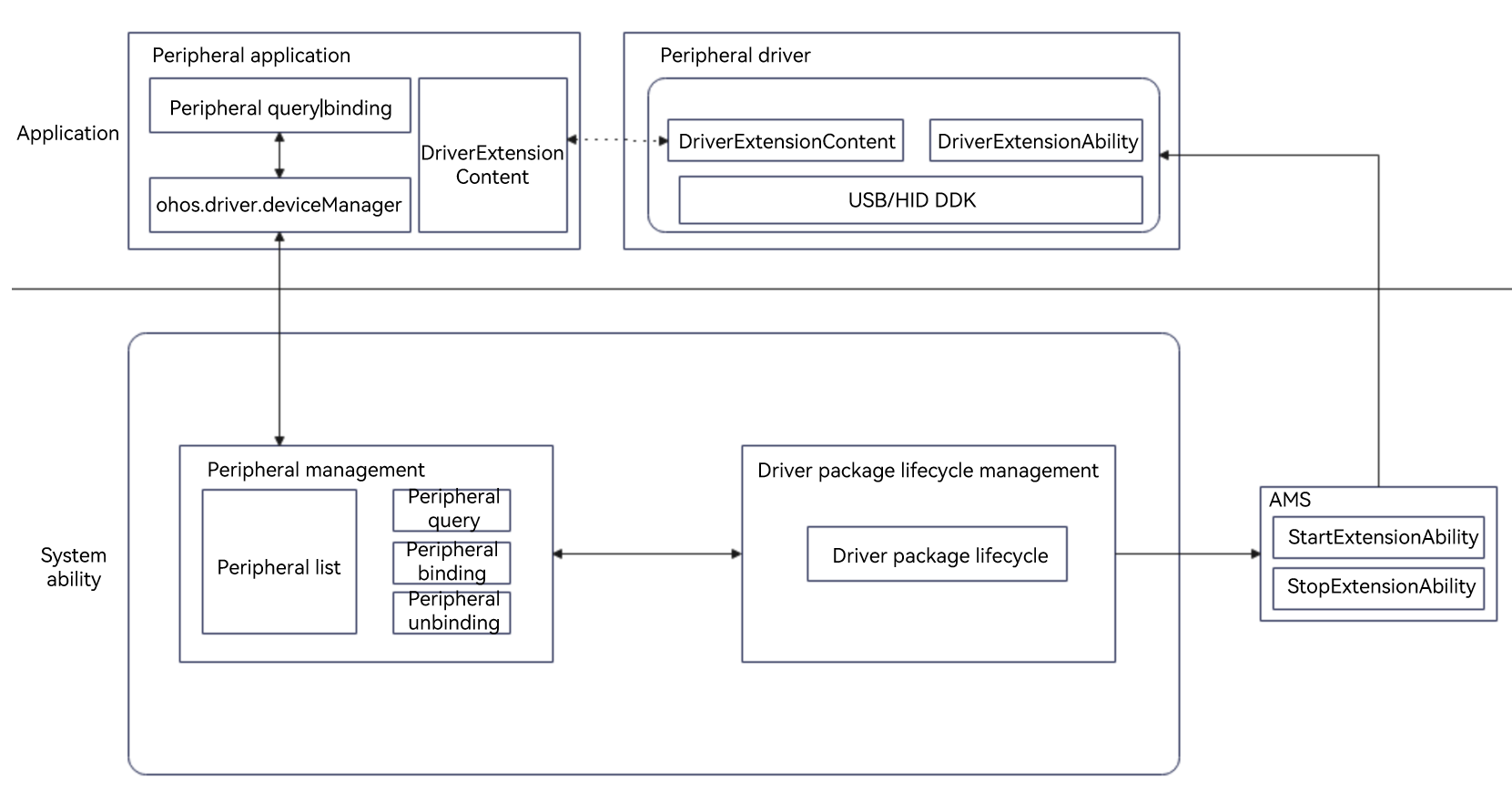
- Extended peripheral driver client: A UI-based basic driver that queries and binds drivers and customizes communication and data processing between the driver and device. For details, see UI-based Driver Development.
- Extended peripheral driver: A UI-free basic driver for specialized extended peripherals or enhanced extended peripheral capabilities, developed based on DDK capabilities. For details, see UI-free Driver Development.
- External Device Manager: Provides extended device management and lifecycle management for driver packages.
- Bundle Manager Service (BMS): Provides bundle management. In HarmonyOS, it is primarily responsible for application installation, uninstallation, and data management.
- Ability Manager Service (AMS): Manages abilities and is used to start and stop the DriverExtensionAbility of an extended peripheral driver.
- System ability (SA): A system service that provides capabilities to external clients. For example, the peripheral extension service SA provides system services for non-standard peripheral driver capabilities.
- Non-standard peripheral: A peripheral that uses a non-standard communication protocol, also known as a vendor-defined protocol.
Implementation Principles
The HDF extended driver framework provides unified APIs for you to leverage the DDK capabilities for user-mode peripheral driver development.
External Device Manager, the core service of user-mode peripheral management, performs lifecycle management of peripherals and peripheral drivers. In addition, standard ArkTS APIs are provided to query, bind, and unbind peripherals.
[h2]Operation Process
Figure 2 shows the process for matching a peripheral driver client with a peripheral driver when a peripheral is connected.
Figure 2 Process for matching a peripheral driver client with a peripheral driver
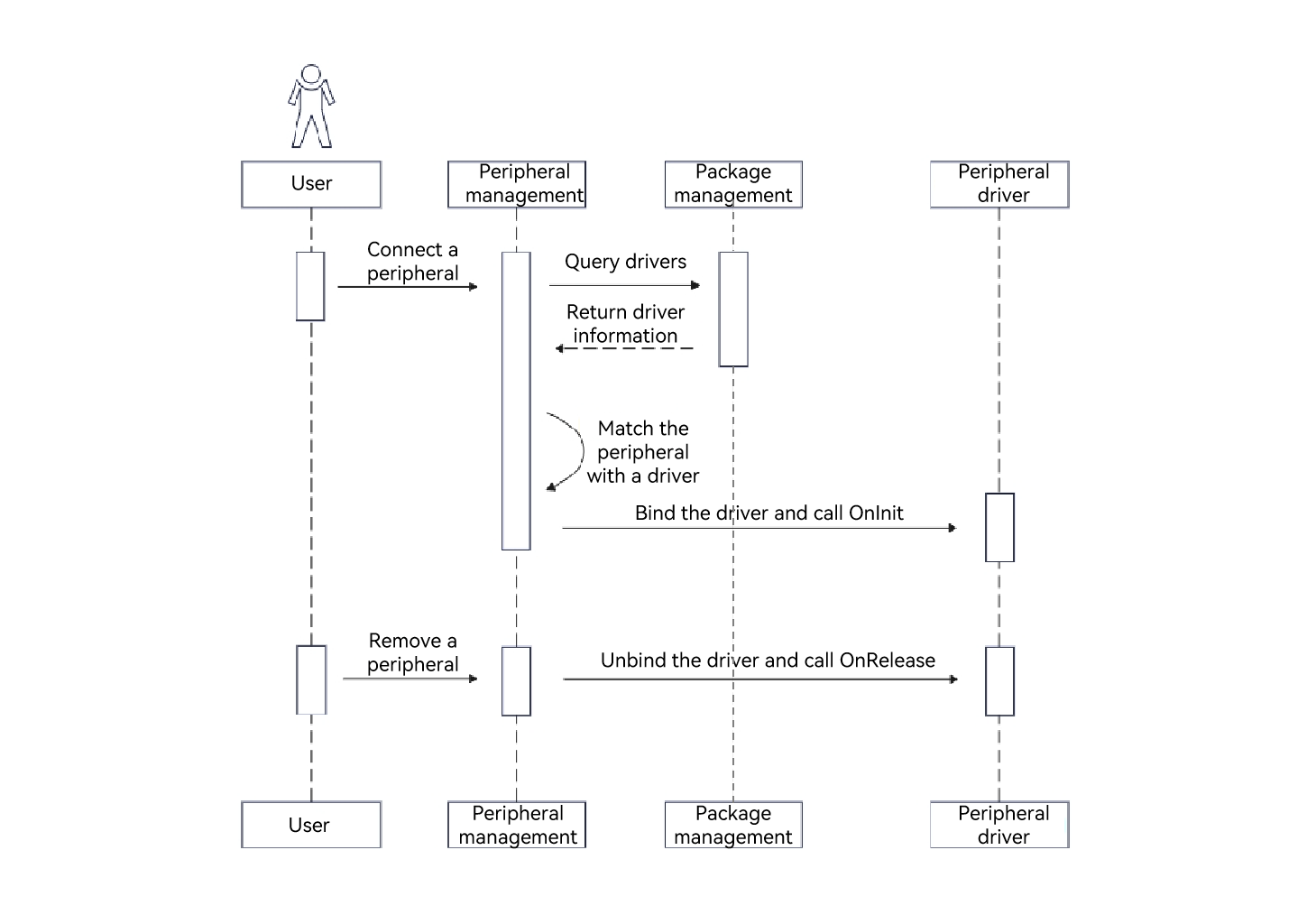
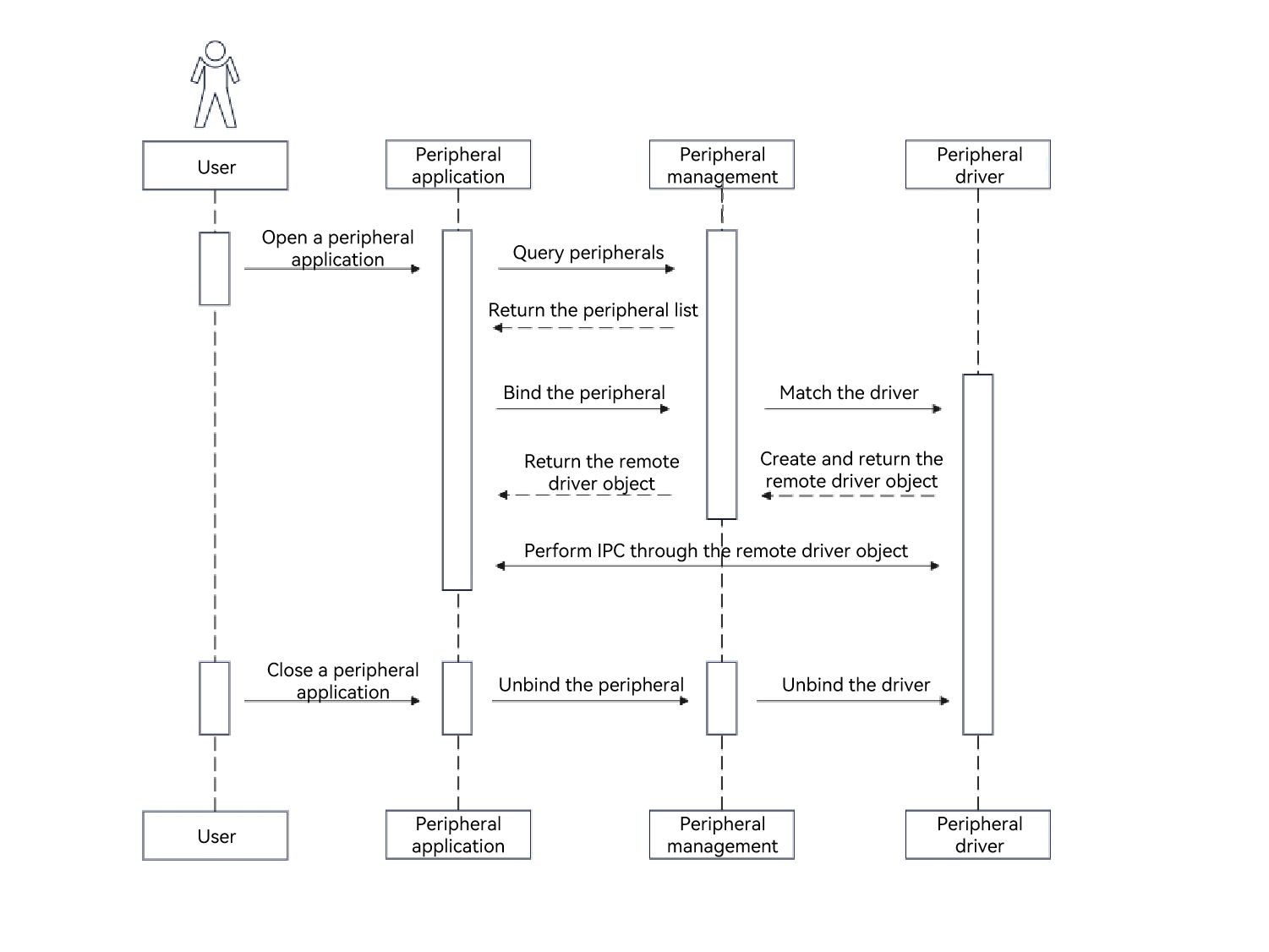
Figure 3 shows the process for binding the peripheral driver client with a peripheral driver.
Figure 3 Process of binding the peripheral driver client with a peripheral driver
Constraints
-
To call the ArkTS or C APIs provided by DDK, you need to apply for specified permissions.
The following table lists the required permissions.
API Type DDK Type Permission ArkTS-API N/A ohos.permission.ACCESS_EXTENSIONAL_DEVICE_DRIVER C-API UsbDdk ohos.permission.ACCESS_DDK_USB C-API HidDdk ohos.permission.ACCESS_DDK_HID C-API USBSerialDDK ohos.permission.ACCESS_DDK_USB_SERIAL C-API ScsiPeripheralDDK ohos.permission.ACCESS_DDK_SCSI_PERIPHERAL -
The C-APIs provided by Driver Development Kit can be used only in the DriverExtension process. Using them in other processes (including child processes) may cause functional exceptions. For details, see Calling DDK C-APIs in a Child Process or a Non-Driver Ability Fails.
-
For API call restrictions of DriverExtensionAbility, see Constraints in the API reference.
Associated Modules
The following table lists the associated modules you may use during development of peripheral drivers.
| Name | Description |
|---|---|
| PerformanceAnalysisKit | Imports hilog for log printing. |
| BasicServicesKit | Imports BusinessError for capturing error information. |
| IPCKit | Imports rpc for IPC (Inter-Process Communication) between the driver and the client. |
| AbilityKit | Imports @ohos.application.Want (Want) for lifecycle management. |
Driver Application Specifications
-
Driver application definition
- A driver application is a user-mode driver for non-standard peripherals, developed using DDK.
- Driver applications are based on DriverExtensionAbility. You must override its lifecycle callback APIs.
-
Driver application installation and uninstallation policies
- Installation policy
- When a user installs a driver application, the system installs it in all existing user spaces.
- When a new user is created, the system installs all previously installed driver applications in that user's space.
- Uninstallation policy: When a user uninstalls a driver application in any user space, the system uninstalls it from all user spaces.
- Installation policy
-
DriverExtensionAbility lifecycle management
- ExtensionAbility is a collective term for scenario-based service extension capabilities (such as user-mode peripheral drivers, service widgets, and input methods), designed to address diverse usage scenarios.
- The lifecycle of each ExtensionAbility is managed by its corresponding SA. The SA calls connectAbility to start the ExtensionAbility and drive the execution of its defined service APIs. When the service completes, the SA calls disconnectAbility to disconnect. The AMS then determines whether to destroy the ExtensionAbility and its associated process based on whether any SA connection remains active. In the user-mode driver development scenario, the system SA responsible for managing the DriverExtensionAbility lifecycle is the driver extension SA.
- The lifecycle of DriverExtensionAbility depends on when a peripheral is connected, which is reflected in the following aspects:
- When a peripheral in the "VID + PID" device list configured for DriverExtensionAbility is connected, its lifecycle interval is the same as the connection period of that peripheral.
- When multiple peripherals in the "VID + PID" device list configured for DriverExtensionAbility are connected in sequence, its lifecycle interval lasts from the connection of the first peripheral to the removal of the last peripheral.
- When a connected peripheral appears in the "VID + PID" lists configured for multiple DriverExtensionAbility instances, the peripheral affects only the lifecycle of the driver ability installed first. For details, see When Multiple Driver Abilities Are Configured for the Same Peripheral Device Model, Inserting the Device Starts Only One Driver Ability.
-
API access security control in DriverExtensionAbility
- The system supports building scenario-specific extension abilities based on ExtensionAbility. DriverExtensionAbility is a type of ability designed for developing user-mode peripheral drivers.
- Within DriverExtensionAbility, only DDK APIs can be accessed to perform access control and data communication for non-standard peripherals.
- Based on the security constraints and service scenarios in driver development, access to other ArkTS APIs is not allowed within DriverExtensionAbility, which is intended to prevent malicious behavior and data leakage.
- Restricted ArkTS API access in DriverExtensionAbility is implemented as follows:
- During initialization and creation of the Extension process, system modules are loaded according to the configured list of ArkTS APIs restricted for DriverExtensionAbility. At runtime, if a restricted ArkTS API is called within DriverExtensionAbility, the call fails because the corresponding system module was not loaded during initialization and creation.
- For the specific list of ArkTS APIs restricted in DriverExtensionAbility, refer to the DriverExtension configuration in frameworks/native/ability/native/etc/extension_blocklist_config.json · HarmonyOS/ability_ability_runtime - AtomGit | GitCode.