概述
华为账号提供了多种通知事件机制,方便应用感知账号状态变化、系统未成年人模式变化和用户信息变更。事件类型包含:
| 事件类型 | 事件分类 | 描述 |
|---|---|---|
| 华为账号登录/登出事件 | 客户端事件 | 应用在前台时通过订阅系统公共事件,实时感知系统华为账号的登录/登出状态。 |
| 系统未成年人模式开启/关闭事件 | 客户端事件 | 应用在前台时通过订阅系统公共事件,实时感知系统未成年人模式的开启/关闭状态。 |
| 用户信息变更事件 | 服务端事件 | 华为账号服务器向应用服务端发送通知,告知用户及其账户信息的重要变更,如用户取消授权、注销账号、手机号变更等。 |
[h2]场景介绍
应用在前台时可以订阅Account Kit提供的华为账号登录/登出广播事件,来感知华为账号的登录状态,实现用户登录/登出应用的逻辑。应用也可通过getHuaweiIDState实时查询华为账号登录状态。
[h2]事件说明
以下是华为账号登录/登出发送的广播事件。
| 事件名称 | 描述 |
|---|---|
| COMMON_EVENT_DISTRIBUTED_ACCOUNT_LOGIN | 表示分布式账号登录成功的动作。华为账号登录成功也会发送此广播事件。 |
| COMMON_EVENT_DISTRIBUTED_ACCOUNT_LOGOUT | 表示分布式账号登出成功的动作。华为账号登出成功也会发送此广播事件。 |
[h2]约束与限制
华为账号登录/登出事件支持Phone、Tablet、PC/2in1设备。并且从5.1.0(18)版本开始,新增支持Wearable设备;从5.1.1(19)版本开始,新增支持TV设备;从26.0.1版本开始,新增支持Car设备。
[h2]开发步骤
-
导入commonEventManager模块及相关公共模块。
import { hilog } from '@kit.PerformanceAnalysisKit'; import { BusinessError, commonEventManager } from '@kit.BasicServicesKit'; -
创建订阅者,并处理订阅结果。
// 订阅者信息
const subscribeInfo: commonEventManager.CommonEventSubscribeInfo = {
  events: [commonEventManager.Support.COMMON_EVENT_DISTRIBUTED_ACCOUNT_LOGIN,
    commonEventManager.Support.COMMON_EVENT_DISTRIBUTED_ACCOUNT_LOGOUT]
};

// 定义订阅者,如开发者使用await改写createSubscriber方法,需要把此变量定义到全局(struct外层)
let subscriber: commonEventManager.CommonEventSubscriber | null = null;
// 创建订阅者
commonEventManager.createSubscriber(subscribeInfo)
  .then((commonEventSubscriber: commonEventManager.CommonEventSubscriber) => {
    subscriber = commonEventSubscriber;
    // 订阅公共事件
    commonEventManager.subscribe(subscriber,
      (error: BusinessError, data: commonEventManager.CommonEventData) => {
        if (error) {
          hilog.error(0x0000, 'testTag',
            `Failed to subscribe, code is ${error.code}, message is ${error.message}`);
        } else {
          hilog.info(0x0000, 'testTag', 'Succeeded in subscribing.');
          if (data.event === commonEventManager.Support.COMMON_EVENT_DISTRIBUTED_ACCOUNT_LOGIN) {
            // 订阅到华为账号登录事件
          }
          if (data.event === commonEventManager.Support.COMMON_EVENT_DISTRIBUTED_ACCOUNT_LOGOUT) {
            // 订阅到华为账号登出事件
          }
        }
      });
  })
  .catch((err: BusinessError) => {
    hilog.error(0x0000, 'testTag', `Failed to createSubscriber. Code: ${err.code}, message: ${err.message}`);
  });
[h2]事件说明
以下是系统未成年人模式开启/关闭发送的广播事件。
| 事件名称 | 值 | 描述 |
|---|---|---|
| COMMON_EVENT_MINORSMODE_ON | usual.event.MINORSMODE_ON | 表示系统未成年人模式开启事件。 |
| COMMON_EVENT_MINORSMODE_OFF | usual.event.MINORSMODE_OFF | 表示系统未成年人模式关闭事件。 |

主动开启系统未成年人模式(PC/2in1设备暂不支持从控制中心开启系统未成年人模式),当前设备会发送系统未成年人模式开启事件。
[h2]开发步骤
-
导入commonEventManager模块及相关公共模块。
import { hilog } from '@kit.PerformanceAnalysisKit'; import { BusinessError, commonEventManager } from '@kit.BasicServicesKit'; -
创建订阅者,订阅系统未成年人模式开启或关闭事件。推荐在应用Ability的onCreate生命周期中调用。
// 订阅者信息
const subscribeInfo: commonEventManager.CommonEventSubscribeInfo = {
  events: [commonEventManager.Support.COMMON_EVENT_MINORSMODE_ON,
    commonEventManager.Support.COMMON_EVENT_MINORSMODE_OFF]
};

// 定义订阅者,如开发者使用await改写createSubscriber方法,需要把此变量定义到全局(struct外层)
let subscriber: commonEventManager.CommonEventSubscriber | null = null;
// 创建订阅者
commonEventManager.createSubscriber(subscribeInfo)
  .then((commonEventSubscriber: commonEventManager.CommonEventSubscriber) => {
    // 这里获取到commonEventSubscriber对象需要暂存,用于后续事件回调。不可直接使用,否则会出现事件回调不生效的情况
    subscriber = commonEventSubscriber;
    // 订阅公共事件
    commonEventManager.subscribe(subscriber,
      (error: BusinessError, data: commonEventManager.CommonEventData) => {
        if (error) {
          dealCommonEventAllError(error);
          return;
        }
        if (data.event === commonEventManager.Support.COMMON_EVENT_MINORSMODE_ON) {
          // 订阅到开启事件,可以调用获取年龄段的接口,根据年龄段刷新内容展示,同时如开发者有缓存年龄段或系统未成年人模式开启状态,则需要刷新缓存
          return;
        }
        if (data.event === commonEventManager.Support.COMMON_EVENT_MINORSMODE_OFF) {
          // 订阅到关闭事件,关闭当前应用的未成年人模式,刷新应用内容展示,取消年龄限制,如开发者有缓存系统未成年人模式开启状态,则需要刷新缓存
        }
      });
  })
  .catch((error: BusinessError) => {
    dealCommonEventAllError(error);
  });
function dealCommonEventAllError(error: BusinessError): void { hilog.error(0x0000, 'testTag', `Failed to subscribe. Code: ${error.code}, message: ${error.message}`); }
[h2]事件说明
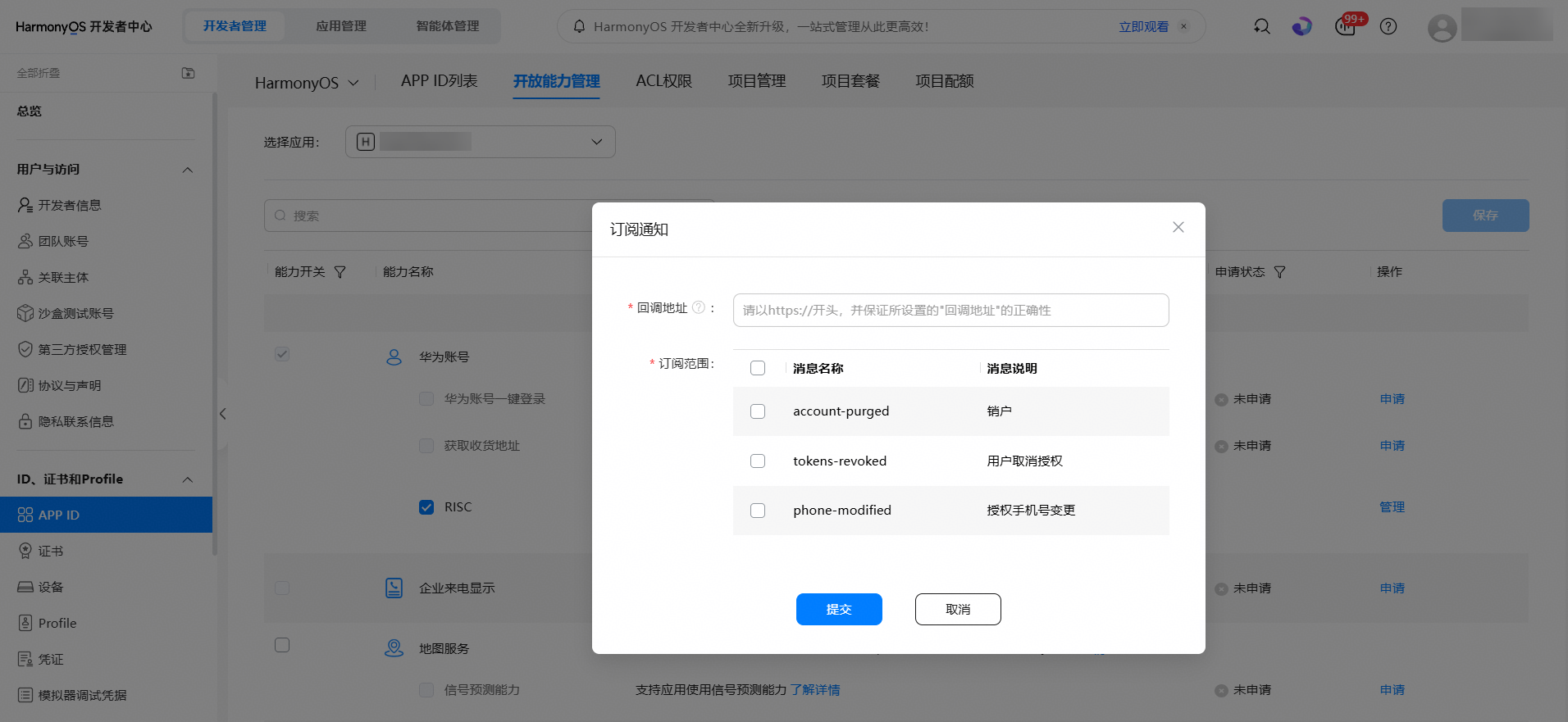
| 消息名称 | 事件类型 | 事件描述 |
|---|---|---|
| tokens-revoked | https://schemas.openid.net/secevent/oauth/event-type/tokens-revoked | 用户取消应用的授权 |
| account-purged | https://schemas.openid.net/secevent/risc/event-type/account-purged | 用户注销华为账号 |
| phone-modified | https://schemas.openid.net/secevent/oauth/event-type/phone-modified | 用户授权手机号变更 |
[h2]订阅用户信息变更
订阅步骤如下:
-
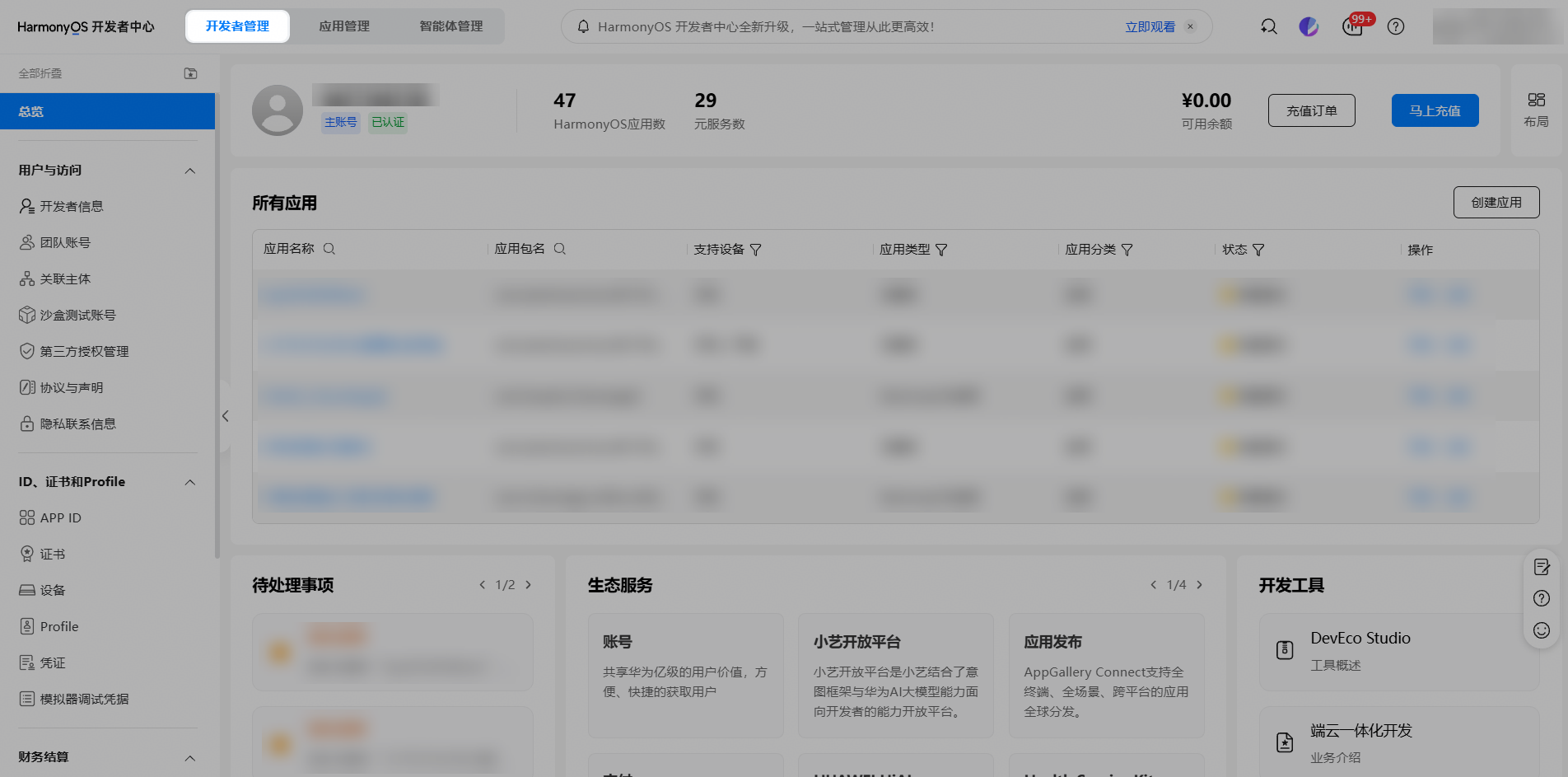
登录HarmonyOS 开发者中心,进入“开发者管理”页面。
-
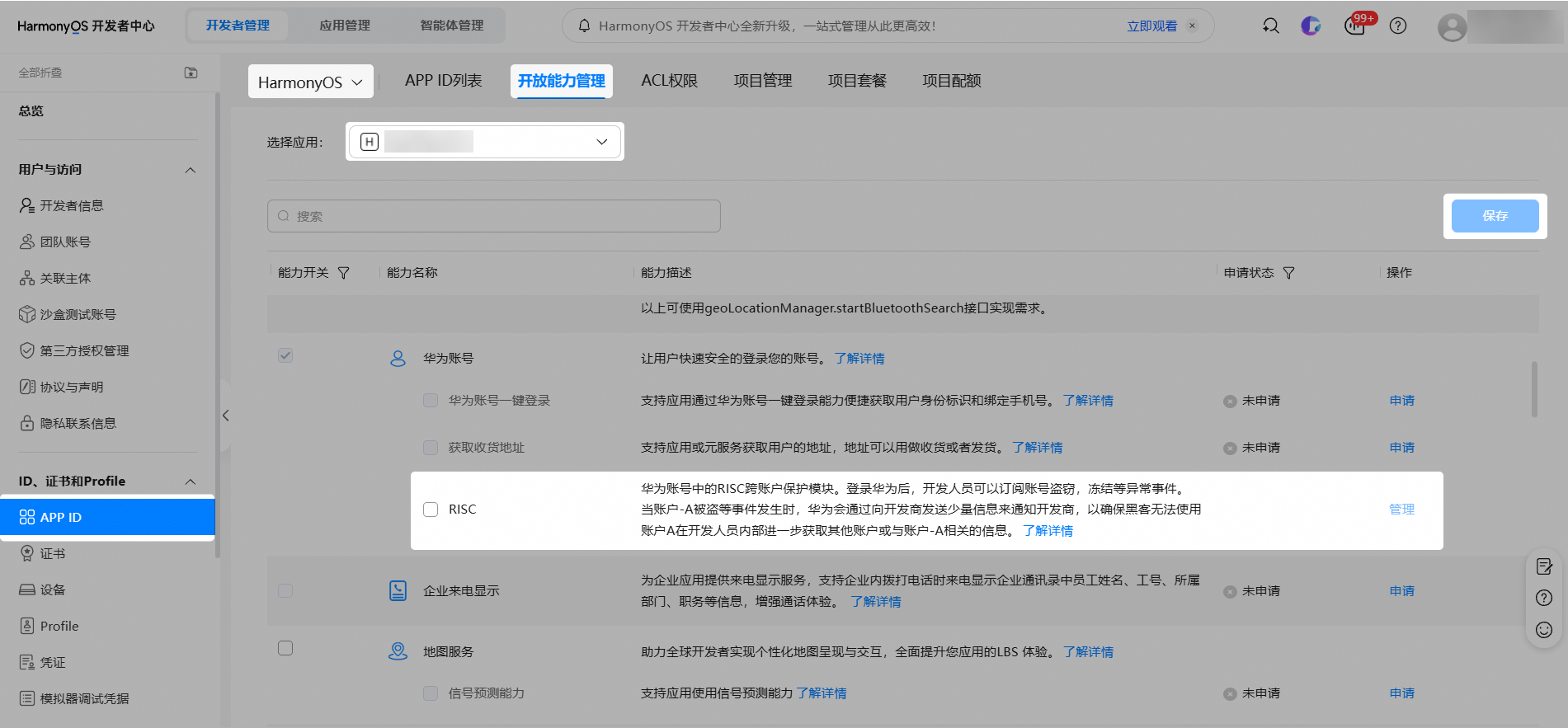
左侧导航栏选择“ID、证书和Profile > APP ID”,页面中选择“HarmonyOS”,点击“开放能力管理”页签;选择需要订阅用户信息变更事件的应用,找到“RISC”并勾选,点击“保存”。
-
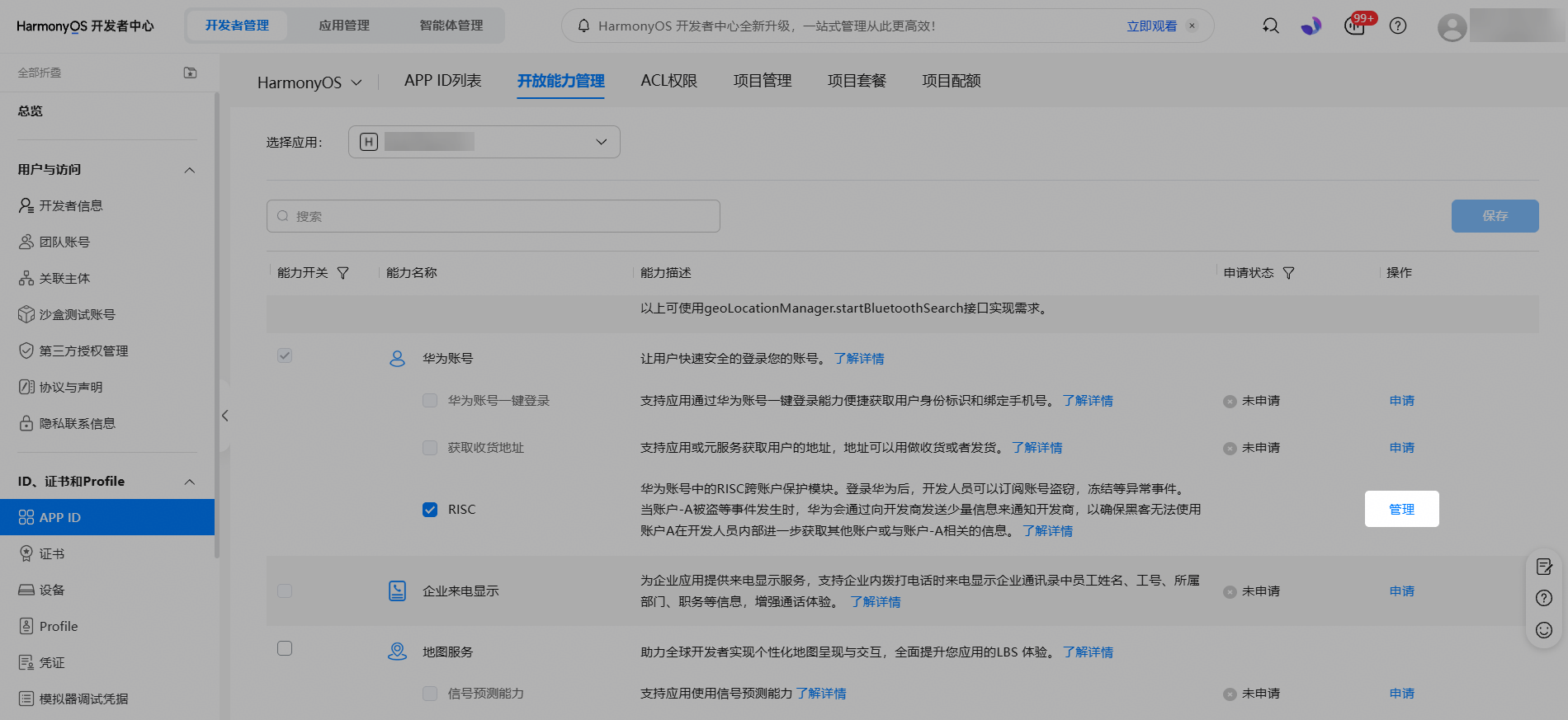
点击“RISC”对应的“管理”按钮。
-
在弹窗中配置“回调地址”及“订阅范围”,然后点击“提交”。

[h2]处理通知消息
华为账号服务器向开发者应用服务端投递消息。开发者应用服务端接收到消息后需要先对消息头中的令牌进行验签,确保消息的完整有效性后解析并获取用户信息变更事件详情。具体步骤如下:
-
验证消息头中的令牌签名。
您可通过任何JWT库(例如:jwt.io)对其进行解析与验证。
无论使用哪种库,您均需完成如下操作:
- 调用接口https://risc.cloud.huawei.com/v1beta/public/risc/.well-known/risc-configuration,获取发行者标识(issuer)与签名密钥证书URI(jwks_uri)。
- 通过依赖的JWT库,对消息头中的令牌进行解析,获取签名的KeyId。
- 通过签名的KeyId,从签名密钥证书URI中获取到JWT签名的公钥。
- 校验JWT签名中的aud与订阅用户信息变更中提供的Client ID一致。
- 校验JWT签名中的issuer与发行者标识(issuer)一致。
具体验签逻辑,请参考如下示例代码:
Maven依赖配置
<dependencies>
   <dependency>
      <groupId>com.github.ben-manes.caffeine</groupId>
      <artifactId>caffeine</artifactId>
      <version>2.9.3</version> <!--此处替换为您项目需要的版本-->
   </dependency>
   <dependency>
      <groupId>com.auth0</groupId>
      <artifactId>jwks-rsa</artifactId>
      <version>0.21.2</version> <!--此处替换为您项目需要的版本-->
   </dependency>
   <dependency>
      <groupId>io.jsonwebtoken</groupId>
      <artifactId>jjwt-impl</artifactId>
      <version>0.11.5</version> <!--此处替换为您项目需要的版本-->
   </dependency>
   <dependency>
      <groupId>io.jsonwebtoken</groupId>
      <artifactId>jjwt-jackson</artifactId>
      <version>0.11.5</version> <!--此处替换为您项目需要的版本-->
   </dependency>
   <dependency>
      <groupId>com.alibaba.fastjson2</groupId>
      <artifactId>fastjson2</artifactId>
      <version>2.0.51</version> <!--此处替换为您项目需要的版本-->
   </dependency>
   <dependency>
      <groupId>org.apache.httpcomponents</groupId>
      <artifactId>httpclient</artifactId>
      <version>4.5.6</version> <!--此处替换为您项目需要的版本-->
   </dependency>
   <dependency>
      <groupId>org.projectlombok</groupId>
      <artifactId>lombok</artifactId>
      <version>1.18.26</version> <!--此处替换为您项目需要的版本-->
   </dependency>
   <dependency>
      <groupId>ch.qos.logback</groupId>
      <artifactId>logback-classic</artifactId>
      <version>1.2.11</version> <!--此处替换为您项目需要的版本-->
   </dependency>
</dependencies>
Java验签代码示例
import com.alibaba.fastjson2.JSON; import com.alibaba.fastjson2.JSONObject; import com.auth0.jwk.JwkProvider; import com.auth0.jwk.UrlJwkProvider; import com.github.benmanes.caffeine.cache.CacheLoader; import com.github.benmanes.caffeine.cache.Caffeine; import com.github.benmanes.caffeine.cache.LoadingCache; import io.jsonwebtoken.Claims; import io.jsonwebtoken.IncorrectClaimException; import io.jsonwebtoken.JwsHeader; import io.jsonwebtoken.Jwt; import io.jsonwebtoken.JwtParser; import io.jsonwebtoken.Jwts; import io.jsonwebtoken.SigningKeyResolver; import io.jsonwebtoken.security.SignatureException; import lombok.Data; import lombok.extern.slf4j.Slf4j; import org.apache.http.HttpEntity; import org.apache.http.HttpStatus; import org.apache.http.client.config.RequestConfig; import org.apache.http.client.methods.CloseableHttpResponse; import org.apache.http.client.methods.HttpGet; import org.apache.http.config.Registry; import org.apache.http.config.RegistryBuilder; import org.apache.http.conn.socket.ConnectionSocketFactory; import org.apache.http.conn.socket.PlainConnectionSocketFactory; import org.apache.http.conn.ssl.SSLConnectionSocketFactory; import org.apache.http.impl.client.CloseableHttpClient; import org.apache.http.impl.client.HttpClients; import org.apache.http.impl.conn.PoolingHttpClientConnectionManager; import org.apache.http.util.EntityUtils; import org.checkerframework.checker.nullness.qual.NonNull; import org.checkerframework.checker.nullness.qual.Nullable; import javax.net.ssl.SSLContext; import javax.net.ssl.TrustManagerFactory; import java.io.IOException; import java.net.URL; import java.security.Key; import java.security.KeyManagementException; import java.security.KeyStore; import java.security.KeyStoreException; import java.security.NoSuchAlgorithmException; import java.security.PublicKey; import java.util.Objects; import java.util.concurrent.TimeUnit; /** * 订阅和处理用户信息变更 */ @Slf4j public class RiscDemo { /** * 公开配置信息地址 */ private static final String PUBLIC_CONFIGURATION_URL = "https://risc.cloud.huawei.com/v1beta/public/risc/.well-known/risc-configuration"; /** * 公开信息缓存 */ private final LoadingCache<String, PublicConfiguration> publicConfigurationCache = Caffeine.newBuilder() .expireAfterWrite(1, TimeUnit.DAYS) .build(key -> { HttpGet request = new HttpGet(PUBLIC_CONFIGURATION_URL); try (CloseableHttpResponse response = getClient().execute(request)) { HttpEntity responseEntity = response.getEntity(); String ret = responseEntity != null ? EntityUtils.toString(responseEntity) : null; EntityUtils.consume(responseEntity); int statusCode = response.getStatusLine().getStatusCode(); // http状态码不是200,抛出异常 if (statusCode != HttpStatus.SC_OK) { throw new IOException("call failed! http status code: " + statusCode + ", response data: " + ret); } JSONObject configJson = (JSONObject) JSON.parse(ret); if (configJson == null) { throw new IllegalArgumentException("response param error! http status code: " + statusCode + ", response data: " + ret); } String issuer = configJson.getString("issuer"); String jwksUri = configJson.getString("jwks_uri"); if (Objects.isNull(issuer) || Objects.isNull(jwksUri)) { throw new IllegalArgumentException("response param error! http status code: " + statusCode + ", response data: " + ret); } PublicConfiguration publicConfiguration = new PublicConfiguration(); publicConfiguration.setIssuer(issuer); publicConfiguration.setJwksUri(jwksUri); return publicConfiguration; } }); /** * 公钥信息缓存 */ private final LoadingCache<String, PublicKey> publicKeyCache = Caffeine.newBuilder() .expireAfterWrite(1, TimeUnit.DAYS) .build(new CacheLoader<String, PublicKey>() { @Override public @Nullable PublicKey load(@NonNull String key) throws Exception { PublicConfiguration publicConfiguration = getPublicConfiguration(); JwkProvider huaweiCerts = new UrlJwkProvider(new URL(publicConfiguration.getJwksUri()), null, null); return huaweiCerts.get(key).getPublicKey(); } }); /** * 调试方法入口 * @param args main方法入参 */ public static void main(String[] args) { // 消息请求头中Authorization: Bearer <token>中的<token> String token = "<token>"; // Client ID String clientId = "<Client ID>"; Jwt<?, ?> jwt = new RiscDemo().validateSecurityEventToken(token, clientId); if (Objects.isNull(jwt)) { // 验签失败 log.error("verify sign failed"); } else { // 验签成功 log.info("verify sign success"); } } /** * 对Authorization头域中的token进行验签 * * @param token 消息请求头中Authorization: Bearer <token>中的<token> * @param clientId clientId * @return 返回为null,则表示验签失败,否则表示验证成功 */ public Jwt<?, ?> validateSecurityEventToken(String token, String clientId) { try { // 公开配置信息中的issuer值 String issuer = getPublicConfiguration().getIssuer(); SigningKeyResolver signingKeyResolver = new SigningKeyResolver() { private PublicKey getPublicKey(JwsHeader<?> jwsHeader) { try { return publicKeyCache.get(jwsHeader.getKeyId()); } catch (Exception e) { throw new RuntimeException(e); } } @Override public Key resolveSigningKey(JwsHeader jwsHeader, Claims claims) { return getPublicKey(jwsHeader); } @Override public Key resolveSigningKey(JwsHeader jwsHeader, String s) { return getPublicKey(jwsHeader); } }; // 验证并解析消息内容 JwtParser parser = Jwts.parserBuilder() .requireIssuer(issuer) .requireAudience(clientId) .setAllowedClockSkewSeconds(60) .setSigningKeyResolver(signingKeyResolver) .build(); return parser.parse(token); } catch (IncorrectClaimException e) { // 消息的claim无效,针对异常进行处理(如:日志记录) log.error("claim invalid", e); } catch (SignatureException e) { // 验签失败,针对异常进行处理(如:日志记录) log.error("verify signature failed", e); } catch (Exception e) { // 其他异常,业务自行处理 log.error("valid event token failed", e); } return null; } private PublicConfiguration getPublicConfiguration() { PublicConfiguration publicConfiguration = this.publicConfigurationCache.get("DEFAULT"); if (publicConfiguration == null) { throw new IllegalArgumentException("public configuration get failed!"); } return publicConfiguration; } private static CloseableHttpClient getClient() { PoolingHttpClientConnectionManager connectionManager = buildConnectionManager( new String[] {"TLSv1.2"}, new String[] { "TLS_ECDHE_RSA_WITH_AES_256_GCM_SHA384", "TLS_ECDHE_RSA_WITH_AES_128_GCM_SHA256", "TLS_ECDHE_ECDSA_WITH_AES_256_GCM_SHA384", "TLS_ECDHE_ECDSA_WITH_AES_128_GCM_SHA256" }); connectionManager.setMaxTotal(400); connectionManager.setDefaultMaxPerRoute(400); RequestConfig config = RequestConfig.custom() .setConnectionRequestTimeout(100) .setRedirectsEnabled(false) .build(); return HttpClients.custom() .useSystemProperties() .setConnectionManager(connectionManager) .setDefaultRequestConfig(config) .build(); } private static PoolingHttpClientConnectionManager buildConnectionManager(String[] supportedProtocols, String[] supportedCipherSuites) { PoolingHttpClientConnectionManager connectionManager = null; try { SSLContext sc = SSLContext.getInstance("TLSv1.2"); TrustManagerFactory tmf = TrustManagerFactory.getInstance(TrustManagerFactory.getDefaultAlgorithm()); tmf.init((KeyStore) null); sc.init(null, tmf.getTrustManagers(), null); SSLConnectionSocketFactory sslsf = new SSLConnectionSocketFactory(sc, supportedProtocols, supportedCipherSuites, SSLConnectionSocketFactory.getDefaultHostnameVerifier()); Registry<ConnectionSocketFactory> registry = RegistryBuilder.<ConnectionSocketFactory>create() .register("http", new PlainConnectionSocketFactory()) .register("https", sslsf) .build(); connectionManager = new PoolingHttpClientConnectionManager(registry); } catch (NoSuchAlgorithmException | KeyStoreException | KeyManagementException e) { log.error("build connect manager failed", e); } return connectionManager; } @Data static class PublicConfiguration { private String issuer; private String jwksUri; } } -
处理消息体。
-
JSON对象格式消息体
消息示例:用户注销华为账号
{
  "iss": "id.cloud.huawei.com",
  "aud": "<Client ID>",
  "iat": 1727619834,
  "jti": "6672ed7d5c5e4c3c92f343ecac40f326",
  "events": {
    "https://schemas.openid.net/secevent/risc/event-type/account-purged": {
      "subject": {
        "extra": "<触发事件用户的OpenID>",
        "iss": "id.cloud.huawei.com",
        "sub": "<触发事件用户的UnionID>",
        "subject_type": "iss_sub"
      }
    }
  }
}
消息示例:用户取消应用的授权
{
  "iss": "id.cloud.huawei.com",
  "aud": "<Client ID>",
  "iat": 1750403661,
  "jti": "97af1abdbbcd4f00a6d8b74c9b1bbb56",
  "events": {
    "https://schemas.openid.net/secevent/oauth/event-type/tokens-revoked": {
      "subject": {
        "extra": "<触发事件用户的OpenID>",
        "iss": "id.cloud.huawei.com",
        "sub": "<触发事件用户的UnionID>",
        "subject_type": "iss_sub"
      },
      "scopes": [
        "phone",
        "userConsent",
        "openid",
        "email"
      ]
    }
  }
}
消息示例:用户授权手机号变更
{ "iss": "id.cloud.huawei.com", "aud": "<Client ID>", "iat": 1750385669, "jti": "c27c197ba5c94081aa32b8dbc52389f3", "events": { "https://schemas.openid.net/secevent/oauth/event-type/phone-modified": { "subject": { "extra": "<触发事件用户的OpenID>", "iss": "id.cloud.huawei.com", "sub": "<触发事件用户的UnionID>", "subject_type": "iss_sub" } } } } -
JSON数组格式消息体
消息示例:用户注销华为账号
[
  {
    "iss": "id.cloud.huawei.com",
    "aud": "<Client ID>",
    "iat": 1750385669,
    "jti": "6672ed7d5c5e4c3c92f343ecac40f326",
    "events": {
      "https://schemas.openid.net/secevent/risc/event-type/account-purged": {
        "subject": {
          "extra": "<触发事件用户的OpenID>",
          "iss": "id.cloud.huawei.com",
          "sub": "<触发事件用户的UnionID>",
          "subject_type": "iss_sub"
        }
      }
    }
  },
  {
    "iss": "id.cloud.huawei.com",
    "aud": "<Client ID>",
    "iat": 1750385669,
    "jti": "6672ed7d5c5e4c3c92f343ecac40f325",
    "events": {
      "https://schemas.openid.net/secevent/risc/event-type/account-purged": {
        "subject": {
          "extra": "<触发事件用户的OpenID>",
          "iss": "id.cloud.huawei.com",
          "sub": "<触发事件用户的UnionID>",
          "subject_type": "iss_sub"
        }
      }
    }
  }
]
消息示例:用户取消应用的授权
[
  {
    "iss": "id.cloud.huawei.com",
    "aud": "<Client ID>",
    "iat": 1750403661,
    "jti": "97af1abdbbcd4f00a6d8b74c9b1bbb56",
    "events": {
      "https://schemas.openid.net/secevent/oauth/event-type/tokens-revoked": {
        "subject": {
          "extra": "<触发事件用户的OpenID>",
          "iss": "id.cloud.huawei.com",
          "sub": "<触发事件用户的UnionID>",
          "subject_type": "iss_sub"
        },
        "scopes": [
          "phone",
          "userConsent",
          "openid",
          "email"
        ]
      }
    }
  },
  {
    "iss": "id.cloud.huawei.com",
    "aud": "<Client ID>",
    "iat": 1750403661,
    "jti": "97af1abdbbcd4f00a6d8b74c9b1bbb57",
    "events": {
      "https://schemas.openid.net/secevent/oauth/event-type/tokens-revoked": {
        "subject": {
          "extra": "<触发事件用户的OpenID>",
          "iss": "id.cloud.huawei.com",
          "sub": "<触发事件用户的UnionID>",
          "subject_type": "iss_sub"
        },
        "scopes": [
          "phone",
          "userConsent",
          "openid",
          "email"
        ]
      }
    }
  }
]
消息示例:用户授权手机号变更
[
  {
    "iss": "id.cloud.huawei.com",
    "aud": "<Client ID>",
    "iat": 1750385669,
    "jti": "c27c197ba5c94081aa32b8dbc52389f3",
    "events": {
      "https://schemas.openid.net/secevent/oauth/event-type/phone-modified": {
        "subject": {
          "extra": "<触发事件用户的OpenID>",
          "iss": "id.cloud.huawei.com",
          "sub": "<触发事件用户的UnionID>",
          "subject_type": "iss_sub"
        }
      }
    }
  },
  {
    "iss": "id.cloud.huawei.com",
    "aud": "<Client ID>",
    "iat": 1750385669,
    "jti": "c27c197ba5c94081aa32b8dbc52389f4",
    "events": {
      "https://schemas.openid.net/secevent/oauth/event-type/phone-modified": {
        "subject": {
          "extra": "<触发事件用户的OpenID>",
          "iss": "id.cloud.huawei.com",
          "sub": "<触发事件用户的UnionID>",
          "subject_type": "iss_sub"
        }
      }
    }
  }
]
其中,各字段含义如下:
参数 描述 aud Client ID(与订阅用户信息变更中提供的Client ID一致)。 iss 消息投递者标识,固定值“id.cloud.huawei.com”。 iat 生成该事件的UTC时间戳(秒级)。 jti 唯一随机字符串,用于标识此消息体,开发者可根据此字段来识别重投消息体。 events 用户信息变更事件与事件消息体,格式为json。key是用户信息变更事件类型,value为其对应事件消息信息。 subject 用户信息变更事件对应的消息体,格式为json,包含字段说明如下:
- sub:触发事件用户的UnionID(用户在同一个开发者下的所有应用中,此值唯一)。具体格式要求请参考OpenID和UnionID的格式说明。
- subject_type:固定为“iss_sub”。
- extra:触发事件用户的OpenID(用户在同一个应用中,此值唯一)。具体格式要求请参考OpenID和UnionID的格式说明。
- iss:标识消息投递者,固定为“id.cloud.huawei.com”。
scopes 取消授权的scope列表,格式为json数组。在事件类型为【https://schemas.openid.net/secevent/oauth/event-type/tokens-revoked】时才存在此字段。 -