Before developing a camera application, you must request required permissions.
This topic provides sample code that covers the complete photo capture process and the API calling sequence. For details about a single process (such as device input, session management, and photo capture), see Camera Device Management (C/C++).
Development Process
After obtaining the output stream capabilities supported by the camera, create a photo stream. The development process is as follows:
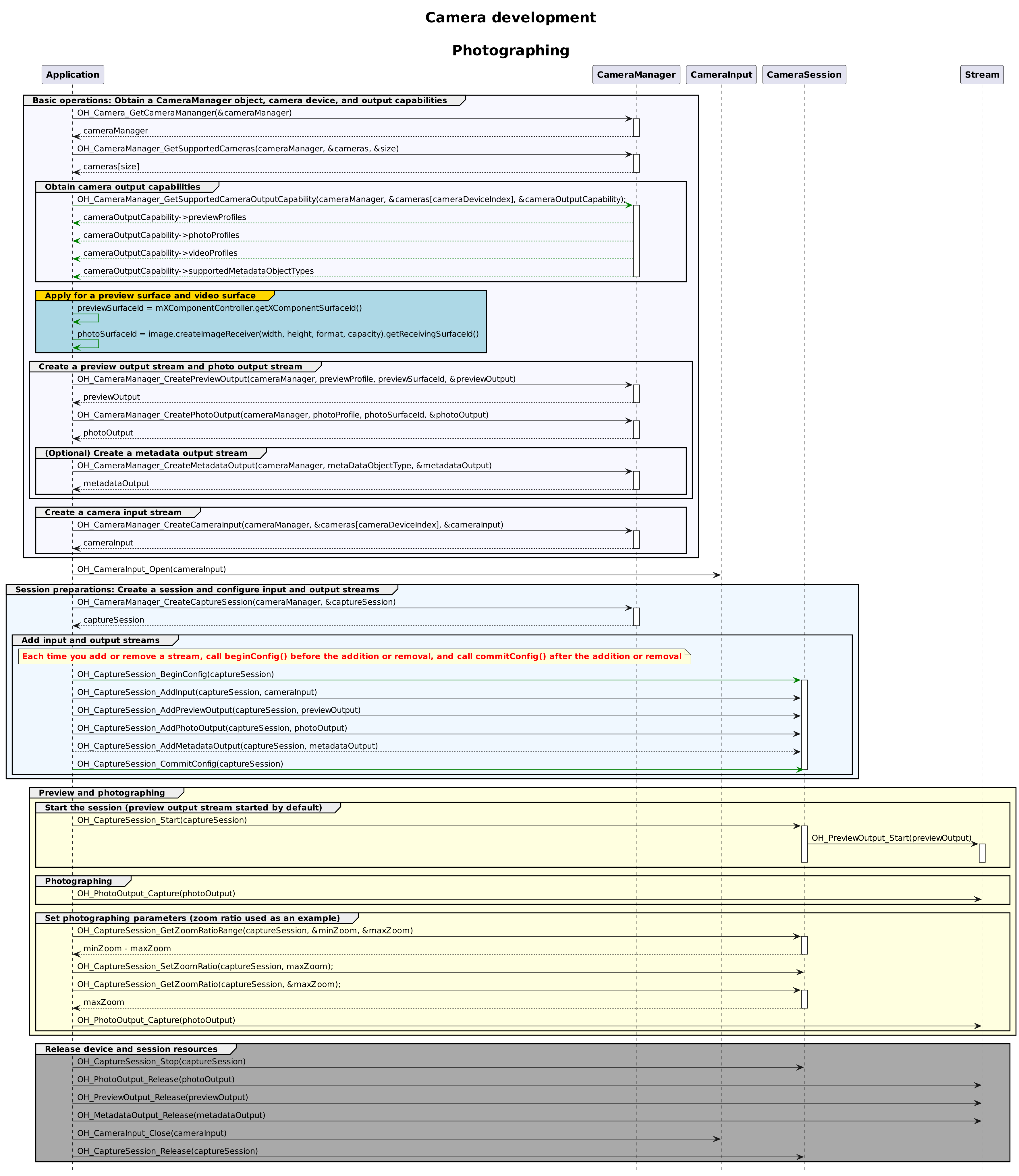
Complete Sample Code
Link the dynamic library in the CMake script.
target_link_libraries(entry PUBLIC
    libace_napi.z.so
    libhilog_ndk.z.so
    libnative_buffer.so
    libohcamera.so
    libohimage.so
    libohfileuri.so
)
Create the header file ndk_camera.h.
#include "ohcamera/camera.h"
#include "ohcamera/camera_input.h"
#include "ohcamera/capture_session.h"
#include "ohcamera/photo_output.h"
#include "ohcamera/preview_output.h"
#include "ohcamera/video_output.h"
#include "ohcamera/camera_manager.h"

class NDKCamera {
public:
    ~NDKCamera();
    NDKCamera(char* previewId);
    Camera_ErrorCode RegisterBufferCb(void* cb);
};
Import the NDK APIs on the C++ side, and perform photo capture based on the surface ID passed in.
#include "hilog/log.h"
#include "ndk_camera.h"

void CaptureSessionOnFocusStateChange(Camera_CaptureSession* session, Camera_FocusState focusState)
{
    OH_LOG_INFO(LOG_APP, "CaptureSessionOnFocusStateChange");
}

void CaptureSessionOnError(Camera_CaptureSession* session, Camera_ErrorCode errorCode)
{
    OH_LOG_INFO(LOG_APP, "CaptureSessionOnError = %{public}d", errorCode);
}

CaptureSession_Callbacks* GetCaptureSessionRegister(void)
{
    static CaptureSession_Callbacks captureSessionCallbacks = {
        .onFocusStateChange = CaptureSessionOnFocusStateChange,
        .onError = CaptureSessionOnError
    };
    return &captureSessionCallbacks;
}

void PreviewOutputOnFrameStart(Camera_PreviewOutput* previewOutput)
{
    OH_LOG_INFO(LOG_APP, "PreviewOutputOnFrameStart");
}

void PreviewOutputOnFrameEnd(Camera_PreviewOutput* previewOutput, int32_t frameCount)
{
    OH_LOG_INFO(LOG_APP, "PreviewOutputOnFrameEnd = %{public}d", frameCount);
}

void PreviewOutputOnError(Camera_PreviewOutput* previewOutput, Camera_ErrorCode errorCode)
{
    OH_LOG_INFO(LOG_APP, "PreviewOutputOnError = %{public}d", errorCode);
}

PreviewOutput_Callbacks* GetPreviewOutputListener(void)
{
    static PreviewOutput_Callbacks previewOutputListener = {
        .onFrameStart = PreviewOutputOnFrameStart,
        .onFrameEnd = PreviewOutputOnFrameEnd,
        .onError = PreviewOutputOnError
    };
    return &previewOutputListener;
}

void OnCameraInputError(const Camera_Input* cameraInput, Camera_ErrorCode errorCode)
{
    OH_LOG_INFO(LOG_APP, "OnCameraInput errorCode = %{public}d", errorCode);
}

CameraInput_Callbacks* GetCameraInputListener(void)
{
    static CameraInput_Callbacks cameraInputCallbacks = {
        .onError = OnCameraInputError
    };
    return &cameraInputCallbacks;
}

void CameraManagerStatusCallback(Camera_Manager* cameraManager, Camera_StatusInfo* status)
{
    OH_LOG_INFO(LOG_APP, "CameraManagerStatusCallback is called");
}

CameraManager_Callbacks* GetCameraManagerListener()
{
    static CameraManager_Callbacks cameraManagerListener = {
        .onCameraStatus = CameraManagerStatusCallback
    };
    return &cameraManagerListener;
}

static void* bufferCb = nullptr;
Camera_ErrorCode NDKCamera::RegisterBufferCb(void* cb) {
    OH_LOG_INFO(LOG_APP, " RegisterBufferCb start");
    if (cb == nullptr) {
        OH_LOG_INFO(LOG_APP, " RegisterBufferCb invalid error");
        return CAMERA_INVALID_ARGUMENT;
    }
    bufferCb = cb;

    return CAMERA_OK;
}
void OnPhotoAvailable(Camera_PhotoOutput* photoOutput, OH_PhotoNative* photo) {
    OH_LOG_INFO(LOG_APP, "OnPhotoAvailable start!");
    OH_ImageNative* imageNative;
    Camera_ErrorCode errCode = OH_PhotoNative_GetMainImage(photo, &imageNative);
    OH_LOG_INFO(LOG_APP, "OnPhotoAvailable errCode:%{public}d imageNative:%{public}p", errCode, imageNative);
    // Read the size attribute of OH_ImageNative.
    Image_Size size;
    Image_ErrorCode imageErr = OH_ImageNative_GetImageSize(imageNative, &size);
    OH_LOG_INFO(LOG_APP, "OnPhotoAvailable imageErr:%{public}d width:%{public}d height:%{public}d", imageErr,
        size.width, size.height);
    // Read the number of elements in the component list of OH_ImageNative.
    size_t componentTypeSize = 0;
    imageErr = OH_ImageNative_GetComponentTypes(imageNative, nullptr, &componentTypeSize);
    OH_LOG_INFO(LOG_APP, "OnPhotoAvailable imageErr:%{public}d componentTypeSize:%{public}zu", imageErr,
        componentTypeSize);
    // Read the component list of OH_ImageNative.
    uint32_t* components = new uint32_t[componentTypeSize];
    imageErr = OH_ImageNative_GetComponentTypes(imageNative, &components, &componentTypeSize);
    OH_LOG_INFO(LOG_APP, "OnPhotoAvailable OH_ImageNative_GetComponentTypes imageErr:%{public}d", imageErr);
    // Read the buffer object corresponding to the first component of OH_ImageNative.
    OH_NativeBuffer* nativeBuffer = nullptr;
    imageErr = OH_ImageNative_GetByteBuffer(imageNative, components[0], &nativeBuffer);
    OH_LOG_INFO(LOG_APP, "OnPhotoAvailable OH_ImageNative_GetByteBuffer imageErr:%{public}d", imageErr);
    // Read the size of the buffer corresponding to the first component of OH_ImageNative.
    size_t nativeBufferSize = 0;
    imageErr = OH_ImageNative_GetBufferSize(imageNative, components[0], &nativeBufferSize);
    OH_LOG_INFO(LOG_APP, "OnPhotoAvailable imageErr:%{public}d nativeBufferSize:%{public}zu", imageErr,
         nativeBufferSize);
    // Read the row stride corresponding to the first component of OH_ImageNative.
    int32_t rowStride = 0;
    imageErr = OH_ImageNative_GetRowStride(imageNative, components[0], &rowStride);
    OH_LOG_INFO(LOG_APP, "OnPhotoAvailable imageErr:%{public}d rowStride:%{public}d", imageErr, rowStride);
    // Read the pixel stride corresponding to the first component of OH_ImageNative.
    int32_t pixelStride = 0;
    imageErr = OH_ImageNative_GetPixelStride(imageNative, components[0], &pixelStride);
    OH_LOG_INFO(LOG_APP, "OnPhotoAvailable imageErr:%{public}d pixelStride:%{public}d", imageErr, pixelStride);
    // Map the ION memory to the process address space.
    void* virAddr = nullptr; // Point to the virtual address of the mapped memory. After unmapping, the pointer is invalid.
    int32_t ret = OH_NativeBuffer_Map(nativeBuffer, &virAddr); // After mapping, the start address of the memory is returned through the parameter virAddr.
    OH_LOG_INFO(LOG_APP, "OnPhotoAvailable OH_NativeBuffer_Map err:%{public}d", ret);
    // Pass the processed buffer to the ArkTS side through the callback for image display or storage (using a security component). For details, see Photo Capture (C/C++).
    if (bufferCb == nullptr) {
        OH_LOG_INFO(LOG_APP, "Current bufferCb invalid error");
        return;
    }
    auto cb = (void (*)(void *, size_t))(bufferCb);
    cb(virAddr, nativeBufferSize);
    // After the processing is complete, unmap and release the buffer.
    ret = OH_NativeBuffer_Unmap(nativeBuffer);
    if (ret != 0) {
        OH_LOG_ERROR(LOG_APP, "OnPhotoAvailable OH_NativeBuffer_Unmap error:%{public}d", ret);
    }
}

NDKCamera::NDKCamera(char* previewId)
{
    Camera_Manager* cameraManager = nullptr;
    Camera_Device* cameras = nullptr;
    Camera_CaptureSession* captureSession = nullptr;
    Camera_OutputCapability* cameraOutputCapability = nullptr;
    const Camera_Profile* previewProfile = nullptr;
    const Camera_Profile* photoProfile = nullptr;
    Camera_PreviewOutput* previewOutput = nullptr;
    Camera_PhotoOutput* photoOutput = nullptr;
    Camera_Input* cameraInput = nullptr;
    uint32_t size = 0;
    uint32_t cameraDeviceIndex = 0;
    char* previewSurfaceId = previewId;
    // Create a CameraManager object.
    Camera_ErrorCode ret = OH_Camera_GetCameraManager(&cameraManager);
    if (cameraManager == nullptr || ret != CAMERA_OK) {
        OH_LOG_ERROR(LOG_APP, "OH_Camera_GetCameraManager failed.");
        return;
    }
    // Listen for camera status changes.
    ret = OH_CameraManager_RegisterCallback(cameraManager, GetCameraManagerListener());
    if (ret != CAMERA_OK) {
        OH_LOG_ERROR(LOG_APP, "OH_CameraManager_RegisterCallback failed.");
    }

    // Obtain the camera list.
    ret = OH_CameraManager_GetSupportedCameras(cameraManager, &cameras, &size);
    if (cameras == nullptr || size <= 0 || ret != CAMERA_OK) {
        OH_LOG_ERROR(LOG_APP, "OH_CameraManager_GetSupportedCameras failed.");
        return;
    }

    if (size < cameraDeviceIndex + 1) {
        OH_LOG_ERROR(LOG_APP, "cameraDeviceIndex is invalid.");
        return;
    }

    // Create a camera input stream.
    ret = OH_CameraManager_CreateCameraInput(cameraManager, &cameras[cameraDeviceIndex], &cameraInput);
    if (cameraInput == nullptr || ret != CAMERA_OK) {
        OH_LOG_ERROR(LOG_APP, "OH_CameraManager_CreateCameraInput failed.");
        return;
    }

    // Listen for camera input errors.
    ret = OH_CameraInput_RegisterCallback(cameraInput, GetCameraInputListener());
    if (ret != CAMERA_OK) {
        OH_LOG_ERROR(LOG_APP, "OH_CameraInput_RegisterCallback failed.");
        return;
    }

    // Open the camera.
    ret = OH_CameraInput_Open(cameraInput);
    if (ret != CAMERA_OK) {
        OH_LOG_ERROR(LOG_APP, "OH_CameraInput_Open failed.");
        return;
    }

    // Obtain the output stream capability supported by the camera.
    ret = OH_CameraManager_GetSupportedCameraOutputCapability(cameraManager, &cameras[cameraDeviceIndex],
                                                              &cameraOutputCapability);
    if (cameraOutputCapability == nullptr || ret != CAMERA_OK) {
        OH_LOG_ERROR(LOG_APP, "OH_CameraManager_GetSupportedCameraOutputCapability failed.");
        return;
    }

    if (cameraOutputCapability->previewProfiles == nullptr) {
        OH_LOG_ERROR(LOG_APP, "previewProfiles == null");
        return;
    }
    // Select an appropriate preview resolution from previewProfiles of cameraOutputCapability.
    previewProfile = cameraOutputCapability->previewProfiles[0];

    if (cameraOutputCapability->photoProfiles == nullptr) {
        OH_LOG_ERROR(LOG_APP, "photoProfiles == null");
        return;
    }
    // Select an appropriate photo resolution from photoProfiles of cameraOutputCapability.
    photoProfile = cameraOutputCapability->photoProfiles[0];

    // Create the preview output stream. The previewSurfaceId parameter refers to the XComponent component mentioned above, and the preview stream is the surface provided by the XComponent component.
    ret = OH_CameraManager_CreatePreviewOutput(cameraManager, previewProfile, previewSurfaceId, &previewOutput);
    if (previewProfile == nullptr || previewOutput == nullptr || ret != CAMERA_OK) {
        OH_LOG_ERROR(LOG_APP, "OH_CameraManager_CreatePreviewOutput failed.");
        return;
    }

    // Listen for preview output errors.
    ret = OH_PreviewOutput_RegisterCallback(previewOutput, GetPreviewOutputListener());
    if (ret != CAMERA_OK) {
        OH_LOG_ERROR(LOG_APP, "OH_PreviewOutput_RegisterCallback failed.");
    }

    // Create a photo output stream.
    ret = OH_CameraManager_CreatePhotoOutputWithoutSurface(cameraManager, photoProfile, &photoOutput);

    // Listen for one-shot photo capture callbacks.
    ret = OH_PhotoOutput_RegisterPhotoAvailableCallback(photoOutput, OnPhotoAvailable);

    // Create the session.
    ret = OH_CameraManager_CreateCaptureSession(cameraManager, &captureSession);
    if (captureSession == nullptr || ret != CAMERA_OK) {
        OH_LOG_ERROR(LOG_APP, "OH_CameraManager_CreateCaptureSession failed.");
        return;
    }

    // Listen for session errors.
    ret = OH_CaptureSession_RegisterCallback(captureSession, GetCaptureSessionRegister());
    if (ret != CAMERA_OK) {
        OH_LOG_ERROR(LOG_APP, "OH_CaptureSession_RegisterCallback failed.");
    }

    // Start configuration for the session.
    ret = OH_CaptureSession_BeginConfig(captureSession);
    if (ret != CAMERA_OK) {
        OH_LOG_ERROR(LOG_APP, "OH_CaptureSession_BeginConfig failed.");
        return;
    }

    // Add the camera input stream to the session.
    ret = OH_CaptureSession_AddInput(captureSession, cameraInput);
    if (ret != CAMERA_OK) {
        OH_LOG_ERROR(LOG_APP, "OH_CaptureSession_AddInput failed.");
        return;
    }

    // Add the preview output stream to the session.
    ret = OH_CaptureSession_AddPreviewOutput(captureSession, previewOutput);
    if (ret != CAMERA_OK) {
        OH_LOG_ERROR(LOG_APP, "OH_CaptureSession_AddPreviewOutput failed.");
        return;
    }

    // Add the photo output stream to the session.
    ret = OH_CaptureSession_AddPhotoOutput(captureSession, photoOutput);
    if (ret != CAMERA_OK) {
        OH_LOG_ERROR(LOG_APP, "OH_CaptureSession_AddPhotoOutput failed.");
        return;
    }

    // Commit the session configuration.
    ret = OH_CaptureSession_CommitConfig(captureSession);
    if (ret != CAMERA_OK) {
        OH_LOG_ERROR(LOG_APP, "OH_CaptureSession_CommitConfig failed.");
        return;
    }

    // Start the session.
    ret = OH_CaptureSession_Start(captureSession);
    if (ret != CAMERA_OK) {
        OH_LOG_ERROR(LOG_APP, "OH_CaptureSession_Start failed.");
        return;
    }

    // Check whether the camera has flash.
    Camera_FlashMode flashMode = FLASH_MODE_AUTO;
    bool hasFlash = false;
    ret = OH_CaptureSession_HasFlash(captureSession, &hasFlash);
    if (ret != CAMERA_OK) {
        OH_LOG_ERROR(LOG_APP, "OH_CaptureSession_HasFlash failed.");
    }
    if (hasFlash) {
        OH_LOG_INFO(LOG_APP, "hasFlash success");
    } else {
        OH_LOG_ERROR(LOG_APP, "hasFlash fail");
    }

    // Check whether a flash mode is supported.
    bool isSupported = false;
    ret = OH_CaptureSession_IsFlashModeSupported(captureSession, flashMode, &isSupported);
    if (ret != CAMERA_OK) {
        OH_LOG_ERROR(LOG_APP, "OH_CaptureSession_IsFlashModeSupported failed.");
    }
    if (isSupported) {
        OH_LOG_INFO(LOG_APP, "isFlashModeSupported success");

        // Set the flash mode.
        ret = OH_CaptureSession_SetFlashMode(captureSession, flashMode);
        if (ret == CAMERA_OK) {
            OH_LOG_INFO(LOG_APP, "OH_CaptureSession_SetFlashMode success.");
        } else {
            OH_LOG_ERROR(LOG_APP, "OH_CaptureSession_SetFlashMode failed. ret : %{public}d ", ret);
        }

        // Obtain the flash mode in use.
        ret = OH_CaptureSession_GetFlashMode(captureSession, &flashMode);
        if (ret == CAMERA_OK) {
            OH_LOG_INFO(LOG_APP, "OH_CaptureSession_GetFlashMode success. flashMode: %{public}d ", flashMode);
        } else {
            OH_LOG_ERROR(LOG_APP, "OH_CaptureSession_GetFlashMode failed. ret : %{public}d ", ret);
        }
    } else {
        OH_LOG_ERROR(LOG_APP, "isFlashModeSupported fail");
    }

    // Check whether the continuous auto focus is supported.
    Camera_FocusMode focusMode = FOCUS_MODE_CONTINUOUS_AUTO;
    bool isFocusModeSupported = false;
    ret = OH_CaptureSession_IsFocusModeSupported(captureSession, focusMode, &isFocusModeSupported);
    if (ret != CAMERA_OK) {
        OH_LOG_ERROR(LOG_APP, "OH_CaptureSession_IsFocusModeSupported failed.");
    }
    if (isFocusModeSupported) {
        OH_LOG_INFO(LOG_APP, "isFocusModeSupported success");
        ret = OH_CaptureSession_SetFocusMode(captureSession, focusMode);
        if (ret != CAMERA_OK) {
            OH_LOG_ERROR(LOG_APP, "OH_CaptureSession_SetFocusMode failed. ret : %{public}d ", ret);
        }
        ret = OH_CaptureSession_GetFocusMode(captureSession, &focusMode);
        if (ret == CAMERA_OK) {
            OH_LOG_INFO(LOG_APP, "OH_CaptureSession_GetFocusMode success. focusMode%{public}d ", focusMode);
        } else {
            OH_LOG_ERROR(LOG_APP, "OH_CaptureSession_GetFocusMode failed. ret : %{public}d ", ret);
        }
    } else {
        OH_LOG_ERROR(LOG_APP, "isFocusModeSupported fail");
    }

    // Obtain the zoom ratio range supported by the camera.
    float minZoom;
    float maxZoom;
    ret = OH_CaptureSession_GetZoomRatioRange(captureSession, &minZoom, &maxZoom);
    if (ret != CAMERA_OK) {
        OH_LOG_ERROR(LOG_APP, "OH_CaptureSession_GetZoomRatioRange failed.");
    } else {
        OH_LOG_INFO(LOG_APP, "OH_CaptureSession_GetZoomRatioRange success. minZoom: %{public}f, maxZoom:%{public}f",
            minZoom, maxZoom);
    }

    // Set a zoom ratio.
    ret = OH_CaptureSession_SetZoomRatio(captureSession, maxZoom);
    if (ret == CAMERA_OK) {
        OH_LOG_INFO(LOG_APP, "OH_CaptureSession_SetZoomRatio success.");
    } else {
        OH_LOG_ERROR(LOG_APP, "OH_CaptureSession_SetZoomRatio failed. ret : %{public}d ", ret);
    }

    // Obtain the zoom ratio of the camera.
    ret = OH_CaptureSession_GetZoomRatio(captureSession, &maxZoom);
    if (ret == CAMERA_OK) {
        OH_LOG_INFO(LOG_APP, "OH_CaptureSession_GetZoomRatio success. zoom: %{public}f ", maxZoom);
    } else {
        OH_LOG_ERROR(LOG_APP, "OH_CaptureSession_GetZoomRatio failed. ret : %{public}d ", ret);
    }

    // Take photos without photo capture settings.
    ret = OH_PhotoOutput_Capture(photoOutput);
    if (ret == CAMERA_OK) {
        OH_LOG_INFO(LOG_APP, "OH_PhotoOutput_Capture success ");
    } else {
        OH_LOG_ERROR(LOG_APP, "OH_PhotoOutput_Capture failed. ret : %{public}d ", ret);
    }

    // Stop the session.
    ret = OH_CaptureSession_Stop(captureSession);
    if (ret == CAMERA_OK) {
        OH_LOG_INFO(LOG_APP, "OH_CaptureSession_Stop success ");
    } else {
        OH_LOG_ERROR(LOG_APP, "OH_CaptureSession_Stop failed. ret : %{public}d ", ret);
    }

    // Release the camera input stream.
    ret = OH_CameraInput_Close(cameraInput);
    if (ret == CAMERA_OK) {
        OH_LOG_INFO(LOG_APP, "OH_CameraInput_Close success ");
    } else {
        OH_LOG_ERROR(LOG_APP, "OH_CameraInput_Close failed. ret : %{public}d ", ret);
    }

    // Release the preview output stream.
    ret = OH_PreviewOutput_Release(previewOutput);
    if (ret == CAMERA_OK) {
        OH_LOG_INFO(LOG_APP, "OH_PreviewOutput_Release success ");
    } else {
        OH_LOG_ERROR(LOG_APP, "OH_PreviewOutput_Release failed. ret : %{public}d ", ret);
    }

    // Release the photo output stream.
    ret = OH_PhotoOutput_Release(photoOutput);
    if (ret == CAMERA_OK) {
      OH_LOG_INFO(LOG_APP, "OH_PhotoOutput_Release success ");
    } else {
      OH_LOG_ERROR(LOG_APP, "OH_PhotoOutput_Release failed. ret : %{public}d ", ret);
    }

    // Release the session.
    ret = OH_CaptureSession_Release(captureSession);
    if (ret == CAMERA_OK) {
        OH_LOG_INFO(LOG_APP, "OH_CaptureSession_Release success ");
    } else {
        OH_LOG_ERROR(LOG_APP, "OH_CaptureSession_Release failed. ret : %{public}d ", ret);
    }

    // Release the resources.
    ret = OH_CameraManager_DeleteSupportedCameras(cameraManager, cameras, size);
    if (ret != CAMERA_OK) {
        OH_LOG_ERROR(LOG_APP, "Delete Cameras failed.");
    } else {
        OH_LOG_ERROR(LOG_APP, "OH_CameraManager_DeleteSupportedCameras. ok");
    }
    ret = OH_CameraManager_DeleteSupportedCameraOutputCapability(cameraManager, cameraOutputCapability);
    if (ret != CAMERA_OK) {
        OH_LOG_ERROR(LOG_APP, "Delete Cameras failed.");
    } else {
        OH_LOG_ERROR(LOG_APP, "OH_CameraManager_DeleteSupportedCameraOutputCapability. ok");
    }
    ret = OH_Camera_DeleteCameraManager(cameraManager);
    if (ret != CAMERA_OK) {
        OH_LOG_ERROR(LOG_APP, "Delete Cameras failed.");
    } else {
        OH_LOG_ERROR(LOG_APP, "OH_Camera_DeleteCameraManager. ok");
    }
}