Purpose
The notification content management rules are formulated to ensure the legitimacy, authenticity, objectivity, consistency, and readability of the content sent through Push Kit, and to provide users with a premium notification experience.
Definition
Push notifications are app messages that appear in the notification panel, on the lock screen, and as banners on home screen.
Push content encompasses all visual and interactive elements displayed within a push notification. This includes, but is not limited to, the message box, text (title and body), images, app icon, redirection action, and redirection target landing page.
The following figure shows the elements.
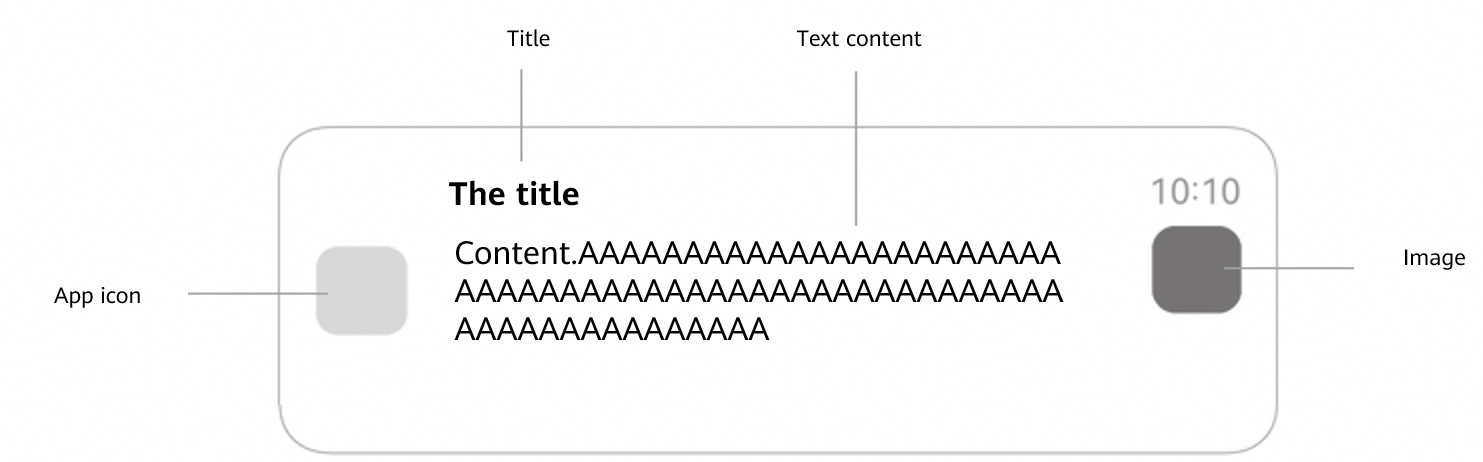
Message box: including the box border, background, and layout.
Text: all text content contained in the notification title and body.
Redirection action: action after a push message is tapped, for example, launching an app.
Landing page: destination page to be redirected to when a push message is tapped.
Notification Content Principles
Push notification content must comply with the principles of consistency, authenticity, objectivity, readability, and compliance, and provide valuable information to users, thereby increasing user engagement rates and enhancing user satisfaction.
[h2]Consistency
The content of push notifications must relate to the services contained in the app, and elements in the content must be consistent with the app's basic information registered with AppGallery. The icons, brand names, or product names of other apps or brands cannot be included. This rule does not apply to push content such as news, which may include icons and names of other apps for business purposes.
The content on the landing page must be consistent with the content described in the push message, which should not induce or force users to tap the push message. Possible inconsistencies include but are not limited to:
- Title-content mismatch: For example, the title is unclear or cannot accurately reflect the landing page content, or elements within the notification are not logically connected, which can be misleading.
- Deceptive notification: The content on the landing page is unrelated to the content of the notification. For example, misrepresent an app push message as an app system notification, communication message, or key notification, such as a friend's interaction, a missed call, or a new message (including a chat message), while in reality the landing page simply opens the app or directs users to irrelevant content.
- Deceptive benefits: The push notification promotes benefits that do not match those provided on the landing page. All forms of benefits and discounts shown in push notifications must be directly credited to the user's account upon tapping the notification for redirection, and must be marked with a clear indication of benefit. It is prohibited to push benefits that require additional user actions without clearly indicating the acquisition method, or to use misleading or deceptive means to promote such benefits.
The landing page content should not be changed.
[h2]Authenticity and Objectivity
The content pushed must be authentic and objective. False, deceptive, or exaggerated content is prohibited.
Push notifications must not mislead users by impersonating Huawei or other apps, imitating message boxes with special functions, or using misleading background images (such as imitating red envelopes, envelopes, or missed calls).
An app should not push false or untrue content, such as:
- Content that contradicts scientific principles or common knowledge.
- Content that does not align with the facts.
- Fabricated information and rumors.
An app should not push clickbait content, such as:
- Gross exaggeration: deliberately exaggerating feelings, scope, results, or degrees to create a sensational effect.
- Unnecessary suspense: deliberately building suspense without providing a resolution.
- Coercive content: using provocative or intimidating expressions in titles to compel user engagement.
An app should not push outdated social news, such as:
- News content that is pushed well after the event has occurred (outdated news content).
- Outdated information about a news event after new developments have occurred.
- Content containing explicit time qualifiers that conflict with the actual time when the notification is sent.
An app should not push content that involves deceptive redirection, such as:
- Button-shaped images or symbols that cannot implement their described functions when tapped.
- Intentionally obscuring, blurring, making overly transparent, disguising, or masking functional redirections, or implementing functions inconsistent with the redirection descriptions. Examples are forced downloads upon notification taps, delayed automatic downloads on landing pages, and scenarios where any tap on the landing page triggers unintended downloads.
[h2]Readability
An app should not push test messages or invalid messages to users.
The pushed text should be presented as complete sentences or phrases with clear meaning, and be free from grammatical errors, to avoid user misunderstanding. For example, avoid splitting a complete sentence across the title and body, or sending batch messages with incomplete or ambiguous content.
The push content should use words and phrases correctly and avoid randomly using idioms, Chinese acronyms, non-standard English abbreviations, or non-common Chinese words, phrases, and idioms.
The push content should use Chinese characters correctly and avoid using pinyin alone, typos, obsolete variant characters, or simplified characters that have been abolished by China. Quotation marks should be used to indicate a character when used homophonically.
The push content should avoid mixing or misusing full-width and half-width punctuation marks.
Images should be clear, legible, and free from defects such as pixelation, distortions, pixel artifacts, or blurriness that may compromise user experience.
A push notification should not be used as a billboard. If the first screen of a landing page that the push notification links to contains ad content, the ad content should not occupy more than half of the user's device screen.
Timely notification clearance principles:
Upon receiving a notification (A) from a specific app, if the user enters the app via the home screen icon or a different notification (B) and checks the message content of notification A, your app needs to clear all the viewed notifications in a timely manner.
Scenario 1: If a user receives N instant messages from a friend and taps any notification to enter the app and check all the messages, the app needs to clear all N notifications associated with that friend.
Scenario 2: When a user views a message associated with a specific page within an app, notifications corresponding to that page must be cleared in a timely manner.
[h2]Compliance
Do not use the following content in a push notification:
Content that compromises national security, divulges state secrets, subverts state power, harms national unity, or impairs the state honor and interests.
Content that uses the national flag, national anthem, national emblem, military flag, military song, military emblem, or the name or image of a state organ or its staff member of the People's Republic of China, either in an explicit or disguised form.
Content that involves the use of images of the Communist Party of China and national leaders (including cartoon images) in marketing materials, including those of current, former, and deceased party or national leaders.
Content that distorts, demonizes, blasphemes, or denies the deeds and spirits of heroic martyrs, or insults, slanders, or otherwise infringes upon the names, portraits, reputations, or honors of heroic martyrs.
Content that undermines social stability, harms the public interest, spreads rumors, disrupts economic and social order, promotes terrorism or extremism, or incites terrorist or extremist activities.
Content that endangers personal safety or property, discloses personal privacy, insults or defames others, or infringes upon others' reputation, privacy, or other lawful rights.
Content that disturbs the public order or good customs and public morals, or departs from a good social climate.
Content that uses exaggerated headlines, headlines that seriously mismatch the content, or vulgar and provocative clickbait headlines.
Content that spreads or describes obscenity, pornography, gambling, violence, murder, or terror, or abets crimes.
- Content that directly shows or depicts human sex organs or covers only a small part of human bodies.
- Content that depicts sexual acts, and sexually suggestive or insulting content in an explicit or implicit manner.
- Content that describes sexual acts, processes, or methods using sexually suggestive or provocative language.
- Content that includes any material that invades an individual's privacy, such as up-skirting, secretly taking photos, or revealing private parts.
- Content that contains comics, animations, websites, images, and links relevant to pornography, or pornographic text, audio, and video content prohibited by relevant authorities, including deleted clips of movies and TV series.
- Content that contains sexual innuendo, sexual provocation, or other material that may be sexually suggestive, or that promotes vulgar, lowbrow, or sensational information.
- Content that publicizes or describes improper dating information such as one-night stand, wife swapping, and sadomasochism.
- Content that depicts blood, horror, or cruelty, or otherwise causes physical or psychological discomfort.
Content that contains ethnic, racial, religious, or gender discrimination, incites ethnic hatred or discrimination, undermines national unity, or incites group or regional discrimination.
Content that disrupts the religious policies of the country or publicizes evil cults or feudal and superstitious ideologies.
Content that impedes the protection of environment, natural resources, or cultural heritages.
Content that contains improper comments on disasters such as natural disasters and major accidents. Content related to sudden events or disasters should avoid sensationalizing gory scenes or dwelling on gruesome details of crimes.
Content that contains the hype of rumors, scandals, misdeeds, entertainment gossip, celebrity gossip, bloody violence, strange stories, vulgar and indecent content, and other elements that contravene the core socialist values.
Content that highlights and publicizes statements from morally questionable artists and individuals involved in negative controversies.
Content that may cause minors to mimic unsafe behaviors, engage in actions that breach social morality, or cultivate undesirable habits.
Content that discloses personal information or data without authorization, including but not limited to: name, age, date of birth, gender, nationality, occupation, employer, education background, family member information, home address and corresponding postal code, and location data.
Content that infringes upon the legitimate rights and interests of third parties, such as trade secrets and copyrights.
Other content prohibited by laws and administrative regulations, as well as that has a negative impact on the online ecosystem.
Rules for pushing news information are as follows:
Tools apps that have not obtained an Internet News Information Service License should not push news information.
Only news information sourced from authorized channels can be pushed. Illegal editing, publishing, or reprinting of news is forbidden.
An app should not push news information that sensationalizes or hypes public opinion hotspots, takes quotes out of context, alters original meanings, or misleads netizens.
Appendix 1 Laws, Regulations, and Standards Governing Pushed Content
Personal Information Protection Law of the People's Republic of China
Cybersecurity Law of the People's Republic of China
Administrative Measures on Internet Information Services
Provisions on Ecological Governance of Network Information Content
Provisions on the Administration of Mobile Internet Applications Information Services
Clean and Sound Network - Special Campaign to Clean Up Mobile App Push Notifications
Appendix 2 Laws and Regulations Governing Advertising and News Push
Marketing content push:
Advertising Law of the People's Republic of China
Interim Measures for the Administration of Internet Advertising
Anti-Unfair Competition Law of the People's Republic of China
News push:
Provisions on the Administration of Internet News Information Services
The management rules described in this section are formulated in accordance with applicable laws and regulations, HUAWEI Developers Service Agreement, Agreement on Use of Huawei APIs, HUAWEI Push Service Agreement, AppGallery Review Guidelines, Atomic Service Review Guidelines, and platform experience requirements.
Huawei assumes no responsibility for the content of third-party websites.