Introduction
libuv is a cross-platform library that implements asynchronous I/O based on event loops. It applies to network programming and file system operations. It is one of the core libraries of Node.js and has been widely used by other software projects.
Supported Capabilities
libuv implements event-driven asynchronous I/O across platforms and
supports standard library interfaces.
Including libuv
To use libuv capabilities, include the following header file:
#include <uv.h>
Add the following dynamic link library to CMakeLists.txt:
libuv.so
Background of Introducing libuv to HarmonyOS
HarmonyOS introduced Node-API of Node.js in its earlier versions to facilitate Node.js developers to extend their JavaScript (JS) APIs with HarmonyOS. It also introduced libuv of Node.js to implement event loops.
[h2]Evolution Trend
To address the scheduling issues caused when the application main thread has an event loop that contains uvloop, we plan to normalize the event loops in the application model to allow only one task queue in the application main loop with task priorities controlled.
You are advised not to use libuv NDK on the main loop of the application obtained by calling napi_get_uv_event_loop. Otherwise, various problems may occur, and a large amount of workload will be brought to future compatibility changes.
If you want to implement interaction with the main thread cyclically, for example, insert a task, use Node-API.
We will continue to provide capabilities of interacting with the main thread and extend JS APIs through Node-API in the future for a long period of time, but shield the event loops in the implementation layer. the main functional APIs of Node-API will be maintained for a long time and provide the same native behavior of Node-API, so that the developers who are familiar with the node.js extension mechanism can easily expand their code to HarmonyOS.
If you are familiar with libuv and can handle memory management and multithreading problems, you can still use libuv to develop your services on HarmonyOS. Unless otherwise required, you do not need to import the libuv library to your application project.
Current Problems and Solutions
According to the existing mechanism, only one event loop can exist in a thread. To ensure proper running of the main event loop of the system application, the main event loop listens for the FD events in the JS environment and executes uv_run only when an FD event is reported. As a result, certain functions that depend on the uvloop event cannot take effect.
Common scenarios and solutions are as follows:
[h2]Scenario 1: The JS main thread throws an asynchronous task to a worker thread for execution and executes the result returned by the JS code.
Example (incorrect)
Call napi_get_uv_event_loop() to obtain the system loop, and use libuv NDK APIs to implement related functions.
ArkTS side:
import { hilog } from '@kit.PerformanceAnalysisKit';
import testNapi from 'libentry.so'

@Entry
@Component
struct Index {
  build() {
    Row() {
      Column() {
        Button("test")
          .width('40%')
          .fontSize('14fp')
          .onClick(() => {
              testNapi.test();
        }).margin(20)
      }.width('100%')
    }.height('100%')
  }
}
Native side:
#include "napi/native_api.h"
#include "uv.h"
#define LOG_DOMAIN 0X0202
#define LOG_TAG "MyTag"
#include <hilog/log.h>

static void execute(uv_work_t* work)
{
    OH_LOG_INFO(LOG_APP, "ohos in execute");
}

static void complete(uv_work_t* work, int status)
{
    OH_LOG_INFO(LOG_APP, "ohos in complete");
    delete work;
}
static napi_value Test(napi_env env, napi_callback_info info)
{
    uv_loop_s* loop = nullptr;
    /* Obtain the uv_loop of the application JS main thread. */
    napi_get_uv_event_loop(env, &loop);
    uv_work_t* work = new uv_work_t;
    int ret = uv_queue_work(loop, work, execute, complete);
    if (ret != 0) {
        OH_LOG_INFO(LOG_APP, "delete work");
        delete work;
    }
    return 0;
}

EXTERN_C_START
static napi_value Init(napi_env env, napi_value exports)
{
    napi_property_descriptor desc[] = {{"test", nullptr, Test, nullptr, nullptr, nullptr, napi_default, nullptr}};
    napi_define_properties(env, exports, sizeof(desc) / sizeof(desc[0]), desc);
    return exports;
}
EXTERN_C_END

static napi_module demoModule = {
    .nm_version = 1,
    .nm_flags = 0,
    .nm_filename = nullptr,
    .nm_register_func = Init,
    .nm_modname = "entry",
    .nm_priv = ((void *)0),
    .reserved = {0},
};

extern "C" __attribute__((constructor)) void RegisterEntryModule(void)
{
    napi_module_register(&demoModule);
}
Add the following code to the index.d.ts file:
export const test:() => number;
Add the following dynamic link library to CMakeLists.txt:
libhilog_ndk.z.so
Example (correct):
Use napi_create_async_work and napi_queue_async_work together.
ArkTS side:
import { hilog } from '@kit.PerformanceAnalysisKit';
import testNapi from 'libentry.so'

@Entry
@Component
struct Index {
  build() {
    Row() {
      Column() {
        Button("test")
          .width('40%')
          .fontSize('14fp')
          .onClick(() => {
              testNapi.test();
        }).margin(20)
      }.width('100%')
    }.height('100%')
  }
}
Native side:
#include "napi/native_api.h"
#include "uv.h"
#define LOG_DOMAIN 0X0202
#define LOG_TAG "MyTag"
#include <hilog/log.h>
uv_loop_t* loop = nullptr;
napi_value jsCb;
int fd = -1;

static napi_value Test(napi_env env, napi_callback_info info)
{
    napi_value work_name;
    napi_async_work work;
    napi_create_string_utf8(env, "ohos", NAPI_AUTO_LENGTH, &work_name);
    /* The fourth parameter specifies the work task of the asynchronous thread, and the fifth parameter is the callback of the main thread. */
    napi_create_async_work(
        env, nullptr, work_name, [](napi_env env, void* data){OH_LOG_INFO(LOG_APP, "ohos in execute"); },
        [](napi_env env, napi_status status, void* data){
            /* The specific implementation is skipped. */
            OH_LOG_INFO(LOG_APP, "ohos in complete");
            napi_delete_async_work(env, (napi_async_work)data);
        },
        nullptr, &work);
    /* Call napi_queue_async_work to trigger an async task. */
    napi_queue_async_work(env, work);
    return 0;
}

EXTERN_C_START
static napi_value Init(napi_env env, napi_value exports)
{
    napi_property_descriptor desc[] = {{"test", nullptr, Test, nullptr, nullptr, nullptr, napi_default, nullptr}};
    napi_define_properties(env, exports, sizeof(desc) / sizeof(desc[0]), desc);
    return exports;
}
EXTERN_C_END

static napi_module demoModule = {
    .nm_version = 1,
    .nm_flags = 0,
    .nm_filename = nullptr,
    .nm_register_func = Init,
    .nm_modname = "entry",
    .nm_priv = ((void *)0),
    .reserved = {0},
};

extern "C" __attribute__((constructor)) void RegisterEntryModule(void)
{
    napi_module_register(&demoModule);
}
Add the following code to the index.d.ts file:
export const test:() => number;
Add the following dynamic link library to CMakeLists.txt:
libhilog_ndk.z.so
[h2]Scenario 2: The libuv API does not work when throwing an FD event to the main loop of the application from the native side.
The main loop of the application receives only FD events, and executes uv_run only after backend_fd in uvloop is triggered. That means uv_run will never be executed if no FD event is triggered when libuv APIs are called in the main loop of the application. As a result, calling libuv APIs does not take effect.
Example (incorrect)
In the following example, calling uv_poll_start in the same way as in native libuv on HarmonyOS does not take effect.
ArkTS side:
import { hilog } from '@kit.PerformanceAnalysisKit';
import testNapi from 'libentry.so'

@Entry
@Component
struct Index {
  build() {
    Row() {
      Column() {
        Button("testClose")
          .width('40%')
          .fontSize('14fp')
          .onClick(() => {
              testNapi.testClose();
        }).margin(20)
      }.width('100%')
    }.height('100%')
  }
}
Native side:
#include "napi/native_api.h"
#include "uv.h"
#define LOG_DOMAIN 0X0202
#define LOG_TAG "MyTag"
#include <hilog/log.h>
#include <thread>
#include <sys/eventfd.h>

uv_loop_t* loop = nullptr;
napi_value jsCb;
int fd = -1;

void poll_handler(uv_poll_t* handle,int status, int events)
{
    OH_LOG_INFO(LOG_APP, "ohos poll print");
}

static napi_value TestClose(napi_env env, napi_callback_info info)
{
    std::thread::id this_id = std::this_thread::get_id();
    OH_LOG_INFO(LOG_APP, "ohos thread id : %{public}ld", this_id);
    size_t argc = 1;
    napi_value workBname;

    napi_create_string_utf8(env, "test", NAPI_AUTO_LENGTH, &workBname);

    napi_get_cb_info(env, info, &argc, &jsCb, nullptr, nullptr);
    // Obtain the event loop.
    napi_get_uv_event_loop(env, &loop);
    // Create an eventfd.
    fd = eventfd(0, 0);
    OH_LOG_INFO(LOG_APP, "fd is %{public}d",fd);
    uv_poll_t* poll_handle = new uv_poll_t;
    // Initialize a poll handle and associate it with eventfd.
    uv_poll_init(loop, poll_handle, fd);
    // Start to listen for the poll event.
    uv_poll_start(poll_handle, UV_READABLE, poll_handler);
    // Create a new thread and write data to eventfd.
    std::thread mythread([](){
        for (int i = 0; i < 8; i++){
            int value = 10;
            int ret = eventfd_write(fd, value);
            if (ret == -1){
                OH_LOG_ERROR(LOG_APP, "write failed!");
                continue;
            }
        }
    });
    mythread.detach();
    return 0;
}

EXTERN_C_START
static napi_value Init(napi_env env, napi_value exports)
{
    napi_property_descriptor desc[] = {{"testClose", nullptr, TestClose, nullptr, nullptr, nullptr, napi_default, nullptr}};
    napi_define_properties(env, exports, sizeof(desc) / sizeof(desc[0]), desc);
    return exports;
}
EXTERN_C_END

static napi_module demoModule = {
    .nm_version = 1,
    .nm_flags = 0,
    .nm_filename = nullptr,
    .nm_register_func = Init,
    .nm_modname = "entry",
    .nm_priv = ((void *)0),
    .reserved = {0},
};

extern "C" __attribute__((constructor)) void RegisterEntryModule(void)
{
    napi_module_register(&demoModule);
}
Add the following code to index.d.ts:
export const testClose:() => number;
Add the following dynamic link library to CMakeLists.txt:
libhilog_ndk.z.so
The process is as follows:
- Call napi_get_uv_event_loop to obtain uvloop of the application main thread.
- Create an eventfd instance.
- Initialize uv_poll_t, and start the handle for it to take effect. Invoke the poll_handler callback when the eventfd instance is readable.
- Create a thread and write data to the eventfd instance.
After the preceding code is executed, poll_handler has no output. This is because the application main thread executes uv_run based on the FD rather than looping in UV_RUN_DEFAULT mode. Although event_handler listens for backend_fd in uvloop, the FD is not added to backend_fd through epoll_ctl when uv_poll_start is executed. The epoll_ctl function is executed only when uv__io_poll in uv_run is executed the next time. Therefore, if no backend_fd event is triggered in the application process, the libuv APIs may not work as expected.
Workaround
In the current system version, do not use napi_get_uv_event_loop to obtain uvloop of the application main thread to develop service logic. If libuv must be used to implement service functions, after uv_xxx_start is called, use uv_async_send to trigger the main thread of the application to execute uv_run. In this way, uv_xxx_start can be properly executed.
Modify the code as follows:
ArkTS side:
import { hilog } from '@kit.PerformanceAnalysisKit';
import testNapi from 'libentry.so'

@Entry
@Component
struct Index {
  build() {
    Row() {
      Column() {
        Button("testClose")
          .width('40%')
          .fontSize('14fp')
          .onClick(() => {
              testNapi.testClose();
        }).margin(20)
      }.width('100%')
    }.height('100%')
  }
}
Native side:
#include "napi/native_api.h"
#include "uv.h"
#define LOG_DOMAIN 0x0202
#define LOG_TAG "MyTag"
#include <hilog/log.h>
#include <thread>
#include <sys/eventfd.h>

uv_loop_t* loop = nullptr;
napi_value jsCb;
int fd = -1;

void poll_handler(uv_poll_t* handle,int status, int events)
{
    OH_LOG_INFO(LOG_APP, "ohos poll print");
}

static napi_value TestClose(napi_env env, napi_callback_info info)
{
    std::thread::id this_id = std::this_thread::get_id();
    OH_LOG_INFO(LOG_APP, "ohos thread id : %{public}ld", this_id);
    size_t argc = 1;
    napi_value workBName;

    napi_create_string_utf8(env, "test", NAPI_AUTO_LENGTH, &workBName);

    napi_get_cb_info(env, info, &argc, &jsCb, nullptr, nullptr);

    napi_get_uv_event_loop(env, &loop);

    fd = eventfd(0, 0);
    OH_LOG_INFO(LOG_APP, "fd is %{public}d",fd);
    uv_poll_t* poll_handle = new uv_poll_t;
    uv_poll_init(loop, poll_handle, fd);
    uv_poll_start(poll_handle, UV_READABLE, poll_handler);

    // Trigger an FD event to enable the main thread to execute uv_run.
    uv_async_send(&loop->wq_async);

    std::thread mythread([](){
        for (int i = 0; i < 8; i++){
            int value = 10;
            int ret = eventfd_write(fd, value);
            if (ret == -1){
                OH_LOG_ERROR(LOG_APP, "write failed!");
                continue;
            }
        }
    });
    mythread.detach();
    return 0;
}

EXTERN_C_START
static napi_value Init(napi_env env, napi_value exports)
{
    napi_property_descriptor desc[] = {{"testClose", nullptr, TestClose, nullptr, nullptr, nullptr, napi_default, nullptr}};
    napi_define_properties(env, exports, sizeof(desc) / sizeof(desc[0]), desc);
    return exports;
}
EXTERN_C_END

static napi_module demoModule = {
    .nm_version = 1,
    .nm_flags = 0,
    .nm_filename = nullptr,
    .nm_register_func = Init,
    .nm_modname = "entry",
    .nm_priv = ((void *)0),
    .reserved = {0},
};

extern "C" __attribute__((constructor)) void RegisterEntryModule(void)
{
    napi_module_register(&demoModule);
}
Add the following code to index.d.ts:
export const testClose:() => number;
Add the following dynamic link library to CMakeLists.txt:
libhilog_ndk.z.so
Using libuv
Important: In the libuv NDK, all APIs that depend on uv_run cannot take effect in a timely manner in the application main loop of the current system, and may cause frame freezing and dropping. Therefore, it is not recommended to use libuv NDK APIs directly on the JS main thread. For asynchronous task execution and communication with the main thread using thread-safe functions, developers can directly call Node-API APIs to implement the related functions.
[h2]Mappings Between libuv APIs and Node-APIs
Instead of using libuv APIs, you can use the equivalent Node-API provided by HarmonyOS, which includes asynchronous work APIs and thread-safe APIs.
Asynchronous Task APIs
libuv provides the uv_queue_work API to perform a time-consuming operation in an asynchronous thread and return the result to the main thread for processing through a callback.
You can use napi_async_work APIs of Node-API to implement asynchronous operations.
The related Node-API interfaces are as follows:
/**
 * @brief Creates a work object that executes logic asynchronously.
 *
 * @param env Pointer to the current execution environment.
 * @param async_resource (Optional) Resource object used to trace asynchronous operations.
 * @param async_resource_name (Optional) Name of the resource object. The value is a string.
 * @param execute Callback invoked to perform an asynchronous operation in another thread.
 * @param execute Callback to be invoked when the asynchronous operation is complete.
 * @param data Pointer to the customized data to be passed to the execute() and complete() callbacks.
 * @param result Pointer to the asynchronous work object created.
 */
napi_status napi_create_async_work(napi_env env,
                                  napi_value async_resource,
                                  napi_value async_resource_name,
                                  napi_async_execute_callback execute,
                                  napi_async_complete_callback complete,
                                  void* data,
                                  napi_async_work* result);

/**
 * @brief Adds an asynchronous work object to the queue so that it can be scheduled for execution.
 *
 * @param env Pointer to the current execution environment.
 * @param work Pointer to the asynchronous work object to add.
 */
napi_status napi_queue_async_work(napi_env env, napi_async_work work);

/**
 * @brief Deletes an asynchronous work object.
 *
 * @param env Pointer to the current execution environment.
 * @param work Pointer to the asynchronous work object to add.
 */
napi_status napi_delete_async_work(napi_env env, napi_async_work work);
Thread-safe APIs for Cross-Thread Sharing and Invocation
When you want to pass a callback from any child thread to the application main thread for execution, you can use the libuv uv_async_t handle for inter-thread communication, and
the following functions:
- uv_async_init()
- uv_async_send()
The equivalent Node-API interfaces are napi_threadsafe_function APIs.
The related Node-API interfaces are as follows:
/**
 * @brief Creates a thread-safe function, which can be called in multiple threads without causing data contention or other thread-safe issues.
 *
 * @param env Pointer to the Node-API environment. It is used to create and operate JS values.
 * @param func Pointer to the JavaScript function to create.
 * @param async_resource Asynchronous resource, which is usually an object that indicates an asynchronous operation.
 * @param async_resource_name Pointer to the resource name, which is used for logging and debugging.
 * @param max_queue_size An integer specifying the maximum size of a queue. When the queue is full, new calls will be discarded.
 * @param initial_thread_count An unsigned integer indicating the initial number of threads when a thread-safe function is created.
 * @param thread_finalize_data Data to be cleared before all threads are created.
 * @param napi_finalize Callback function thread_finalize_cb, which is called when all threads are complete and is used to clear resources
 * @param context Pointer to the context, which is passed to call_js_func().
 * @param call_js_cb Pointer to the callback to be invoked when the JS function is called.
 * @param result Pointer to the napi_threadsafe_function struct, which will be constructed as the thread-safe function created.
 */
napi_status napi_create_threadsafe_function(napi_env env,
                                            napi_value func,
                                            napi_value async_resource,
                                            napi_value async_resource_name,
                                            size_t max_queue_size,
                                            size_t initial_thread_count,
                                            void* thread_finalize_data,
                                            napi_finalize thread_finalize_cb,
                                            void* context,
                                            napi_threadsafe_function_call_js call_js_cb,
                                            napi_threadsafe_function* result);

/**
 * @brief Acquires a thread-safe function.
 *
 * @param function Pointer to the thread-safe function to release.
 */
napi_status napi_acquire_threadsafe_function(napi_threadsafe_function function);

/**
 * @brief Calls a thread-safe function.
 * @param function Pointer to the thread-safe function to release.
 * @param data Pointer to the user data.
 * @param is_blocking Enumerated value that determines whether the JavaScript function call is blocking or non-blocking.
 */
napi_status napi_call_threadsafe_function(napi_threadsafe_function function,
                                          void* data,
                                          napi_threadsafe_function_call_mode is_blocking);
/**
 * @brief Releases a thread-safe function.
 *
 * @param function Pointer to the thread-safe function to release.
 * @param is_blocking Enumerated value that determines whether the JavaScript function call is blocking or non-blocking.
 */
napi_status napi_release_threadsafe_function(napi_threadsafe_function function,
                                             napi_threadsafe_function_call_mode is_blocking);
If you need to use other libuv APIs to implement service functions, read on to discover basic libuv concepts and common APIs to be used in HarmonyOS, which are helpful to prevent application crashes when using libuv APIs. The following also provides information about the APIs that can be used in the application main thread and those cannot.
[h2]Available APIs
[h2]Constraints for libuv Single Thread
When using libuv in HarmonyOS, observe to the following: The thread for calling uv_run must be the loop thread (the thread that initializes the loop using uv_loop_init), and all non-thread-safe operations of uvloop must be performed on the loop thread. Otherwise, the application may crash. HarmonyOS imposes stricter restrictions on the use of libuv. For non-thread-safe functions, libuv implements the multi-thread check mechanism, which generates warning logs when detecting multi-threading problems. To ensure the check accuracy and prevent incorrect use of uv interfaces, it is recommended that the same thread be used for creating an event loop and executing uv_run. The constraints vary depending on the source of the loop. Specifically, you can create a loop or obtain a loop from env.
Creating a Loop
Developers can initialize a loop by calling uv_loop_init. The lifecycle of the loop is maintained by the developer. (If uv_loop_new is used to create a loop, only a null pointer is returned on failure, whereas uv_loop_init returns an error code when loop initialization fails. For details, see libuv Error Codes, which prompt developers to obtain the cause of the error.) In this case, as described earlier, ensure that uv_run is executed on the same thread as the loop creation/initialization operation, that is, the loop thread. In addition, other non-thread-safe operations, such as timer-related operations, must be performed on the loop thread.
If tasks have to be thrown from other threads to the loop thread, use uv_async_send. Specifically, register a callback when the async handle is initialized, and implement the corresponding operation in the callback. When uv_async_send is called, execute the registered callback on the main thread.
ArkTS side:
import { hilog } from '@kit.PerformanceAnalysisKit';
import testNapi from 'libentry.so'

@Entry
@Component
struct Index {
  build() {
    Row() {
      Column() {
        Button("TestTimerAsync")
          .width('40%')
          .fontSize('14fp')
          .onClick(() => {
              testNapi.testTimerAsync();  // Initialize the async handle.
        }).margin(20)

          Button("TestTimerAsyncSend")
          .width('40%')
          .fontSize('14fp')
          .onClick(() => {
              testNapi.testTimerAsyncSend(); // Call uv_async_send from a child thread to submit the timer task.
        }).margin(20)
      }.width('100%')
    }.height('100%')
  }
}
Native side:
#include <napi/native_api.h>
#include <uv.h>
#define LOG_DOMAIN 0x0202
#define LOG_TAG "MyTag"
#include "hilog/log.h"
#include <thread>

uv_async_t* async = new uv_async_t;
bool cond1 = false;
bool cond2 = false;

// Tips: When using a loop, pay special attention to the uv_stop function. Before calling uv_stop,
// instruct all threads associated with the loop to close their handles. For details, see the implementation of the stop_loop function.
int stop_loop(uv_loop_t* loop)
{
    uv_stop(loop);
    auto const ensure_close = [](uv_handle_t* handle, void*) {
        if (uv_is_closing(handle)) {
            return;
        } else {
            uv_close(handle, nullptr);
        }
    };
    // Iterate through all handles. If a handle is active, call ensure_close on it.
    uv_walk(loop, ensure_close, nullptr);
    // Continue to run uv_run until there is no active handle or request in the loop.
    while(true) {
        if (uv_run(loop, UV_RUN_DEFAULT) == 0) {
            break;
        }
    }

    // Check the loop status.
    if (uv_loop_alive(loop) != 0) {
        return -1;
    }
    return 0;
}

// Create a timer.
void async_cb(uv_async_t* handle) {
    auto loop = handle->loop;
    uv_timer_t* timer = new uv_timer_t;
    uv_timer_init(loop, timer);

    // Close the async handle at appropriate time.
    if (cond2) {
        uv_close((uv_handle_t*)handle, [](uv_handle_t* handle){
            delete (uv_async_t*)handle;
        });
        return;
    }

    uv_timer_start(timer,
        [](uv_timer_t* timer){
            // Do something.
            // Stop the timer at the right time.
            if (cond1) {
                uv_timer_stop(timer);
                uv_close((uv_handle_t*)timer, [](uv_handle_t* handle){
                    delete(uv_timer_t*)handle;
                });
            }
        },
        100, 100);
}

// Initialize the async handle and bind the corresponding callback.
static napi_value TestTimerAsync(napi_env env, napi_callback_info info) {
    std::thread t([](){  // Thread A, loop thread
        uv_loop_t* loop = new uv_loop_t;
        // Create a loop and manage the loop lifecycle.
        uv_loop_init(loop);
        // Initialize an async handle and register a callback.
        uv_async_init(loop, async, async_cb);
        // Start the loop.
        uv_run(loop, UV_RUN_DEFAULT);
        // Close all handles.
        stop_loop(loop);
        // Release the loop.
        uv_loop_close(loop);
        delete loop;
    });
    t.detach();
    return 0;
}

// Call uv_async_send on another thread.
static napi_value TestTimerAsyncSend(napi_env env, napi_callback_info info)
{
    std::thread t1([](){ // Thread B.
        uv_async_send (async); // Call uv_async_send to instruct the loop thread to call timer_cb bound to the async handle.
        uv_sleep(500);
        // Modify cond1 and disable the timer handle.
        cond1 = true;
    });

    std::thread t2([](){ // Thread B.
        uv_sleep(1000);
        // Modify cond2 and disable the async handle.
        cond2 = true;
        uv_async_send(async);
    });

    t1.detach();
    t2.detach();
    return 0;
}

EXTERN_C_START
static napi_value Init(napi_env env, napi_value exports)
{
    napi_property_descriptor desc[] = {
        {"testTimerAsync", nullptr, TestTimerAsync, nullptr, nullptr, nullptr, napi_default, nullptr},
        {"testTimerAsyncSend", nullptr, TestTimerAsyncSend, nullptr, nullptr, nullptr, napi_default, nullptr},
    };
    napi_define_properties(env, exports, sizeof(desc) / sizeof(desc[0]), desc);
    return exports;
}
EXTERN_C_END

static napi_module demoModule = {
    .nm_version = 1,
    .nm_flags = 0,
    .nm_filename = nullptr,
    .nm_register_func = Init,
    .nm_modname = "entry",
    .nm_priv = ((void *)0),
    .reserved = {0},
};

extern "C" __attribute__((constructor)) void RegisterEntryModule(void)
{
    napi_module_register(&demoModule);
}
Add the following code to index.d.ts:
export const testTimerAsync:() => number;
export const testTimerAsyncSend:() => number;
Obtaining a Loop from env
Generally, the loop obtained from env by using napi_get_uv_event_loop is an event loop of a JS main thread created by the system. Therefore, avoid calling non-thread-safe functions on its child threads.
If a non-thread-safe function has to be called on a non-loop thread due to service requirements, use the thread-safe function uv_async_send to submit the task to the loop thread. Specifically, define a handle of the uv_async_t* type. When initializing the handle, add the non-thread-safe function that needs to be called on a child thread in async_cb. Then, call uv_async_send in a non-loop thread, and execute async_cb on the loop thread. For details, see case 2 of "Correct Example" in Handles and Requests in libuv.
[h2]Thread-safe Functions
A large number of asynchronous works are involved in libuv. Improper use of libuv APIs may cause multithreading issues. The following lists the common thread-safe and non-thread-safe functions in libuv. If you call a non-thread-safe function in multi-thread programming, you must add a lock for the function or ensure correct code execution sequence. Otherwise, a crash issue may occur.
Thread-safe functions:
- uv_async_send(): sends a signal to an asynchronous handle. This API can be called in any thread.
- uv_thread_create(): creates a thread and executes the specified function. This API can be called in any thread.
- Lock-related APIs, such as uv_mutex_lock() and uv_mutex_unlock().
Tips: Even if the function like uv_xxx_init is implemented in a thread-safe manner, avoid calling it on multiple threads at the same time. Otherwise, resource contention may occur. The best way is to call the function in an event loop thread.
Note: After uv_async_send is called, the callback is triggered asynchronously. If uv_async_send is called multiple times, libuv only guarantees that the callback is executed at least once. As a result, once uv_async_send is triggered multiple times on the same handle, libuv's handling of the callback may deviate from the developer's expectation. Sending to the same async handle multiple times may also cause other async_cb tasks submitted between any two send operations on the same handle to be lost. On the native side, however, it can be guaranteed that the number of callback executions is consistent with the number of times the developer calls napi_call_threadsafe_function.
Non-thread-safe functions:
- uv_os_unsetenv(): deletes an environment variable.
- uv_os_setenv(): sets an environment variable.
- uv_os_getenv(): obtains an environment variable.
- uv_os_environ(): retrieves all environment variables.
- uv_os_tmpdir(): obtains the temporary directory.
- uv_os_homedir(): obtains the home directory.
[h2]Event Loops in libuv
As a core concept in libuv, an event loop manages all resources of the entire event loop and runs through the lifecycle of the entire event loop. Generally, the thread where uv_run is located is the main thread of the event loop.
Event Loop Running Modes
UV_RUN_DEFAULT: runs the event loop until there are no active handles or requests. This is the default mode.
UV_RUN_ONCE: polls for I/O once. If there is a callback in pending_queue, execute the callback and then skip uv__io_poll. In this mode, there is an event to occur in the loop by default.
UV_RUN_NOWAIT: polls for I/O once but do not block if there are no pending callbacks. In this mode, uv__io_poll is executed once and pending_queue is not executed.
Common APIs
int uv_loop_init(uv_loop_t* loop);
Initializes a loop.
int uv_loop_close(uv_loop_t* loop);
Closes a loop. The operation is successful only after all handles and requests in the loop are closed. Otherwise, UV_EBUSY is returned.
int uv_loop_delete(uv_loop_t* loop);
Releases a loop. This API calls uv_loop_close to release all internal resources associated with the loop and then releases the loop. In HarmonyOS, the assert() function does not take effect. Therefore, the loop is released regardless of whether uv_loop_close successfully clears the loop resources. When using this API, ensure that the resources associated with the loop can be successfully released when the loop thread exits. That is, all the handles and requests associated with the loop must be closed. Otherwise, resource leaks occur. Exercise caution when using this API. You are advised not to use this API unless necessary.
uv_loop_t* uv_default_loop(void);
Creates a process-level loop. In HarmonyOS, libuv loops still exist in the application main loop and other JS worker threads. You are not advised to use this API to create loops and implement service functions.
int uv_run(uv_loop_t* loop, uv_run_mode mode);
Runs an event loop. For details about the running mode, see "Event Loop Running Modes."
int uv_loop_alive(uv_loop_t loop);
Checks whether a loop is active.
void uv_stop(uv_loop_t* loop);
Stops an event loop. The event loop stops only in the next iteration of the loop. If this API is called before an I/O operation, uv__io_poll will be skipped instead of being blocked.
[h2]Handles and Requests in libuv
A handle indicates a persistent object, which is usually mounted to the corresponding handle_queue in a loop. If a handle is active, uv_run will process the callback in the handle each time.
A request indicates a temporary request. A request triggers only one callback.
The commonly used handles and requests in HarmonyOS include the following:
/* Handle types. */
typedef struct uv_handle_s uv_handle_t;
typedef struct uv_timer_s uv_timer_t;
typedef struct uv_async_s uv_async_t;
typedef struct uv_signal_s uv_signal_t;

/* Request types. */
typedef struct uv_req_s uv_req_t;
typedef struct uv_work_s uv_work_t;
typedef struct uv_fs_s uv_fs_t;
Note: In handles, uv_xxx_t inherits from uv_handle_t. In requests, uv_work_t inherits from uv_req_t.
It is critical to understand the handles in libuv and manage its lifecycle. Observe the following when using a handle:
- Perform the handle initialization in the event loop thread.
- If the handle needs to be initialized in a worker thread due to service requirements, use an atomic variable to check whether the initialization is complete before the handle is used.
- For the handle that is no longer used, call uv_close to remove it from the loop.
Note that uv_close is used to close a handle asynchronously. Its prototype is as follows:
void uv_close(uv_handle_t* handle, uv_close_cb close_cb)
Where: - handle: pointer to the handle to close.
- close_cb: function used to process the handle. This function is used to perform operations such as memory management.
After uv_close is called, the handle to be closed is added to the closing_handles queue in the loop, and waits for the loop thread to run uv__run_closing_handles. Finally, the close_cb callback is executed in the next iteration of the loop. Therefore, operations such as memory release should be performed in close_cb. Improper use of the close API that is executed asynchronously may cause multithreading issues. You need to ensure correct timing of uv_close and ensure that all the handles are closed before close_cb is executed.
Tips: The following rule of thumb in the official libuv documentation needs to be observed. If a handle of type uv_foo_t has a uv_foo_start() function, then it is active from the moment that function is called. Likewise, uv_foo_stop() deactivates the handle again.

-
Call uv_close before all handles are closed, and all memory operations must be performed in close_cb of uv_close.
-
All handle operations cannot be called on non-loop threads by obtaining the loop of other threads.
When asynchronous tasks are submitted, the libuv requests that are dynamically acquired must be released in the complete() callback executed on the loop thread. The following uses uv_work_t as an example.
uv_work_t* work = new uv_work_t;
uv_queue_work(loop, work, [](uv_work_t* req) {
    // Asynchronous operation
}, [](uv_work_t* req, int status) {
    // Callback
    delete req;
});
[h2]Using libuv Timers
Observe the following when using the libuv timers:
- Do not use libuv APIs (uv_timer_start, uv_timer_stop, and uv_timer_again) in multiple threads to operate the timer heap of the same loop simultaneously. Otherwise, the application may crash. To use libuv APIs to operate timers, perform the operations on the thread associated with the current env's loop.
- To throw a timer to a thread, use uv_async_send.
Incorrect Example
In the following example, operations on the timer heap of the same loop are performed in multiple threads at the same time, which poses a high crash rate.
ArkTS side:
import { hilog } from '@kit.PerformanceAnalysisKit';
import testNapi from 'libentry.so'

function waitforRunner(): number {
    "use concurrent"
    hilog.info(0xff, "testTag", "executed");
    return 0;
}

@Entry
@Component
struct Index {
  build() {
    Row() {
      Column() {
        Button("TimerTest")
          .width('40%')
          .fontSize('14fp')
          .onClick(() => {
            let i: number = 20;
            while (i--) {
              setTimeout(waitforRunner, 200);
              testNapi.testTimer();
          }
        }).margin(20)
      }.width('100%')
    }.height('100%')
  }
}
Native C++:
#include <napi/native_api.h>
#include <uv.h>
#define LOG_DOMAIN 0x0202
#define LOG_TAG "MyTag"
#include "hilog/log.h"
#include <thread>
#include <unistd.h>

static napi_value TestTimer(napi_env env, napi_callback_info info)
{
    uv_loop_t* loop = nullptr;
    uv_timer_t* timer = new uv_timer_t;

    napi_get_uv_event_loop(env, &loop);
    uv_timer_init(loop, timer);
    std::thread t1([&loop, &timer](){
        uv_timer_start(timer, [](uv_timer_t* timer){
            uv_timer_stop(timer);
        }, 1000, 0);
    });

    t1.detach();
    return 0;
}

EXTERN_C_START
static napi_value Init(napi_env env, napi_value exports)
{
    napi_property_descriptor desc[] = {
        {"testTimer", nullptr, TestTimer, nullptr, nullptr, nullptr, napi_default, nullptr},
    };
    napi_define_properties(env, exports, sizeof(desc) / sizeof(desc[0]), desc);
    return exports;
}
EXTERN_C_END

static napi_module demoModule = {
    .nm_version = 1,
    .nm_flags = 0,
    .nm_filename = nullptr,
    .nm_register_func = Init,
    .nm_modname = "entry",
    .nm_priv = ((void *)0),
    .reserved = {0},
};

extern "C" __attribute__((constructor)) void RegisterEntryModule(void)
{
    napi_module_register(&demoModule);
}
Add the following code to index.d.ts:
export const testTimer:() => number;
Correct Example
Case 1: Ensure that timer-related operations are performed on the JS main thread. Modify the TestTimer() function used in the previous example as follows:
static napi_value TestTimer(napi_env env, napi_callback_info info)
{
    uv_loop_t* loop = nullptr;
    uv_timer_t* timer = new uv_timer_t;

    napi_get_uv_event_loop(env, &loop);
    uv_timer_init(loop, timer);
    uv_timer_start(timer, [](uv_timer_t* timer){
        uv_timer_stop(timer);
    }, 1000, 0);

    return 0;
}
Case 2: To throw a timer to a child thread, use the thread-safe function uv_async_send.
ArkTS side:
import { hilog } from '@kit.PerformanceAnalysisKit';
import testNapi from 'libentry.so'

@Entry
@Component
struct Index {
  build() {
    Row() {
      Column() {
        Button("TestTimerAsync")
          .width('40%')
          .fontSize('14fp')
          .onClick(() => {
              testNapi.testTimerAsync();  // Initialize the async handle.
        }).margin(20)

          Button("TestTimerAsyncSend")
          .width('40%')
          .fontSize('14fp')
          .onClick(() => {
              testNapi.testTimerAsyncSend(); // Call uv_async_send from a child thread to submit the timer task.
        }).margin(20)
      }.width('100%')
    }.height('100%')
  }
}
Native side:
#include <napi/native_api.h>
#include <uv.h>
#define LOG_DOMAIN 0x0202
#define LOG_TAG "MyTag"
#include "hilog/log.h"
#include <thread>
#include <unistd.h>
uv_async_t* async = new uv_async_t;

// Create a timer.
void async_cb(uv_async_t* handle)
{
    auto loop = handle->loop;
    uv_timer_t* timer = new uv_timer_t;
    uv_timer_init(loop, timer);

    uv_timer_start(timer, [](uv_timer_t* timer){
        uv_timer_stop(timer);
    }, 1000, 0);
}

// Initialize the async handle and bind the corresponding callback.
static napi_value TestTimerAsync(napi_env env, napi_callback_info info)
{
    uv_loop_t* loop = nullptr;
    napi_get_uv_event_loop(env, &loop);
    uv_async_init(loop, async, async_cb);
    return 0;
}

static napi_value TestTimerAsyncSend(napi_env env, napi_callback_info info)
{
    std::thread t([](){
        uv_async_send (async); // Call uv_async_send in a child thread to instruct the main thread to call timer_cb associated with async.
    });
    t.detach();
    return 0;
}

EXTERN_C_START
static napi_value Init(napi_env env, napi_value exports)
{
    napi_property_descriptor desc[] = {
        {"testTimerAsync", nullptr, TestTimerAsync, nullptr, nullptr, nullptr, napi_default, nullptr},
        {"testTimerAsyncSend", nullptr, TestTimerAsyncSend, nullptr, nullptr, nullptr, napi_default, nullptr},
    };
    napi_define_properties(env, exports, sizeof(desc) / sizeof(desc[0]), desc);
    return exports;
}
EXTERN_C_END

static napi_module demoModule = {
    .nm_version = 1,
    .nm_flags = 0,
    .nm_filename = nullptr,
    .nm_register_func = Init,
    .nm_modname = "entry",
    .nm_priv = ((void *)0),
    .reserved = {0},
};

extern "C" __attribute__((constructor)) void RegisterEntryModule(void)
{
    napi_module_register(&demoModule);
}
Add the following code to index.d.ts:
export const testTimerAsync:() => number;
export const testTimerAsyncSend:() => number;
[h2]Inter-Thread Communication
So far, you have acquainted yourself with the basic concepts of libuv. Now let's dive into the inter-thread communication in libuv.
The inter-thread communication of libuv is implemented based on the uv_async_t handle. The related APIs are as follows:
int uv_async_init(uv_loop_t* loop, uv_async_t* handle, uv_async_cb async_cb)
Initializes a handle.
loop: pointer to the event loop.
handle: pointer to the handle for inter-thread communication.
async_cb: callback to be invoked.
This API returns 0 if the operation is successful; returns an error code if the operation fails.
int uv_async_send(uv_async_t* handle)
Wakes up the event loop and calls the async handle's callback.
handle: pointer to the handle for inter-thread communication.
Return 0 if successful; otherwise, return an error code.

-
A uv_async_t remains active from the time uv_async_init is called until it is closed with uv_close.
-
The execution order of uv_async_t strictly follows the order of uv_async_init, rather than the order of uv_async_send. Therefore, it is necessary to manage the timing properly according to the initialization order.

Example:
#include <iostream>
#include <thread>
#include "uv.h"

uv_loop_t* loop = nullptr;
uv_async_t* async = nullptr;
int g_counter = 10;

void async_handler(uv_async_t* handle)
{
    std::cout << "ohos async print" << std::endl;
    if (--g_counter == 0) {
        // Call uv_close to close the async handle and release the memory in the main loop.
        uv_close((uv_handle_t*)async, [](uv_handle_t* handle) {
            std::cout << "delete async" << std::endl;
            delete (uv_async_t*)handle;
        });
    }
}

int main()
{
    loop = uv_default_loop();
    async = new uv_async_t;
    uv_async_init(loop, async, async_handler);
    std::thread subThread([]() {
        for (int i = 0; i < 10; i++) {
            usleep (100); // Avoid multiple calls to uv_async_send being executed only once.
            std::cout << i << "th: subThread triggered" << std::endl;
            uv_async_send(async);
        }
    });
    subThread.detach();
    return uv_run(loop, UV_RUN_DEFAULT);
}
The sample code describes only a simple scenario. The procedure is as follows:
- Initialize the async handle in the main thread.
- Create a worker thread and trigger uv_async_send every 100 milliseconds. After uv_async_send is called 10 times, call uv_close to close the async handle.
- Run the event loop on the main thread.
As indicated by the following information, each time uv_async_send is called, the main thread executes the callback.
0th:subThread triggered
ohos async print
1th:subThread triggered
ohos async print
2th:subThread triggered
ohos async print
3th:subThread triggered
ohos async print
4th:subThread triggered
ohos async print
5th:subThread triggered
ohos async print
6th:subThread triggered
ohos async print
7th:subThread triggered
ohos async print
8th:subThread triggered
ohos async print
9th:subThread triggered
ohos async print
delete async
[h2]Thread Pool
The thread pool in libuv uses the member variable wq_async in uv_loop_t to control the communication between the main thread and worker threads. The core API is as follows:
int uv_queue_work(uv_loop_t* loop,
                  uv_work_t* req,
                  uv_work_cb work_cb,
                  uv_after_work_cb after_work_cb)
Initializes a work request which will run the given work_cb in a thread from the thread pool.
work_cb: task submitted to the worker thread.
after_work_cb: callback to be executed by the loop thread.

after work_cb is called after work_cb is complete. It is triggered by an FD event triggered by uv_async_send(loop->wq_async) and executed in the next iteration of the loop thread. The uv_work_t lifecycle ends only when after_work_cb is executed.
Submitting Asynchronous Tasks
The following figure illustrates a simplified workflow of the native libuv thread pool. The default pending flag of the handle is 1. The number of worker threads is an example only.

Precautions for Submitting Asynchronous Tasks
In HarmonyOS, uv_queue_work() in a UI thread works as follows: Throw work_cb to the thread pool of the related priority of Function Flow Runtime (FFRT) and wait for FFRT to schedule and execute the task; throw after_work_cb to the event queue of eventhandler with the corresponding priority, wait for eventhandler to schedule, and return to the loop thread for execution. Note: After uv_queue_work() is called, it does not mean any task is complete. It only means work_cb() is inserted into the thread pool of the related priority of FFRT. The workflow of the taskpool and jsworker threads is the same as that of native libuv.
Constraints of Using uv_queue_work()
uv_queue_work() is only used to throw asynchronous tasks. The execute() callback of an asynchronous task added to the thread pool will be scheduled and executed. Therefore, it does not guarantee that tasks and their callbacks submitted multiple times will be executed in the order they were submitted.
uv_queue_work() can be called only on the loop thread. This prevents multi-threading issues. Do not use uv_queue_work() as a means for inter-thread communication. Specifically, do not use uv_queue_work to throw an asynchronous task from thread A to thread B, setting execute() to an empty task and executing the complete() callback on thread B. This approach is not only inefficient but increases the difficulty in locating faults. To avoid inefficient task submission, use napi_threadsafe_function.
[h2]Current Usage of libuv
Currently, libuv threads are used in the main thread, JS Worker thread, TaskWorker thread in the Taskpool, and IPC thread of HarmonyOS. Except the main thread, which uses eventhandler as the main loop, other threads use the UV_RUN_DEFAULT mode in libuv as the event main loop of the calling thread to execute tasks. In the main thread, eventhandler triggers task execution by an FD event. eventhandler listens for backend_fd in uv_loop. Once an FD event is triggered in the loop, eventhandler calls uv_run to execute tasks in libuv.
As a result, all the libuv APIs that are not triggered by an FD event in the main thread are not responded in a timely manner. The libuv APIs on the JS worker threads work as expected.
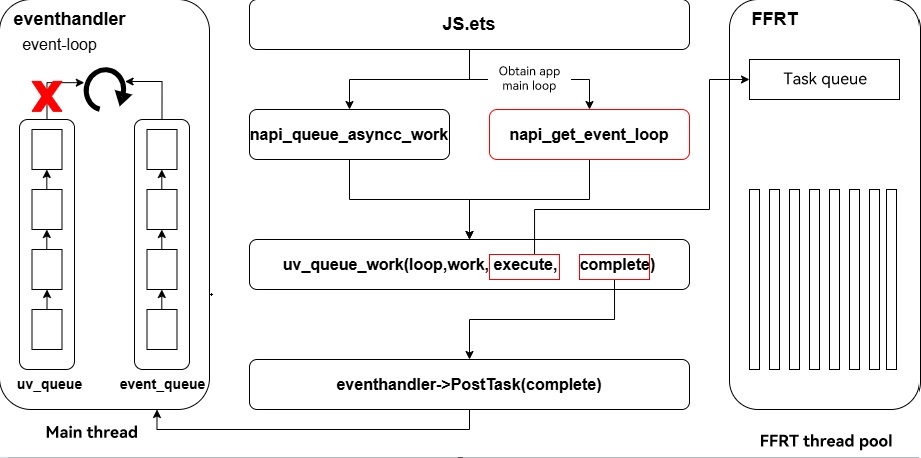
In addition, in the application main thread, all asynchronous tasks are eventually executed through libuv. However, in the current system, the libuv thread pool has been incorporated to the FFRT. Any asynchronous task thrown to the libuv thread will be scheduled by the FFRT thread. The callbacks of the application main thread are also inserted into the eventhandler queue by PostTask(). This means that after the async task in an FFRT thread is complete, the callback of the main thread is not triggered by uv_async_send. The following figure shows the process.
The following types of requests can be processed as expected in the application main loop:
-
uv_random_t
Function prototype:
/**
 * @brief Adds a work request to an event loop queue.
 *
 * @param loop Pointer to the event loop.
 * @param req Pointer to the request.
 * @param buf Buffer for storing the random number.
 * @param buflen Length of the buffer.
 * @param flags Options for generating a random number. The value is an unsigned integer.
 * @param cb Callback used to return the random number generated.
 *
 * @return Returns 0 if the operation is successful; returns an error code otherwise.
 */
int uv_random(uv_loop_t* loop,
             uv_random_t* req,
             void* buf,
             size_t buflen,
             unsigned flags,
uv_random_cb cb); -
uv_work_t
Function prototype:
/**
 * @brief Adds a work request to an event loop queue. **work_cb** will be called by a new thread in the next iteration of the event loop. When **work_cb** is complete, **after_work_cb** will be called on the event loop thread.
 *
 * @param loop Pointer to the event loop.
 * @param req Pointer to the work request.
 * @param work_cb Callback to be executed on a new thread.
 * @param after_work_cb Callback to be invoked on the event loop thread.
 *
 * @return Returns 0 if the operation is successful; returns -1 otherwise.
 */
int uv_queue_work(uv_loop_t* loop,
                  uv_work_t* req,
                  uv_work_cb work_cb,
uv_after_work_cb after_work_cb); -
uv_fs_t
All asynchronous APIs provided by the file class can work as expected in the application main thread. Common APIs include the following:
/**
 * @brief Reads a file asynchronously.
 *
 * @param loop Pointer to the event loop.
 * @param req Pointer to the file operation request.
 * @param file File descriptor.
 * @param bufs An array of buffers for storing the data read.
 * @param nbufs Number of buffers.
 * @param off Offset in the file from which data is read.
 * @param cb Callback to be invoked when the read operation is complete.
 * @return Returns 0 if the operation is successful; returns -1 otherwise.
 */
int uv_fs_read(uv_loop_t* loop, uv_fs_t* req,
              uv_file file,
              const uv_buf_t bufs[],
              unsigned int nbufs,
              int64_t off,
              uv_fs_cb cb);

/**
 * @brief Opens a file asynchronously.
 *
 * @param loop Pointer to the event loop.
 * @param req Pointer to the file operation request.
 * @param path Pointer to the path of the file to open.
 * @param flags Modes for opening the file.
 * @param mode Permission on the file.
 * @param cb Callback to be invoked when the read operation is complete.
 *
 * @return Returns 0 if the operation is successful; returns -1 otherwise.
 */
int uv_fs_open(uv_loop_t* loop,
               uv_fs_t* req,
               const char* path,
               int flags,
               int mode,
               uv_fs_cb cb);

/**
 * @brief Sends data from a file to another asynchronously.
 *
 * @param loop Pointer to the event loop.
 * @param req Pointer to the file operation request.
 * @param out_fd File descriptor of the destination file.
 * @param in_fd File descriptor of the source file.
 * @param off Offset in the file from which data is read.
 * @param len Length of the data to be sent.
 * @param cb Callback to be invoked when the read operation is complete.
 *
 * @return Returns 0 if the operation is successful; returns -1 otherwise.
 */
int uv_fs_sendfile(uv_loop_t* loop,
                   uv_fs_t* req,
                   uv_file out_fd,
                   uv_file in_fd,
                   int64_t off,
                   size_t len,
                   uv_fs_cb cb);

/**
 * @brief Writes data to a file asynchronously.
 *
 * @param loop Pointer to the event loop.
 * @param req Pointer to the file operation request.
 * @param file File descriptor.
 * @param bufs An array of buffers for storing the data to be written.
 * @param nbufs Number of buffers.
 * @param off Offset in the file from which data is read.
 * @param cb Callback to be invoked when the read operation is complete.
 *
 * @return Returns 0 if the operation is successful; returns -1 otherwise.
 */
int uv_fs_write(uv_loop_t* loop,
                uv_fs_t* req,
                uv_file file,
                const uv_buf_t bufs[],
                unsigned int nbufs,
                int64_t off,
                uv_fs_cb cb);

/**
 * @brief Copies a file asynchronously.
 *
 * @param loop Pointer to the event loop.
 * @param req Pointer to the file operation request.
 * @param path Pointer to the path of the file to copy.
 * @param new_path Pointer to the destination path.
 * @param flags Options for the copy operation.
 * @param cb Callback to be invoked when the read operation is complete.
 *
 * @return Returns 0 if the operation is successful; returns -1 otherwise.
 */
int uv_fs_copyfile(uv_loop_t* loop,
                   uv_fs_t* req,
                   const char* path,
                   const char* new_path
                   int flags,
uv_fs_cb cb); -
uv_getaddrinfo_t
Function prototype:
/**
 * @brief Obtains address information asynchronously.
 *
 * @param loop Pointer to the event loop.
 * @param req Pointer to the request for obtaining address information.
 * @param cb Callback to be invoked when the read operation is complete.
 * @param hostname Pointer to the host name to resolve.
 * @param service Pointer to the service name.
 * @param hints Pointer to the address information with additional address type constraints.
 *
 * @return Returns 0 if the operation is successful; returns -1 otherwise.
 */
int uv_getaddrinfo(uv_loop_t* loop,
                   uv_getaddrinfo_t* req,
                   uv_getaddrinfo_cb cb,
                   const char* hostname,
                   const char* service,
const struct addrinfo* hints); -
uv_getnameinfo_t
Function prototype:
/**
 * @brief Obtains name information asynchronously.
 *
 * @param loop Pointer to the event loop.
 * @param req Pointer to the request.
 * @param getnameinfo_cb Callback to be invoked when the name information is obtained.
 * @param addr Pointer to the address information to resolve.
 * @param flags Flags for controlling the behavior of the lookup.
 *
 * @return Returns 0 if the operation is successful; returns -1 otherwise.
 */
int uv_getnameinfo(uv_loop_t* loop,
                   uv_getnameinfo_t* req,
                   uv_getnameinfo_cb getnameinfo_cb,
                   const struct sockaddr* addr,
                   int flags);
The following APIs do not work as expected in the application main thread:
- Idle handle
- prepare handle
- check handle
- signal-related functions
- Functions related to TCP and UDP
[h2]libuv Error Codes
Error Codes of uv_loop_init
| Return Value | Value | Description |
|---|---|---|
| 0 | 0 | Success |
| UV_ENOMEM | -4057 | not enough memory |
| UV_EMFILE | -4066 | too many open files |
| UV_ENFILE | -4061 | file table overflow |
| UV_EINVAL | -4071 | invalid argument |
| UV_EAGAIN | -4088 | resource temporarily unavailable |
| UV_EBUSY | -4082 | resource busy or locked |
The complete definitions of all error code macros are located in the errno.h header file of the SDK. You can view them in the local SDK directory, with a path similar to:
{SDK path}/native/sysroot/usr/include/uv/errno.h