According to the SPMD model, when using Ascend C for programming, we write an operator implementation code. When the operator is called, N running instances are started and run on N cores. This section describes the entry function for implementing an operator.
The kernel function is an entry for implementing an Ascend C operator on the device. In a kernel function, to-be-performed data access and operations need to be specified for code executed on a core. When the kernel function is called, multiple cores will execute the same kernel function code in parallel, with the same parameters.
Ascend C allows you to use kernel functions, which are syntax extensions of C/C++ functions, to manage the running code on the device. You can create operator objects and call their member functions in kernel functions to implement all functions of the operator. The kernel function is a bridge between the host and the device. This chapter describes how to use the kernel function.

Kirin 9020, Kirin 9030, and Kirin X90 series processors do not support kernel function calls using <<<>>>.
Kernel Function Definition
extern "C" __global__ __aicore__ void add_custom(__gm__ uint8_t* x, __gm__ uint8_t* y, __gm__ uint8_t* z)
The preceding is an example of kernel function declaration. Comply with the following rules when writing kernel functions:
Using function type qualifiers
In addition to defining kernel functions in C/C++ function declaration mode, you need to add additional function type qualifiers, including global and aicore, to kernel functions.
Use the global function type qualifier to identify a kernel function that can be called by <<<>>>. Use the aicore function type qualifier to identify a kernel function that is executed on the AI Core of the device: __global__ __aicore__ void kernel_name(argument list).
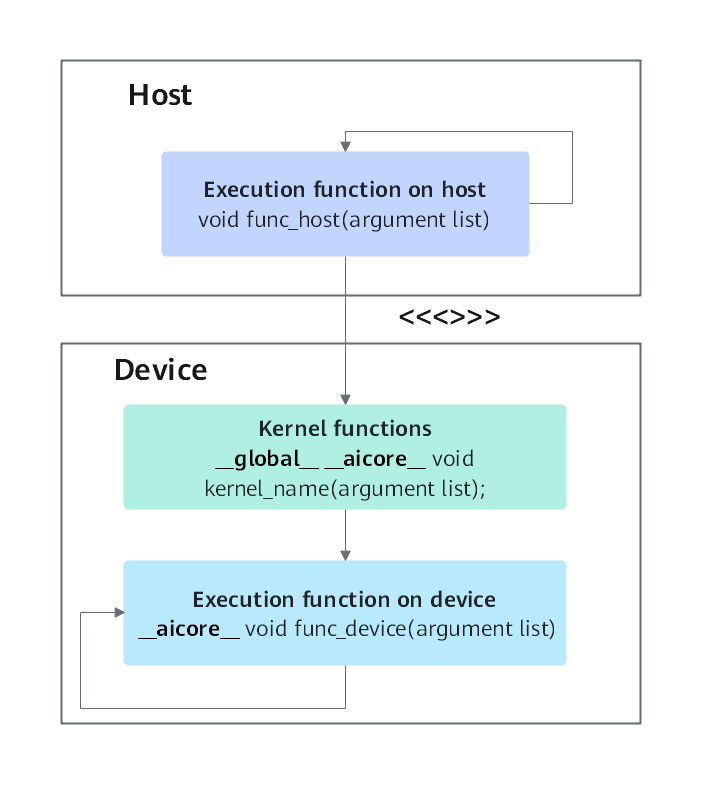
Functions used in programming can be classified into three types: kernel functions (executed on the device), host functions, and device functions (except kernel functions). The following figure shows the calling relationship between the three types of functions.
- Host functions can call host functions of the same type, similar to function calling in general C/C++ programming. Kernel functions can also be called by <<<>>>.
- Device functions (except kernel functions) can call device functions of the same type.
- Kernel functions can call device functions (except kernel functions).
Figure 1 Calling relationships between kernel functions (executed on the device), host functions, and device functions (except kernel functions)
Using variable type qualifiers
The variable type qualifier gm needs to be added to the pointer input parameter variable, indicating that the pointer variable points to a memory address in the global memory.
Other rules or suggestions
Rule 1: The kernel function must have the void return type.
Rule 2: The input parameter must be a pointer or C/C++ built-in data type (primitive data types), for example, half* s0, float* s1, and int32_t c.
Suggestion: To unify the expression, you are advised to use the GM_ADDR macro to modify the input parameter. The definition of the GM_ADDR macro is as follows:
#define GM_ADDR __gm__ uint8_t*
An example of using GM_ADDR to modify the input parameter is as follows:
extern "C" __global__ __aicore__ void add_custom(GM_ADDR x, GM_ADDR y, GM_ADDR z)
The pointer of the uint8_t type is used as an example. In subsequent use, the pointer needs to be converted into the actual pointer type.
Kernel Function Call
The call statement of the kernel function is an extension of the C/C++ function call statement. This section describes only the basic calling method. During actual operator development, you can call operators using this method or by connecting to the Ascend C framework. For details, see Project-based Operator Development.
The common function calling mode is as follows:
function_name(argument list);
The kernel function uses the kernel launch symbol <<<...>>> to specify the execution configuration of the kernel function.
kernel_name<<<blockDim, l2ctrl, stream>>>(argument list);
The kernel launch symbol can be called only when performing compilation on the NPU. It cannot be identified by compilation on the CPU.
The execution configuration is determined by the following blockDim, l2ctrl, and stream parameters:
[h2]blockDim
Specifies the number of cores on which a kernel function will be executed. A logical ID, that is, block_idx, is allocated to each core that executes the kernel function, and block_idx can be obtained by calling GetBlockIdx during the kernel function implementation.
blockDim is a concept about logical cores, and its value range is [1, 65535]. To fully utilize hardware resources, set this parameter to the number of physical cores or a multiple of the number of physical cores. For the coupled architecture and decoupled architecture, the meaning and setting rules of blockDim during running are different. The details are as follows:
Coupled architecture: Because the Vector and Cube Units are integrated, blockDim is used to start multiple AI Core instances, without differentiating Vector Units and Cube Units. The number of AI Cores can be obtained by calling GetCoreNumAic or GetCoreNumAiv.
Decoupled architecture
- For operators that contain only Vector Units, blockDim is used to set the number of vector (AIV) instances to be started. For example, if an AI processor has 40 vector cores, set blockDim to 40.
- For operators that contain only Cube Units, blockDim is used to set the number of cube (AIC) instances to be started. For example, if an AI Processor has 20 Cube cores, set blockDim to 20.
- Operators for Vector/Cube fusion computing are started by groups of AIVs and AICs. blockDim is used to set the number of groups to be started. For example, if an AI Processor has 40 Vector cores and 20 Cube cores, a group consists of two Vector cores and one Cube core. Set the number of groups to 20. In this case, 20 groups are started, including 40 Vector cores and 20 Cube cores.

In this scenario, the value of blockDim (logical cores) cannot exceed the number of physical cores (a physical core contains two Vector cores and one Cube core).
- The number of AIC and AIV cores can be obtained by calling GetCoreNumAic and GetCoreNumAiv, respectively.
[h2]stream
aclrtStream type. Streams preserve the order of some asynchronous operations being executed on the device.
[h2]Calling Example
The following kernel function add_custom is used to add two vectors. The following is a calling sample:
// If blockDim is set to 8, the add_custom kernel function is called on eight cores. Each core independently executes the kernel function in parallel. The argument lists of the kernel function are x, y, and z.
add_custom<<<8, nullptr, stream>>>(x, y, z);
The kernel function is called asynchronously. After the kernel function is called, the control right is returned to the host immediately. You can call the aclrtSynchronizeStream function to force the host program to wait until all kernel functions are executed.
aclError aclrtSynchronizeStream(aclrtStream stream);
Kernel Function Sample
The following provides sample code snippets for implementing kernel functions. For details about the complete sample, see Vector Programming.
// Implement the kernel function.
extern "C" __global__ __aicore__ void add_custom(GM_ADDR x, GM_ADDR y, GM_ADDR z)
{
    // Initialize the operator class. The operator class provides methods such as operator initialization and core processing.
    KernelAdd op;
    // Initialization function, which is used to obtain the input and output addresses to be processed by the kernel function and initialize the memory.
    op.Init(x, y, z);
    // Core processing function, which is used to complete core logic such as data movement and computation of operators.
    op.Process();
}